
This semester, the Institute for Social Concerns is redesigning their poverty studies minor, renaming it the justice and society minor. Co-directed by professors Connie Snyder Mick and Dan Graff, the new curriculum is designed to weave together the theoretical study of justice and its practical application, specifically focused on ensuring that students have the research skills to effectively grapple with justice questions and foster change.
Inspired by both Catholic social teaching and Fr. Hesburgh’s legacy, the justice and society minor is aimed at students who seek to be changemakers in the world.
“We believe that a commitment to justice is a fundamental lens through which to understand, experience and, indeed, change the world. Whether pursuing a degree in engineering or English, students gain a foundational understanding of justice with which to enhance their degree. The minor forms leaders of consequence through a constructive collision of perspectives where business and biology majors grapple with wicked problems, bringing their unique expertise to the table,” Suzanne Shanahan, the Institute’s director, wrote in a statement to The Observer.
For current poverty studies students considering continuing with the new minor, co-director Graff affirmed that the minor still encompasses poverty issues. Instead, he said, the new focus allows a broader perspective on the topic and a larger commitment to true action.
Snyder Mick suggests that this evolution reflects the new faculty expertise. “The Justice and Society minor represents the research interests of all the faculty at the Institute for Social Concerns. We’ve had some wonderful new hires recently and this approach adds their expertise in technology, environment, and migration to our longstanding attention to labor, incarceration, and poverty,” Mick wrote in a statement.
Mick additionally stressed the direct connection between poverty and justice. “Lawyer and activist Bryan Stevenson argues that the opposite of poverty is not wealth but justice. This renaming of the Poverty Studies interdisciplinary minor emphasizes the expanse of our goal, which is a more just and beautiful world. Poverty is the problem, justice is the solution. Community action in society is how we continue to work toward that vision in this minor,” Mick wrote.
The minor will now begin with a gateway “Doing Justice” course taught by Graff, which requires three elective courses that tackle questions of justice and culminates in a collaborative capstone titled “Delivering Justice,” where students build off original research conducted throughout the program to produce a tangible project.
Graff highlighted the connections between the minor and the Institute’s research endeavors. “We offer a variety of research opportunities at the Institute. For example, our justice labs—[including] just wage, mass incarceration, housing and the common good—offer students the option to conduct collaborative, engaged research with community partners on pressing social issues,” Graff wrote.
Graff encourages students across majors to join the program, as the curriculum is fairly flexible. “There’s a sort of stereotype that the typical SOCO student is [studying] liberal arts, but we have a lot of students from the other colleges, and we want to keep recruiting and maybe expanding. I think it would only enhance the community and the cohort if we had somebody from each of the colleges and schools… That's one of the reasons we're not requiring an experiential learning component, because that's harder for some students,” Graff wrote.
Working in tandem with that goal, the minor’s interdisciplinary approach to studying justice is designed to stretch across departments and emphasize the intersections. “Wisdom comes from many spaces, and this course recognizes that philosophy, theology, history, the social sciences, literature and the arts, and practitioners’ own thoughts and organizations and movements all contribute to a more sophisticated and nuanced understanding of how to think about and respond to demands for justice,” Graff wrote.
Both Graff and Mick emphasize how important it is that students are able to view the people impacted by injustice as concrete and fully human, rather than data points or distant abstractions, a problem they say the minor’s curriculum will address.
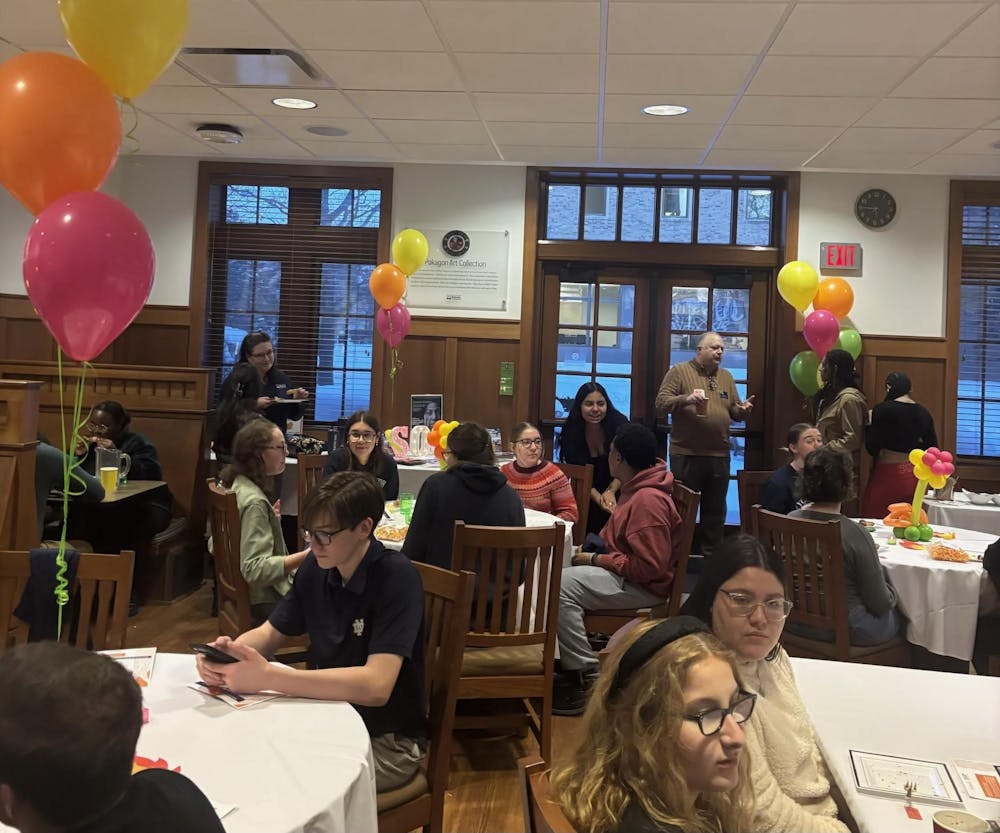
At the launch party Thursday evening, the co-directors and other Institute faculty welcomed students interested in the redesigned minor with s’mores and cocoa.
Mark Bausch, a sophomore currently pursuing the poverty studies minor, solidified his decision to continue the program after attending the event, as he feels that justice is an essential part of studying at Notre Dame. “Notre Dame says that people should be a force for good, and you can't be a force for good if you're not thinking about justice,” Bausch said.
Editor’s note: a previous version of this story mislabeled the justice and society minor as new. It has been edited to reflect the fact that the minor serves as a redesigned version of the Institute’s current poverty studies minor.


