As a fellow Mexican, I am always thrilled to watch Guillermo Del Toro’s gothic films. From the Oscar-winning best picture, “The Shape of Water,” to the innovative animation “Guillermo Del Toro’s Pinocchio,” his beautifully grotesque art has been praised by critics and the public alike. Because of this, I was looking forward to watching his latest film, “Frankenstein,” which recently screened at the Browning Cinema in the DeBartolo Performing Arts Center. Already praised as “One of Del Toro's finest,“ I entered the theater expecting my already established idea of Mary Shelley’s classic novel to evolve into one of Del Toro’s saturated color palettes and tangible effects.
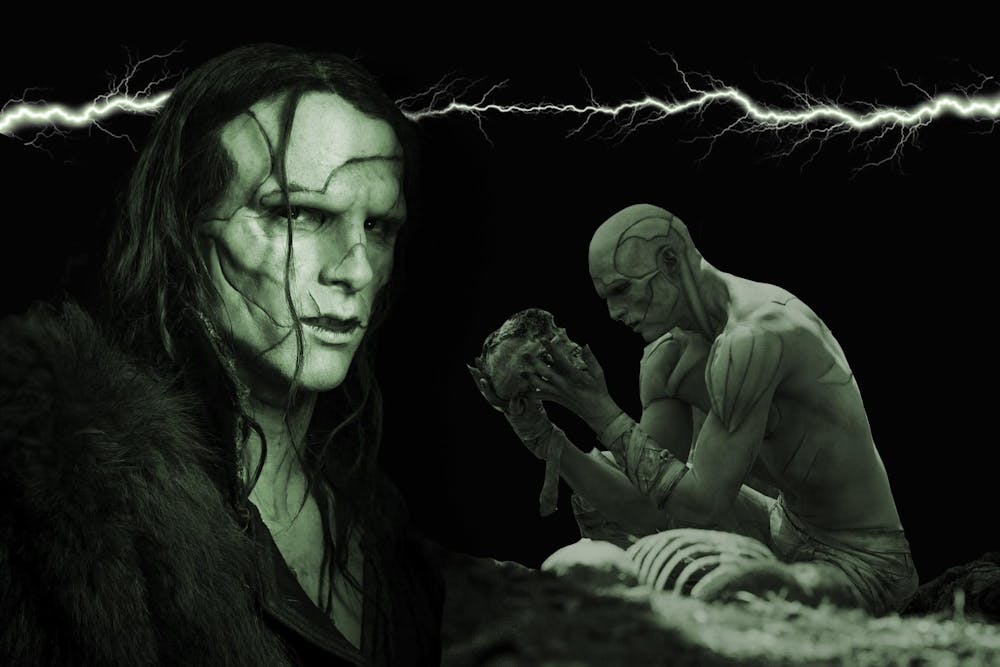
In Del Toro’s dream project, the first part of the film presents the visionary scientist Victor Frankenstein’s (Oscar Isaac) obsession with life and death. When his project is finally finished, he is astounded by the hideous creature (Jacob Elordi) that has emerged. After psychologically mistreating the monster in order to understand it and regretting the danger that may come from such a hideous being, Victor destroys his lab, killing the creature with it … or so he thought. Elordi’s sensitive character travels far, finding a quaint family to observe from the shadows. Through them, the monster learns beyond the essential skills we humans need to live. Elordi beautifully conveys the creature’s understanding of family, friendship and self-worth, wondering who he is and where he belongs, ultimately condemning himself as something other than human: an outsider feared by all and a monster. While he is hated by many, there is one character who sees him as a living creature instead of the reincarnation of evil.
Mia Goth’s interpretation of Elizabeth, Victor’s younger brother’s fiancée, contrasts with Victor’s cruel treatment of the monster. This showcases Del Toro’s intention to show the public who the real villain of the story is, instead of the ethical ambiguity the original novel claims.
While the book pursues a similar storyline, it is portrayed from a very different perspective. Shelley originally wrote the novel at the age of 18 while having a ghost story competition at Lord Byron’s property near Lake Geneva, Switzerland. Unlike the cruel villain Del Toro chooses to showcase, Shelley’s Victor comes from a loving family, including his adoptive sister and fiancée, Elizabeth. Absorbed by the thirst for knowledge and desire to defy the laws of nature, the monster is born. After the creature flees in fear, Shelley takes us into his thoughts, emotions and path to exploring the world for the first time.
In contrast to the film, where the creature’s rejection is tied primarily to Victor’s abuse, Shelley’s creature slowly learns he will never be loved because of his terrifying physique and society’s cruelty. In the novel, Shelley never assigns full blame to either Victor or the creature, forcing the reader to question the ongoing dilemma: are villains born or made? The film, however, establishes the characters’ roles very prominently and resolves this ambiguity by clearly framing Victor as the moral villain, leaving little doubt about who is responsible for the creature’s descent. Shelley refuses to answer, whereas Del Toro chooses to.
While the film’s quality and depth have made it one of the best of the year, there are several elements that I personally found disagreeable. The novel’s beginning and end are told through Captain Robert Walton’s perspective, a curious character who listens to both Victor’s and the creature’s stories. The film tries, and fails, to narrate this section of the novel. There is a sense of urgency and lack of depth that creates a much less impactful emotional resolution in contrast to Shelley’s ambiguous yet impactful ending. The second situation the film hurried was the creature’s exploration throughout the new world around him. This summarization makes the twist from the innocent individual to a sudden evil creature full of vengeance, redirecting all blame to Victor’s initial abuse instead of the difficult external exposure he received from the outside world.
Regardless of the changes the Netflix film has made, such as the surprising emotional connection between Elizabeth and the creature and Victor’s unhappy childhood, Del Toro’s vision is not only beautifully executed but also carries intense emotional depth. With the help of realistic makeup by artist Mike Hill, stunning shots by cinematographer Dan Laustsen, a strong score by Alexandre Desplat and symbolic fashion designs by Kate Hawley, the movie itself is a work of art. Isaac’s maniac search for power, Elordi’s innocent search for belonging and Goth’s empathetic connection with the unwanted pulls the viewer into Shelley’s classic horror while still reminding us of the art of cinema.
Regardless of the very unnecessary and controversial changes that were made, I heartily enjoyed this new, reimagined version of the classic horror story that people have loved for many years. I am eager to continue following this ongoing trend in cinema that reimagines literature’s best pieces and brings something completely new.