
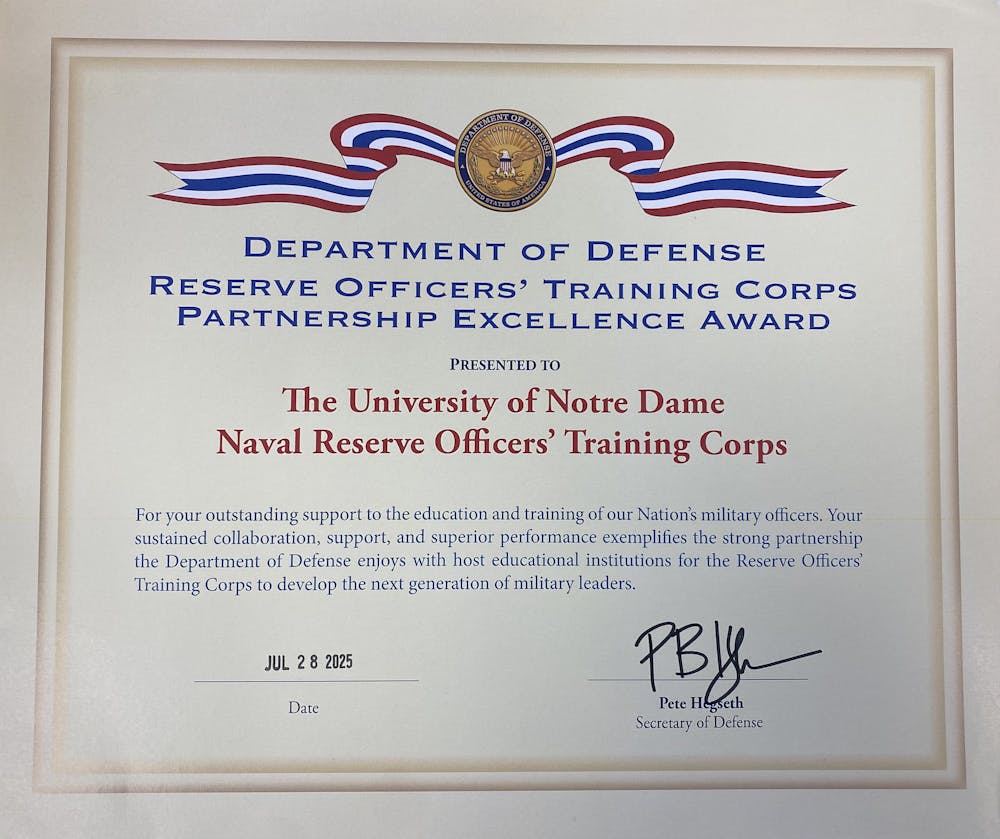
Notre Dame’s Naval Reserve Officers Training Corps program has received the Educational Institution Partnership Excellence Award from the Department of Defense, highlighting its “outstanding support to the education and training of our nation’s military officers” and designating it as the top Navy collegiate program in the nation. Signed by Defense Secretary Pete Hegseth, the certificate states that the Naval ROTC’s “sustained collaboration, support, and superior performance exemplifies the strong partnership the Department of Defense enjoys with host educational institutions for the Reserve Officers’ Training Corps to develop the next generation of military leaders.”
Notre Dame’s NROTC began in September of 1941, following a long history of cooperation between the United States Navy and the University. NROTC at Notre Dame initially consisted of a four-year program of naval science.
However, with the start of World War II, the University expanded its ROTC program and shortened its completion timeline, enabling it to become one of four midshipmen training centers in the United States. The first NROTC class graduated in 1944, and Notre Dame produced nearly 12,000 officers throughout the war, making it among the nation’s largest contributors of commissioned officers.
The same award was given to Notre Dame Army ROTC program last May.
In addition to the certificate, Notre Dame’s NROTC also received a letter from Hegseth recognizing the program as superior in categories such as performance and educational institutional support. The letter notes that the University has historically supported Naval ROTC in multiple ways, including the participation of University presidents in its annual three mile run.
“The faculty here at the University supports us hands down,” Capt. John Smith, professor of naval science and commanding officer of the Notre Dame NROTC, said. “It’s one of the most supportive teams I’ve met … hugely supportive of what we do here and our ability to create future naval officers.”
In total, the Naval ROTC teaches seven courses, all of which count toward a student’s degree at the University.
The letter also cites benefits that active duty service members receive at the University, including “parking, tuition assistance, facilities access, and inclusion in faculty social events,” as well as the University’s recognition of service members at Notre Dame football games.
Regarding the students themselves, the letter emphasizes the commitment of Notre Dame midshipmen to service — both to the University and to the South Bend community, stating that, “The midshipmen collectively averaged 40 hours a week of community service to seven different organizations.”
“They participate in a lot of events with the University: outreach programs, the Veterans Day vigil, our leadership weekend, and we do a lot of stuff with the athletics department,” Smith said. “The ROTC has been a huge team effort since 1941.”
The certificate also commends Notre Dame for its ability to “continually [produce] a high standard of midshipmen that consistently exceed the standard in academic achievements, community involvement, and officer aptitude.” To that end, Smith praised the “caliber of midshipmen” Notre Dame produces, and recognized his predecessor as integral to the Notre Dame NROTC’s elite status.
“Capt. Lance Thompson, who was my predecessor here, had a significant role in achieving this. Specifically, he was here for three and a half years and developed and changed a lot of how we train the officers here and the midshipmen, which I think played a huge role in us receiving the award.”
To ensure success for Notre Dame midshipmen, Smith emphasized the importance of proper development and mentorship and the need to maintain the right balance of hands-on and independent learning.
“Here, we allow the midshipmen to come up with a lot of their own leadership tactics and things, which are all supervised by my staff. So, we have a hands-on role, but it’s more of a step back and allow them to lead and develop and come up with their own solutions to problems. Instead of us just providing solutions to things, they’re developing their own leadership styles and tactics.”


