
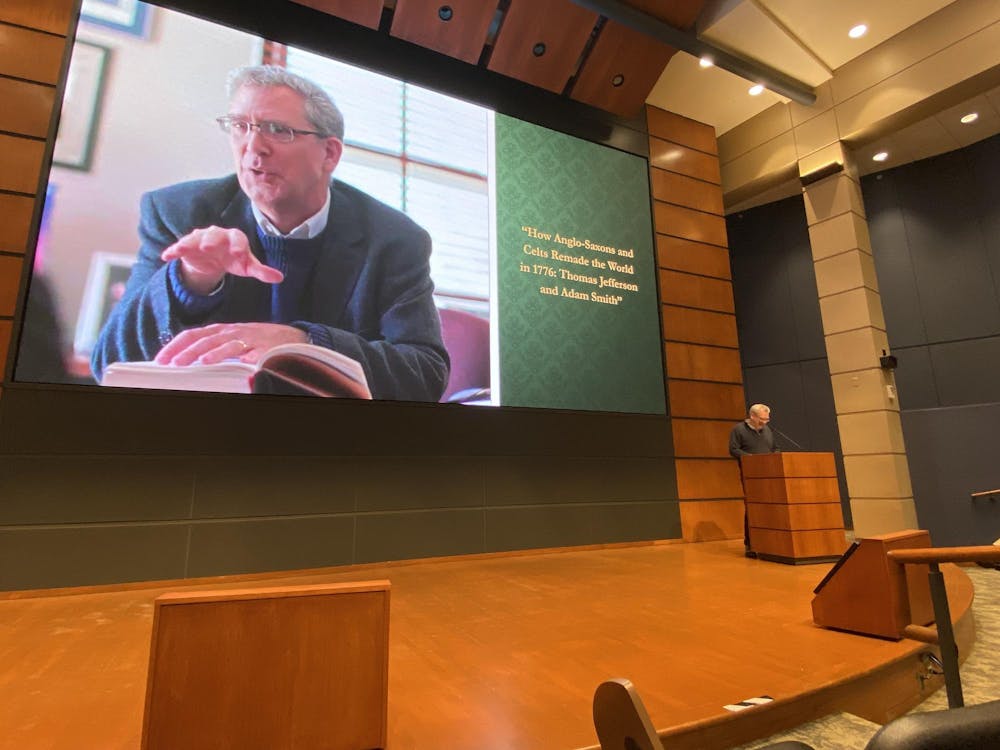
On Tuesday, Jan. 27, Bradley Birzer, a member of the Notre Dame Class of 1990 and professor of history at Hillsdale College, spoke to a packed auditorium in the Mendoza College of Business auditorium on the inspirations of the American founding in a lecture titled “How Anglo-Saxons and Celts Remade the World in 1776: Thomas Jefferson and Adam Smith.”
The lecture was part of the one-credit spring semester course “1776: The Ideas That Made the Modern World,” taught by political science professor Vincent Phillip Muñoz and Mendoza College of Business professor Jim Otteson.
Introduced by Otteson, Birzer earned his doctorate in 1999 from Indiana University and has authored several books, including “Russell Kirk: American Conservative,” “American Cicero: Charles Carroll of Carrollton” and “Sanctifying the World: The Augustinian Life and Mind of Christopher Dawson.” Birzer also has two forthcoming books, “The Declaration of Independence: 1776 and All That” and “Tolkien and the Inklings: Men of the West.”
Birzer began his lecture by discussing Thomas Jefferson and Adam Smith, focusing on the meaning of the Declaration of Independence in relation to human dignity. America, he said, is deeply conservative because the United States, upon independence, adopted and preserved common law, which has its roots in Anglo-Saxon culture.
“Anglo-Saxon Law [existed] going back to pre-Christian days among the Anglo-Saxon Germans,” Birzer said. “From the common law, we get things like being innocent until proven guilty, we have a trial by jury if we’re arrested, the government does not have a right to our body, we have a right to Habeas Corpus. We don’t have to be put under cruel and unusual punishment.”
Birzer discussed how these principles were inherited by the modern United States and are deeply embedded in the Declaration of Independence. Every grievance listed by the colonists derived from common law, he argued. These Anglo-Saxon roots were especially influential for the founders, particularly Jefferson, who even proposed that the legendary Anglo-Saxon warriors Hengist and Horsa appear on the Great Seal of the United States. Birzer said Jefferson saw a parallel between the warriors’ departure from the authority of the king of Saxony and the American colonists’ break from British rule.
Birzer also noted that colonial America was largely Protestant and emphasized the role of literacy during the revolutionary era.
“One of the great advantages of the Protestant people is they are almost completely literate,” Birzer said. “We had one of the highest rates of literacy among white Americans during the Revolution of any place in the world.”
This widespread literacy allowed Americans to read and engage with Germanic history, particularly “Germania” by the Roman historian Tacitus, which was widely circulated. Birzer touched on how literacy also enabled the Declaration of Independence to be printed just two days after it was written, on July 6, 1776. Early printings included an introduction by a writer known as Demophilus, who linked the Declaration to Anglo-Saxon heritage.
Quoting a letter Jefferson wrote in 1825, one year before his death, Birzer said the Declaration was intended to “place before mankind the Common Sense of the subject in terms so plain and firm as to command their ascent and to justify ourselves in the independent stand we were compelled to take.”
Birzer noted these ideas come from Aristotle, Locke, Cicero, and Algernon Sidney. These ideas were commonly taught to students, among the frequent teaching of Greek and Latin. Translation was a common test among students, and each Founding Father received this classical education.
In the Declaration of Independence, Birzer focused on the line that “all men are created equal.” Birzer argued that the Declaration of Independence and Christianity have served as the most powerful forces in history to uphold the dignity of all people.
“At some point, this absolutely has to become real,” Birzer said of the Declaration’s promise of equality.


