
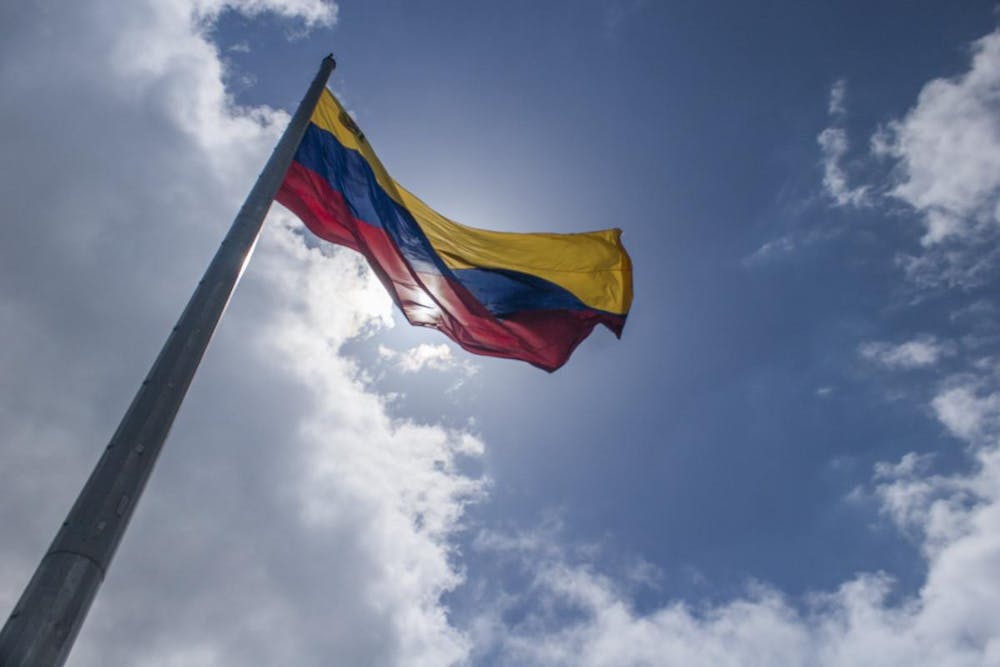
On Jan. 3, the United States conducted a military operation in Venezuela to remove president Nicholas Maduro and bring him to the U.S. to face charges in court. The Trump administration said his alleged ties to drug trafficking organizations pose an imminent national threat to the United States.
Recent history of Venezuela
Venezuela was a democracy prior to the election of Hugo Chávez in 1998.
Laura Gamboa, assistant professor of democracy and global affairs, explained that when Chávez came to power he reformed the country’s constitution with support of his party to “diminish the ability of the opposition to compete in free and fair elections.” She said by launching a coup and boycotting elections, the opposition struggled to successfully oppose these actions and instead, she argued, worsened the situation.
Professor of political science Micheal Coppedge said Chávez was able to maintain some popularity and legitimacy in the country through his use of oil revenues to fund social programs and success in winning repeated elections.
“When he died, Nicholas Maduro came in and he did not have the benefit of higher oil revenues because prices fell almost as soon as he became president — not because he was president but for other reasons, he was unlucky in that way — and he was not able to maintain any great level of popularity and so in order to hold on to power he became increasingly authoritarian cracking down on opposition, marginalizing the national assembly, controlling the press,” Coppedge said.
Gamboa added, “All the way up until 2015 or 2016, Venezuela was what we call a competitive authoritarian regime. They had elections, the position was able to compete in the elections, but the elections were so unfair that the opposition had very little possibility to win.”
Gamboa explained that the opposition consists of multiple factions, the more radical faction led by María Corina Machado. Recently, Machado was forced to resign from public office and Edmundo González Urrutia took her public-facing position. They advocate for international intervention to dislodge the Maduro administration.
Aníbal Pérez-Liñán, professor of political science and global affairs, explained that as a result of the struggle to win elections the regime became increasingly oppressive.
In 2015, Maduro invalidated the election of several members of the opposition to the national assembly to ensure that the national assembly did not have a two-thirds majority.
“It was kind of a red flag for Maduro because he figured out he could no longer win elections,” Gamboa said.
Paola Bautista de Alemán is a Venezuelan politician and Hewlett visiting fellow for public policy within the Kellogg Institute. She is a vice president of political education for Primero Justicia, a faction of the opposition. She has been in exile since fleeing the country in March 2025. Her husband and three children were forced to flee in July. They reunited in South Bend on Aug. 25. She said most of the board of her political party are currently exiled or jailed.
“Since July 28, 2024, the civic space has closed almost completely because we had presidential elections and Nicholas Maduro lost the election and Edmundo González Urrutia, which was the candidate of the opposition, won the election by a landslide. Nicholas Maduro made fraud and stayed in power, even though we had the proof that we won the election, and this started a period of massive human rights violations and crimes against humanity,” Bautista de Aleman said.
Caribbean attacks
Contextualizing U.S. military actions in the Caribbean prior to Maduro’s removal, Bautista de Alemán explained, “The boats were part of the district work of the Cartel de los Soles. They were used to bring drugs to other countries and that is why they were attacked by the US forces.”
Gamboa said, “They are blowing up boats in the middle of the Caribbean with no concern. They are threatening countries across the globe just because they offend the president here.”
Pérez-Liñán added that blowing up boats was a way to put pressure on the Venezuelan regime when negotiations failed. He said while standard policy dictated intercepting the boats, bombing them instead put pressure on the government.
Maduro’s removal
Based on military intelligence, the United States decided to conduct a brief military operation to remove Maduro and bring him to face charges in the US courts along with his wife Cila Florez. However, the implications of such actions are that the rest of the Maduro regime did not fall.
Bautista de Alemán explained that there were a limited number of casualties — mostly Cuban nationals who were protecting Maduro. She said Venezuelans were concerned that foreign nationals were involved with their government.
The professors disagreed on the legitimacy of the claim of national security threat, debating the existence and threat of Cartel de los Soles.
Coppedge said, “It is a really flimsy argument in part because, although Maduro protects drug traffickers, he is in no real sense a head of a coherent organization that is spiriting drugs into the United States. In the second place, because the really harmful drug that has been killing a lot of Americans is fentanyl. Venezuela mostly explores cocaine, and actually mostly exports cocaine to Europe.”
“It is a narco-dictatorship and their relationship with Cartel de los Soles, which is a criminal organization that delivered drugs to the U.S. and other countries, operates and uses the Venezuelan state to do criminal tasks.” Bautista de Alemán said, “I think for the Trump administration there is an honest concern about security and that concern is not only regarding drugs, but is regarding the presence of irregular groups from autocratic forces in Venezuela, which is very close to the US, and it has a strategic location in the map.
Gamboa added she did not buy the argument that Maduro was a direct threat to the United States, citing the same reasons as Coppedge and adding, “The cartel they claim Maduro runs does not exist … if really this was about penalizing drug traffickers, then Juan Orlando Hernández would never have been pardoned. There is evidence that he literally trafficked drugs.”
President Trump held a press conference with oil executives on Jan. 9. He demanded that the 14 oil executives he met with invest 100 billion dollars into revitalizing Venezuela’s oil and “got an underwhelming reception.” He attributed it to the low international market for oil and the ways in which many oil companies previously invested in Venezuela and were expropriated in the mid 1970s. While Venezuela claims they were compensated appropriately, some of the companies beg to differ.
In an open letter to the president, ExxonMobil expressed hesitancy over the proposition, citing the ways in which they have had their assets seized twice previously in Venezuela. They acknowledged having a limited perspective from the current Venezuelan government.
President Trump
The professors offered their analysis on how this conflict might impact Trump’s legacy.
Gamboa said, “He is a leader with authoritarian tendencies. A lot of his actions in government have been authoritarian. He has no regard for human life, and he is turning the United States into a competitive authoritarian regime.”
“I think Trump wants to be remembered as what we may call a president of reconstruction,” Pérez-Liñán said. The question remains what the American public perception of such transformation will be.
Coppedge added, “There is a substantial part of the Republican base, the MAGA base even, that really supported Trump because he claimed not to be in favor of getting involved and getting bogged down in conflicts in other countries, but now he has done just the opposite.”
Bautista de Alemán said, “President Trump right now has the opportunity to be the person who opens the door to democracy in Venezuela, Cuba and Nicaragua or the other option is that he can be remembered as the person who took away a dictator and did not have democratic motivations and only was acting due to economic interest. I really really hope that he can be the first option.”
International law
After the United States went into Venezuela to capture Maduro, the United Nations held an emergency meeting to chastise U.S. action. This has led to broader questions about respect toward international law.
“The position with respect to Latin America is a very explicit statement of returning to the Monroe Doctrine. That is the idea that the US can intervene in Latin American militarily to defend its interests above and beyond the consideration of the sovereignty of other countries in the region and especially in order to prevent the presence of other powers in the hemisphere,” Pérez-Liñán said.
Bautista de Alemán explained that Venezuelans followed the international law pathways as they were designed to be followed, but they did not receive help.
“They failed us. I am concerned about what happened on Jan. 3, but I have a broader concern that is: what happens when a country does everything and the international law does not have the answers that we really need?,” Bautista de Alemán said.
Gamboa said, “In the past, they at least pretended or tried to make an argument that they were not violating international law. Now, they do not even care.”
Looking forward
While President Trump claims the United States will run Venezuela, it is uncertain what that entails.
Pérez-Liñán explained that so far it appears that the current administration has remained in power with Delcy Rodríguez, Maduro’s vice president, stepping up to lead and appeasing the demands of the Trump Administration.
As Bautista de Alemán said, “Secretary Rubio has said that they have a design for Venezuela to move toward democracy and there are three stages which are stabilization, recovery and transition to democracy. Our main challenge as Venezuelans and as a society that has been fighting for democracy for more than twenty five years is to be part of that process.”
Gamboa added, “Transitions to democracy we have learned in the past happen in mysterious ways. It is possible that two decades from now the regime actually transitions, and to a certain extent this invasion was what sparked that process, but I would not give credit to Donald Trump even if that is the case.”


