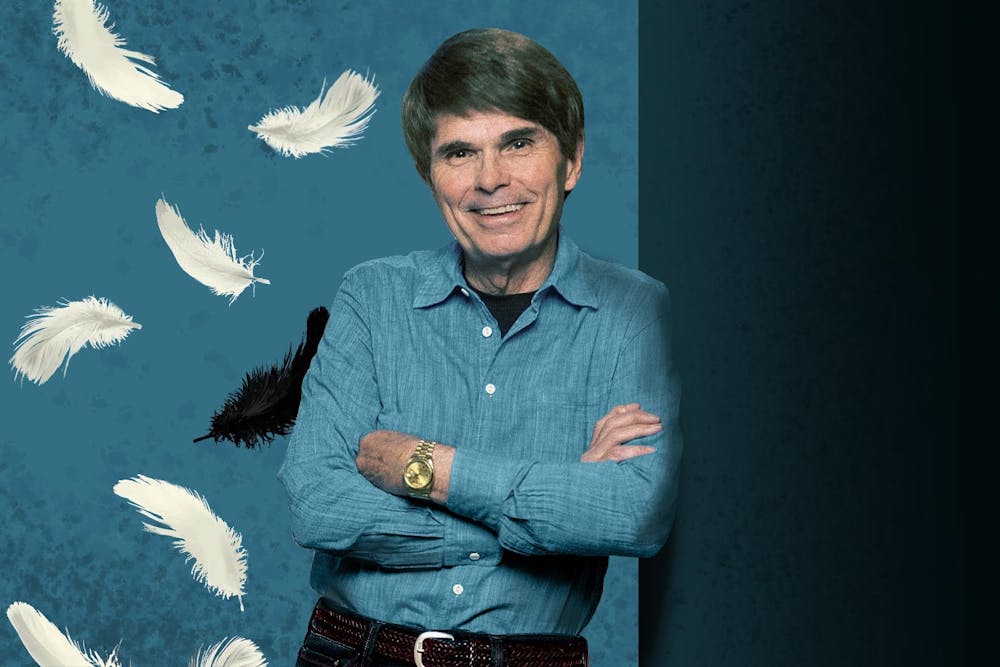
“The Friend of the Family,” Dean Koontz’s new novel, is a book for book lovers, heartfelt and genuine. While Koontz is primarily known for his works of suspense and horror, “The Friend” is a work of period fiction echoing classic literature and nineteenth-century “big house” novels. Set in California during the early decades of the twentieth century, it presents the story of Alida, a captive “star” of a circus freak show, who, after a particularly cruel exhibition, is freed from her carnival prison and adopted by a caring couple and their loving family. For the first time, Alida is seen beyond her deformity and acknowledged for her intelligence and humanity. What follows is an account of compassion and testimony for the discovery of beauty in all places.
“The Friend” is a welcome genre shift for Koontz. While it “drives publishers a little nutty at times,” Koontz explained that he doesn’t want to keep rewriting the same book despite industry expectations for authors to find and adhere to a successful formula. “My current publisher has been an exception to that. Perhaps that’s why I can go from a comic novel like ‘Going Home in the Dark’ to a novel like ‘The Friend of the Family,’” the author said in an interview.
The style and voice of “The Friend” are undeniably his, hitting all his trademarks, including California settings, a faithful dog and a well-crafted villain. His signature suspense is present in the novel as well as a layer of mystery concerning Alida’s new home, which is a very entertaining thread.
The historical setting of “The Friend” was a standout aspect of the novel. I thoroughly enjoyed catching the cultural references within, such as Cary Grant (whom Koontz thinks “is one of the greatest film actors to ever live”) briefly being a character and Venerable Archbishop Fulton Sheen receiving a mention. Beyond pop culture, the historical circumstances were a fascinating backdrop, encompassing both world wars and the times between. Koontz explained that every detail was fact-checked and that ensuring the work’s historical accuracy is one of the challenges of writing a period piece. “At one point, someone tucks a Kleenex from a box. I wrote the line and suddenly thought, ‘Wait a minute, a Kleenex in 1930?’ And you have to go and check out hundreds and thousands of small details like that,” the author said. Despite his current love for research, Koontz reminisced that, especially in his academic career, he used to loathe it, even making up sources and citing “books that didn’t exist with authors who were nonexistent” to get out of it. Now, he loves the process and strongly dissuades students from faking sources.
One of the most powerful aspects of “The Friend” is its inclusion of countless literary references, spanning authors from Charles Dickens to H.G. Wells. This is why I state it’s for book lovers; however, these go beyond Easter eggs for bookish readers. They show Alida’s knowledge of the world and its vast ideas despite being imprisoned, reflecting Koontz’s own childhood. “I think I knew right before it began that Alida was going to have lived through books because that was her only choice of being what she is and who she is. She, really until the age of seventeen, has no freedom, except the freedom which books provide. That really is an autobiographical element because I grew up in a very unpleasant environment, an alcoholic, violent father, poverty and everything that comes along with that. My escape was into books. In a sense, I could understand Alida’s methods of surviving all of that was to escape into books, but not just to escape — to read and see that the world offered many other ways to live a life than the one that was imposed on you when you came into the world. In many ways, her life was guided by the best things in novels that she had read,” Koontz said.
Through our conversation, it became increasingly clear that many aspects of “The Friend of the Family” are autobiographical. Koontz noted how his own life experiences shaped his writing profoundly: “Whatever you go through, it does add value to you and it brings you to a better understanding of how to live your life most successfully and what to avoid doing.” This is very evident in his ability to craft a villain. “The Friend of the Family” has one of the most despicable villains in his oeuvre: the Captain, who is all-around deplorable. Koontz provided insight into his villain crafting process, noting how his childhood with a sociopathic father forms these characters. He mused that, whenever faced with a moral dilemma, he thinks, “What would dad do?” and does the opposite.
What readers may not know is that Koontz is a convert to Catholicism and, while he has never written an explicitly religious novel, one can find underlying themes that align with faith, hope and Catholic social teaching — like the dignity of the human person, which is especially prevalent in “The Friend of the Family” — in most of his works. This is strongly influenced by his childhood. Koontz told me that he converted to Catholicism while in college. “When I first started dating [my wife] Gerda, the first thing that I noticed was what [her] intact family was like. When you’re raised in a family like mine, you think that all households are like that when the door is closed. You have to have other examples to learn the difference. I started seeing these families who were intact, happy and functional. I began to associate that with Catholicism because that is the thing they all had in common. That is when I began to think that this was something I wanted, and that was where the conversion took faith. And there I’ve been ever since,” the author said.
In “The Friend,” one of the most prevalent themes is, in the author’s words, “The value of every life regardless of what its apparent limitations might be.” This is where one of the key ideas, friendship and relationship, really shines. The novel concerns and uplifts genuine, loving human connection. On the flip side, it also explores toxic relationships and their resulting problems. Through our conversation, it was apparent how Koontz’s own service and interactions with others shaped the formation of Alida and her story: “My wife and I have worked for some years with Canine Companions for Independence, which is an organization that provides assistance dogs for people with severe disabilities. One day, after we went away for a weekend at a Canine Companions function where there were hundreds of people with severe disabilities, I came home and said what was most amazing about that was that not one person that we met and interacted with was complaining, self-pitying or had a pessimistic view of anything. They were all optimistic, forward-looking, hoping to better their lives. It’s very eye opening to me. It’s where I began to understand that every life is meaningful. Every life has the potential to lift up others. This is what these people do. They lead by courage in the face of health and functional problems. That became a theme in the book, for sure.”
This leads me to another major theme in the novel: hope. “The Friend” testifies to hope’s power and persistence in the darkest of times, whether it be an abusive relationship or a world war. The novel is told by Alida, and this first-person narrative was a highlight for me because it allows moments to empathize with Alida’s experiences, struggles and hope. Her hope never falters, and Alida’s voice and insights portray this beautifully. “The recognition of beauty and order in the world is fundamental to living a happy life. If what you see all the time is disorder and ugliness, you are going to have a life very much like that. It is important to recognize the gifts that God created for us in the world, and if you do, hope can never be lost,” Koontz said.
In my conversation with Koontz, I asked him if he had any words of writing wisdom for Notre Dame students. In his process, he doesn’t outline: “As a book comes alive, it becomes something other than what you originally intended. You should be free and able to go with that.” Koontz also warns that publishers often limit authors to write within genre constraints and keep personal values to a minimum to increase mass-appeal. “I have found what the public wants is not what the publishing industry wants to give them. You have to stay with your own values and have faith in your fellow human beings, and you will find you can make a place for yourself. It’s just harder than if you write the way they want you to,” Koontz advised.
I would recommend “The Friend of the Family” to book lovers who enjoy stories about beauty and friendship. Further, if you have been wanting to read Koontz but are wary of horror or thriller stories, then this is your chance to experience his storytelling. It truly is a wonderful novel.