
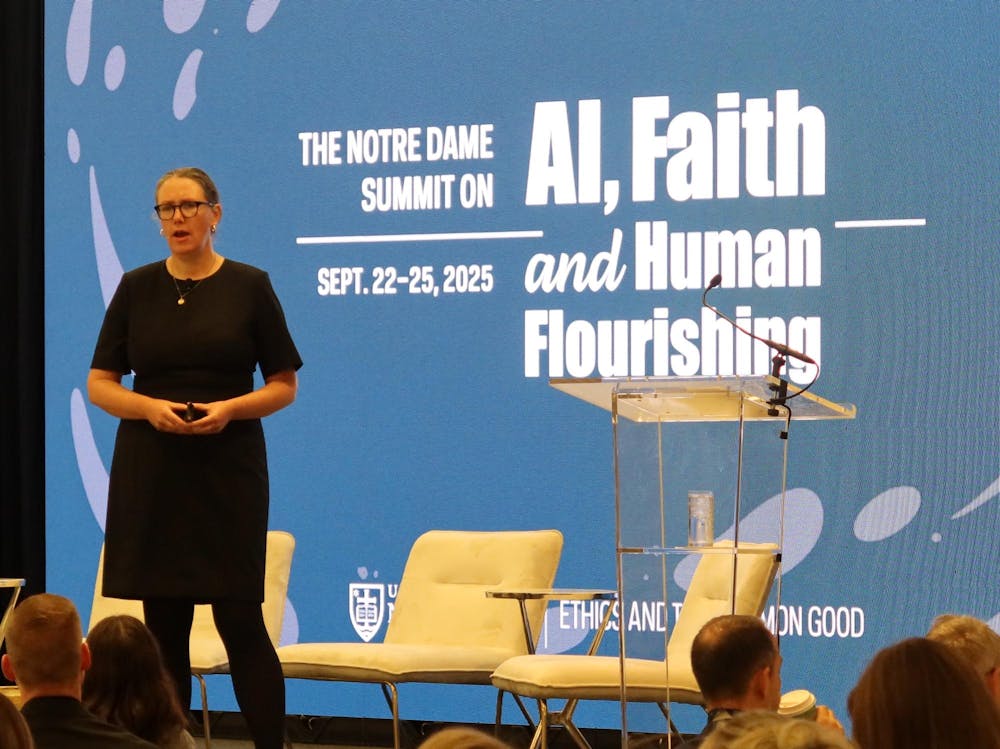
Notre Dame has received a $50.8 million grant from the Lilly Endowment to support the DELTA Network, an expansion of the faith-based AI ethics framework developed by the University’s Institute for Ethics and the Common Good. The grant is the largest Notre Dame has ever received from a private foundation in University history.
“The Lilly Endowment’s landmark investment reflects the responsibility of a leading global Catholic research university to engage the ethical challenges posed by artificial intelligence. This work is central to Notre Dame’s mission and strengthens our ability to bring moral leadership, rooted in faith, into urgent conversations shaping our shared future,” Provost John McGreevy said in a statement to The Observer.
DELTA is an acronym for dignity, embodiment, love, transcendence and agency. According to a press release announcing the grant, the framework is based on “principles and values from Christian traditions,” but also “designed to be accessible to people of all faith perspectives.”
The grant is an investment in “human formation in the age of powerful artificial intelligence,” director of research and external engagement for the Institute for Ethics and the Common Good Adam Kronk said. Kronk is leading the implementation of the DELTA framework.
“Our hope is to help as wide a swath of people, as we can be very intentional about whether and how they will interact with artificial intelligence in different facets of their lives,” Kronk shared. “We want to make sure that we're preserving and promoting key elements of our human existence as this technology plays a bigger role in each dimension of our day.”
Julia French, the Institute’s program manager for the grant, shared that they have conducted approximately 200 benchmarking calls with various stakeholders across the country, including technologists, AI developers, educators and students. To gather information, focus groups were established across the country in San Francisco, Boston, Washington, D.C. and Notre Dame.
“Part of our hope with the DELTA project is that we’re going to provide networking and programming materials to bring together all of these different stakeholders and push forward the DELTA framework,” French said.
A key focus of the project is exploring the human formation necessary for engaging with this technology.
“AI is coming and there’s not much that we can do to mitigate its rollout,” French said. “But what we can really focus on is who we are going to be as humans when we’re choosing to use it or not and how we are choosing to use it.”
The funding from Lilly Endowment is being directed toward building a network of “interdisciplinary and intergenerational communities of practice focused on education, pastoral ministry and public engagement,” according to the press release. The grant will support the development of “hubs” in both Silicon Valley and the Northeast to engage with tech leaders and the public on the DELTA framework.
Additionally, the Institute plans to develop a signature DELTA course for the university level, promoting AI ethics.
“To have the highest private grant ever awarded to Notre Dame be within the Institute for Ethics and the Common Good says a lot about Notre Dame and its values,” said senior Mary Jordan, who has participated in a panel on DELTA. “This framework reminds us of the value of human life and connection with real human beings. AI shouldn’t replace that.”
Editor’s note: Meghan Sullivan, the director of the Institute for Ethics and the Common Good, has written a series of letters to the editor about DELTA, which can be read here.


