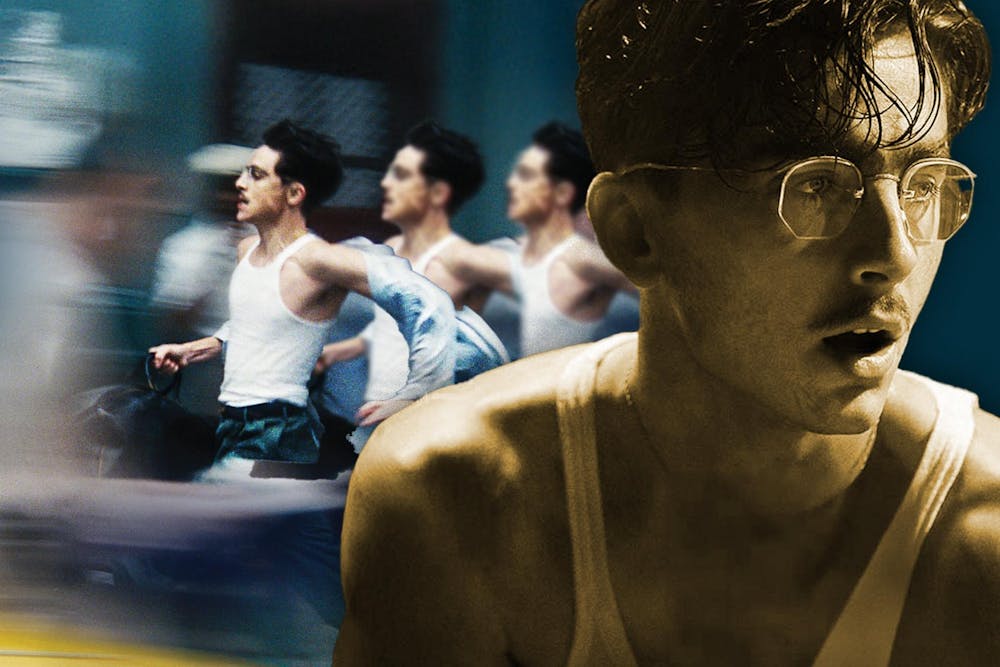
In a time when the future of cinema is deeply uncertain due to industry collapse and cultural degradation, “Marty Supreme” has been a beacon of hope. Its sprawling, bold marketing campaign — spearheaded by star Timothée Chalamet — was something to behold. Surreal comedy sketches, blimps and rap collabs generated actual hype for an original film, a near impossibility in this environment. Accordingly, its box office performance has been very strong, and it is on track to become one of A24’s highest grossing films. But beneath all the buzz and Chalamet’s awards season success, what is “Marty Supreme” really about?
Director Josh Safdie’s kindred follow-up to “Uncut Gems” is an exhilarating nightmare of ambition gone awry. Set in 1950s New York, the film follows Marty Mauser, a young Jewish kid with a big dream of becoming the world’s greatest ping-pong player. However, he’s stuck as a shoe salesman with little money or resources. So what is he to do? Well, Marty, slick-talking and conniving, engages in all kinds of crazy schemes to make his dream come true. The film is a gripping tragicomedy of errors as Marty digs himself deeper into problems that only compound, resulting in a tour de force of anxiety that never relents.
Chalamet brilliantly sells Marty’s beguiling, arrogant nature as he upends everyone in his life in pursuit of greatness. Despite his sleazy ways, you can’t help but be swept up in his ambition. Chalamet also brings striking physicality to the ping-pong matches, which are shot and edited with incredible energy. The other standout performance surprisingly comes from Kevin O’Leary, who plays Milton Rockwell — essentially a caricature of O’Leary’s “Mr. Wonderful” persona from “Shark Tank.” Rockwell is a harsh businessman who has a turbulent relationship with Marty, ultimately becoming his reluctant benefactor. O’Leary is hilarious but imposing when he needs to be, and helps sell the thematic tension between the brash attitude of dreamers like Marty and the forces of capitalism demanding their full obedience.
The film’s chaos is a vehicle for some very provocative commentary on post-war America. The trauma of World War II and the Holocaust lingers over the story and its characters. Marty seems eager to prove himself in a country that still largely regards him as a hapless outsider; his quest to become a great ping-pong player is really a quest to become a great American. So he goes all in and adopts the hyper-individualism and exploitation he feels is necessary to achieve the American dream and assimilate. He lusts after a celebrity actress, refuses to settle down with his childhood friend Rachel even though she’s pregnant with his child and constantly destroys all communal and familial ties in his scorched-earth approach to success.
But eventually, Marty hits a wall in the final act, which is what I want to discuss in detail, as it reveals the film’s true meaning. After a journey to hell and back, he finally gets Rockwell to finance his participation in the ping pong world championship in Japan, but only under the condition that he first plays in an exhibition match for Rockwell’s company. Rockwell, like many American businessmen at the time, is rabid to capitalize on the burgeoning market in Japan, despite the scars of World War II being less than a decade old. Earlier in the film, Marty throws this fact in Rockwell’s face, criticizing his eagerness to work with the country who killed his son during the war, which predictably enrages Rockwell.
The exhibition match is rigged so that his Japanese rival, Koto Endo, can win and make his domestic fans happy. Marty initially complies with the ruse and is forced to kiss a pig on stage as punishment for defeat. But then something snaps in Marty. Whether it’s because the fixed match violated the integrity of the sport, or he’s indignant about Rockwell pimping him out for money, or he refuses to be humiliated for a former Axis power, Marty challenges Endo to a real match. What follows is one of the most tense and thrilling film sequences in recent memory. It’s like Marty is using the match to protest America’s sacrifice of its values and greatness for global hegemony. The kinetic editing intersperses punishing rallies with transfixed audience reactions while the ethereal 80s-inspired score kicks into overdrive, briefly convincing you that ping pong is the greatest sport in the world.
After a nailbiter, Marty beats Endo, and it’s a moment of ecstasy — but the feeling lasts all of 20 seconds. His smile quickly fades away, and Chalamet gives a haunting look of emptiness. Here, Marty undergoes ego death and realizes the futility of his striving. He thought his career alone would bring him fulfillment, but it was only fleeting. He has achieved a hollow victory, leaving in its wake the destroyed lives of everyone who cared about him. He races back home to Rachel and his child. As he meets his newborn son in the hospital, he breaks down and cries tears of joy. He has realized community and family — the very things he was destroying in his pursuit of greatness — were the ultimate sources of fulfillment all along. And now, he has found a new vocation of greatness: fatherhood. The film is not saying that one shouldn’t dream big, but only that ambition must not come at the expense of relationships rooted in love.
The ending is brilliantly subversive and recontextualizes all of the film’s preceding chaos; a movie ostensibly about the obsessive pursuit of success tears it all down in the last five minutes. This has proven highly polarizing, and I’ve been amused watching people in film circles argue that it’s ironic or insincere. But the ending to me reads like a man who has genuinely changed and found a new lease on life thanks to the humbling, cosmic power of parenthood.
Underneath the suffocating anxiety and electric ping-pong sequences, “Marty Supreme” is a fascinating film about geopolitics, assimilation and the struggle between career and family. The ending redemption of its narcissistic, amoral protagonist might be a challenging pill for some to swallow, but I found it to be a surprisingly moving testament to family in a film that initially seemed indifferent towards it. Safdie and Chalamet have created something really special here.