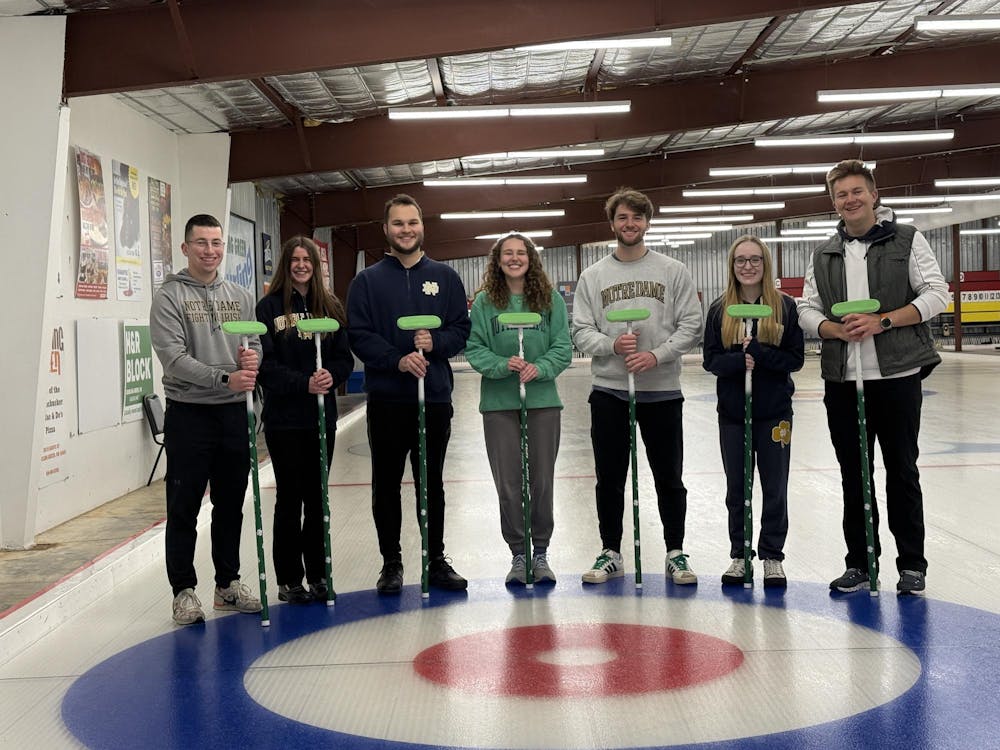
With the start of the 2026 Winter Olympics season, curling is slowly but surely grasping the attention of viewers around the world. At Notre Dame, the club curling team members balance practices along with classes, homework and responsibilities that come with student life. For club president Ava Schapman and competition coordinator Will Crumlett, curling is more than an athletic fascination. It’s a commitment to community, teamwork and strategy.
Schapman is a sophomore from Duluth, Minn. She has been curling for 12 years. She qualified for the USA Curling Junior U21 Nationals, where she earned a bronze medal. At Duluth’s local club, one of the oldest in the nation, Schapman learned from coach, Aidan Oldenburg, the 24-year-old lead for the U.S. Olympic team in Milan Cortina. Schapman said that her love for curling played a factor in her decision to attend Notre Dame. “It was important for me that as I continued on to college, curling could still be a part of my life,” she said.
Crumlett is a junior from Elgin, Ill. He became familiar with the sport during his freshman year at Notre Dame, when he attended the club fair and noticed the curling table, realizing that he had only ever seen the sport air during the Olympics. Deciding he wanted to give the sport a try, he went to the first practice of the year. “Ever since then,” Crumlett said, “I slowly increased my leadership role on the team and became more involved.”
Capturing the attention of American sports fans every four years, curling is a sport that is played on a long sheet of ice where players slide granite stones toward a target, called ”the house.” In an effort to land the stone in the center of the house, players may use their brooms to sweep the ice in hopes of maintaining the stone’s momentum. Points are awarded based on which team lands their stones closest to the the center of the house, termed ”the button.”
The Notre Dame club curling team practices together once a week in Compton Family Ice Arena. “Bonspiels,” the familiar term for curling tournaments, occur over weekends throughout the end of fall semester and the beginning of spring semester. In the past, the team has traveled to Stevens Point, Wis., Bowling Green, Ohio, and Rochester, N.Y., competing against universities ranging from Yale to Minnesota to Michigan Tech. It’s a non-varsity sport with highly demanding weekend tournament schedules.
“You might start a typical bonspiel on a Friday at 6 or 8 p.m., finish around anywhere from 10:30 to 11 p.m. and then have to be back at 7 a.m. and curl until 11 p.m. the next day. It’s a pretty packed schedule,” Crumlett said.
With busy bonspiel schedules over the weekends, Notre Dame students must keep up with homework, studying and other responsibilities. Schapman reassured that “balancing academics during the week isn’t very difficult. Weekends can be pretty intense because games can take over two hours and several games are played in a day. But there’s also the social aspect of talking with the team we play after bonspiels as well, so it's all worth it.”
The club curling team hopes to gain access to additional resources in the near future, including dedicated curling ice, which will help them practice more effectively. Currently, the team practices on hockey ice.
“One of the biggest challenges for us would be not having the correct type of ice, whereas other schools might have the opportunity to practice on real curling ice multiple times a week. Translating from hockey ice to dedicated curling ice can be difficult for the team,” Schapman said.
Hockey ice and curling ice are distinct from one another, and both sports play on the ice at differing intensity levels.
“There’s a lot of differences between hockey ice and curling ice,” Crumlett said. “Hockey players and ice skaters typically leave chipped ice behind. Although curling doesn’t always look like a precise sport, there’s a lot of precision involved with every curling throw. The hockey ice has a lot of imperfections when it comes to being level and smooth.”
While there are obstacles to playing the sport on campus, there are certain qualities of the sport that reveal its uniqueness and set it apart from other clubs and opportunities offered at Notre Dame.
“Compared to the other club sports, people may have never had previous exposure to the sport itself. While there have been people who have curled prior to coming to Notre Dame, the vast majority of people on our team have never tried it out before. It represents this unique opportunity that people are starting out with a fresh experience,” Crumlett added.
Now that the Olympics have kicked off, curling is gaining momentum because more people are becoming enamored with the creativity and uniqueness of the sport. Schapman said that the popularity of curling goes through a four-year cycle, with interest increasing around the Winter Olympics. Both Schapman and Crumlett have noticed that more students are expressing interest in the club at Notre Dame now that curling is airing on national television.
Crumlett says the team still has room for improvement.
“Typically Notre Dame has been an underdog in the bonspiels. The Midwest region is known for having a lot of people who have curled in high school and have plenty of experience. Developing some talent to compete with these teams is one of our top priorities,” he said.
The club’s leaders are focused on encouraging anyone who is willing to give the sport a shot to come out to a practice.
“We want you there!” Schapman said. “Don’t feel like because you’ve never curled, it will be a burden to us. We want to share our love of the sport with you. If you don’t end up liking it, at least you tried!”