
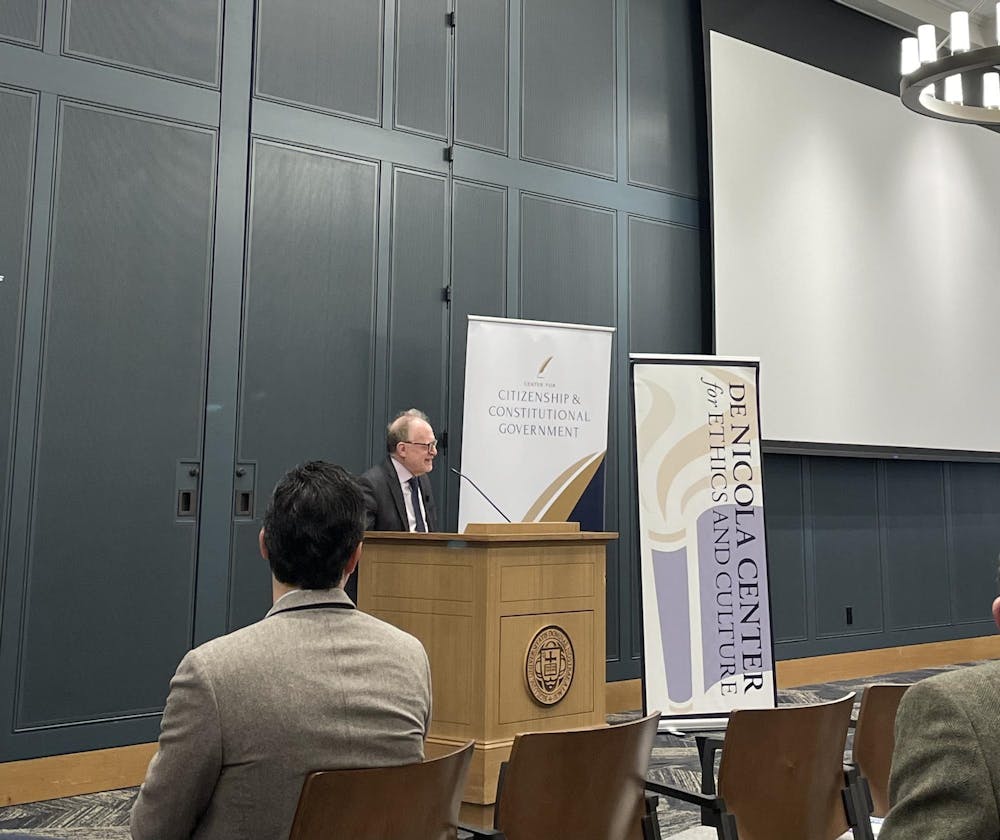
On Tuesday afternoon, biographer Sam Tanenhaus spoke in McKenna Hall to discuss his bestselling biography of famed conservative political commentator William Buckley, entitled “Buckley: The Life and the Revolution That Changed America.” In his address, Tanenhaus highlighted the role of Buckley’s Catholic faith in forming his personal and political views, as well as his influence in curbing populist movements on the right.
Tanenhaus was chosen by Buckley to write his biography in 2008, giving him access to personal correspondence and interviews. The book was released in June 2025.
Tanenhaus explained that while Buckley’s father influenced his political beliefs, it was his mother who had the most influence upon his faith. While he only had a year of formal Catholic education, his mother’s influence and his experience as an altar boy in his local parish gave him a very personal and devout Catholic faith, which Tanenhaus said he “never doubted.”
Although his home environment may have been favorable to the Catholic faith, Tanenhaus noted that the external environments in which Buckley found himself were often anything but that. The Buckley family may have been quite wealthy, but found themselves socially excluded by elites in their Connecticut town because of their Catholicism.
Buckley’s Catholic faith was most challenged, however, when he completed his undergraduate education at Yale University. Catholics were a decided minority at Yale, Tanenhaus explained, constituting only 13% of the student body and often experiencing prejudice because of their faith. Buckley’s experience at Yale, where he served as the editor-in-chief of the Yale Daily News, motivated the publication of his first book — the bestselling “God and Man at Yale: The Superstitions of ‘Academic Freedom’” — which criticized the curriculum and academic environment at the university.
“He just discussed the curriculum at Yale, and he said, ‘Why is it that a university founded by Protestants to teach churchmen, clergymen in 1701, and was still doing that 1901, is suddenly filled with New Dealers and atheists 50 years later?’” Tanenhaus explained.
Tanenhaus noted that the inclusion of the word “superstition” in the title turned a moniker used against Catholics toward the educational establishment at Yale.
“He takes the thing that the liberal elites of his era prided themselves on most — their free thinking enlightenment view of the world, and he calls it a superstition, which is exactly what they think his Catholicism is,” Tanenhaus said.
Tanenhaus described Buckley as “the greatest campus journalist in American history” and noted that his editorials were read across the country.
While Buckley never explicitly mentioned his Catholicism in “God and Man at Yale,” Tanenhaus said that he faced allegations that he was an “agent of the Vatican” by his critics. After his graduation from Yale, Buckley faced similar criticism when he founded his successful newspaper National Review, which was in fact a broadly Christian, not Catholic publication.
For all Buckley’s prowess as a campus journalist, Tanenhaus argued his greatest influence lay in how he was able to guide the conservative movement in the 1970s. While figures such as Pat Buchanan wanted to move conservatives in a more populist direction, Tanenhaus argued Buckley kept the Republican Party away from this movement by rallying around Ronald Reagan for president, whom he described as “Buckley’s protege and disciple.” Instead of a domestic populist campaign, he sought to organize Republicans around a “global campaign against communism.”
“He didn’t like populism and he didn’t like that kind of appeal to people’s baser instincts,” Tanenhaus said, joking, “Luckily that doesn’t happen in our politics today.”
Tanenhaus noted one of the key moments in Buckley’s efforts in this regard came during his commencement address at Notre Dame in 1978. Buckley spoke a year after President Jimmy Carter had delivered his own commencement address at Notre Dame, where he argued that the U.S. foreign policy should focus more on promoting human rights than vociferously focusing on anti-communism.
According to Tanenhaus, Buckley rebuked Carter’s message, pointing to the communist Soviet Union as one of the greatest human rights violators and arguing that anti-communism should be the defining feature of U.S. foreign policy. By focusing on anti-communism, Tanenhaus explained, Buckley was arguing for an outward-focused, instead of populist Republican Party.
“He’s coming to the nearest thing the Catholic Church has to a Vatican in America,” Tanenhaus said. “And he wanted to come here and tell his people, people on his side, the intellectuals, ‘Don’t get seduced and go down this other path.’”
Although the speech was not well received on campus, Tanenhaus argued it had a lasting impact.
“It’s one of those really good pieces of oratory and writing that grow better over time,” Tanenhaus said. “So when you read it today it seems like a really eloquent plea, because we know where the history was leading, that Buckley got it right.”


