
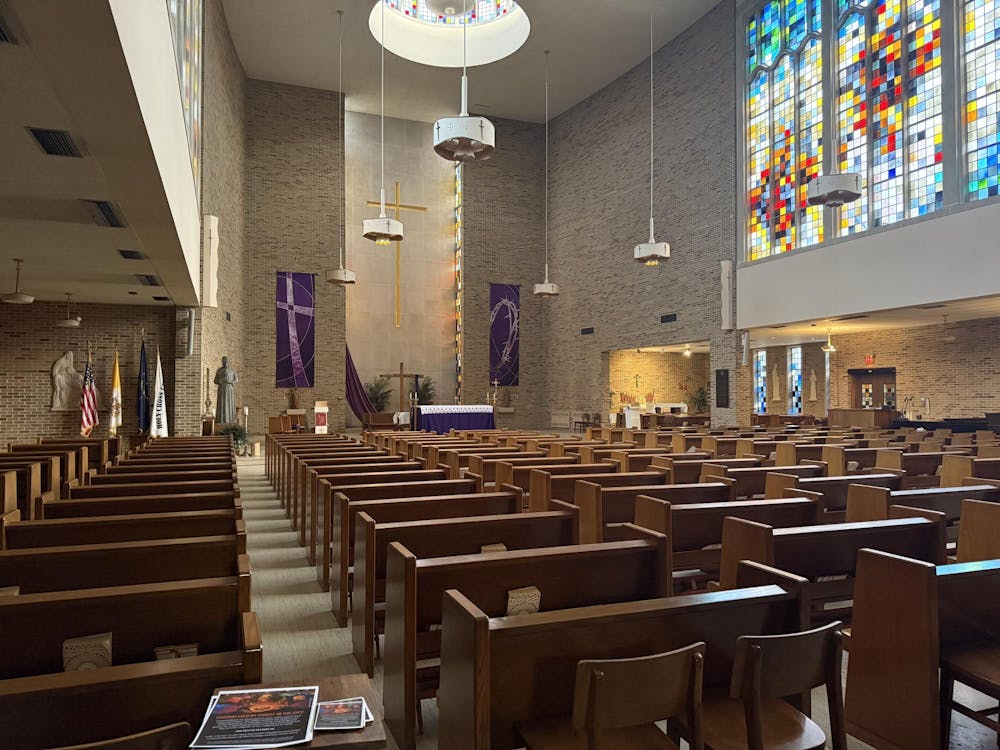
Bishop Kevin Rhoades of the Diocese of Fort Wayne-South Bend visited Holy Cross College on Wednesday as part of the Mind and Heart Lecture Series, delivering a talk on what he described as one of the greatest challenges facing the modern world — the global migration and refugee crisis.
The lecture series began in 2021, aiming to combine intellectual reflection with moral responsibility, connecting reason, compassion and the Holy Cross mission of healing the world.
Rhoades clarified that the event was not meant to be a political debate, but rather a reflection on what it means to live out the Catholic faith and values in today’s world and on how to confront today’s challenges.
Rhoades centered his talk on the staggering scale of human displacement worldwide. According to United Nations data he cited, 117.3 million people are currently displaced globally. Of those, 42.5 million are refugees who have fled their countries, 67.8 million are displaced within their own borders and millions more are asylum seekers.
He emphasized that these figures represent more than data points. “I’m sharing these statistics to highlight the staggering dimensions of this crisis, but it is important that we not only look at the numbers — these are real people. Over 40% of refugees today are children under the age of 18. Over 60% are in family units. And the sufferings of refugees are multifaceted,” Rhoades said.
Throughout the lecture, Rhoades framed migration as a moral and theological issue. Drawing from Scripture and Catholic social teaching, he argued that Christians are called to recognize the dignity of every person. “Pope Francis coined the phrase ‘globalization of indifference’ to describe a widespread mentality where people are desensitized to the suffering of others, viewing the migrant crisis as someone else’s problem. As Christians, we must never treat the suffering of others as if it does not concern us,” he explained. “We have a moral duty to care about the plight of migrants and refugees.”
Rhoades emphasized that one must approach migration first through faith. “We must look at this issue first and foremost from the perspective of God’s revelation transmitted to us in Scripture and tradition, and not from the perspective of one’s political party or narrow ideology,” he said.
At the center of his message was a balance of rights and responsibilities. Catholic teaching, he explained, affirms both the right of nations to regulate their borders and the right of people to migrate when their lives or dignity are threatened. It also recognizes what he calls the “right not to migrate”, or the right of individuals to live safely and with dignity in their own homelands. “The Church teaches that people have a right to find safety, economic opportunity and dignity in their own homeland, rather than being forced to leave due to poverty, violence, persecution or natural disasters,” Rhoades said.
These principles shape the work of organizations like Catholic Relief Services, which addresses root causes of migration by supporting development, healthcare, education and conflict prevention in vulnerable regions. Rhoades described CRS initiatives he has witnessed firsthand, including water security projects, disease prevention programs and youth outreach efforts focused on reducing violence.
He also addressed U.S. immigration policy, emphasizing the need for humane asylum processes, family reunification and expanded legal pathways. While affirming the importance of secure borders, he urged generosity toward migrants and refugees, particularly given the nation’s resources. “We’re morally obliged to be sure that our goods benefit those in need, including migrants and refugees,” Rhoades said.
He also discussed the United States’ new policy of allowing only 7,500 refugees to be resettled in the country this year, suggesting the nation should act with more benevolence to those who are in unfortunate situations. “This is the lowest ceiling since the program began in 1980 … small countries, poor countries, are accepting these suffering people, and we’re not. The U.S. used to be at the forefront of welcoming those who were fleeing war, violence, persecution and oppression,” he said.
Following the lecture, Louis Albarran, a professor of humanities and theology at Holy Cross College, offered a response focused on the relationship between Church teaching and everyday practice. He warned that political polarization often shapes Catholics’ views more strongly than doctrine itself, creating what he described as a “breach” between belief and lived faith.
Citing research from theologian Matthew Shadle, Albarran noted many American Catholics remain mostly disengaged from Church teaching when it comes to political decisions. “Only 16% of U.S. Catholics are even aware of the bishops’ voting guides,” he said. “Only 3% have actually read them. And of those who are aware of them, three-quarters say they had no influence on their vote … whatever is shaping the partisan identities of Americans is having a greater influence on Catholics than the teaching of the bishops.”
After the lecture, Holy Cross College junior Jimmy Ward reflected on the significance of the bishop’s presence on campus. “Having the bishop come to campus is very special,” he said. “It’s something you have to take advantage of when it does happen.” He added that his main takeaway was that “grounding yourself in Catholic doctrine as much as you can is the first step to becoming a better Catholic.”
Editor’s note: Ward is a former sports writer for The Observer.
Holy Cross College freshman Yaretzi Castillo described the lecture as deeply moving. “I wanted to hear him talk about the immigration policy,” she said. “I almost cried. It was very emotional, in a good way.” She said she left with the sense that “we should find an equal medium of solving these issues and work from multiple perspectives.”


