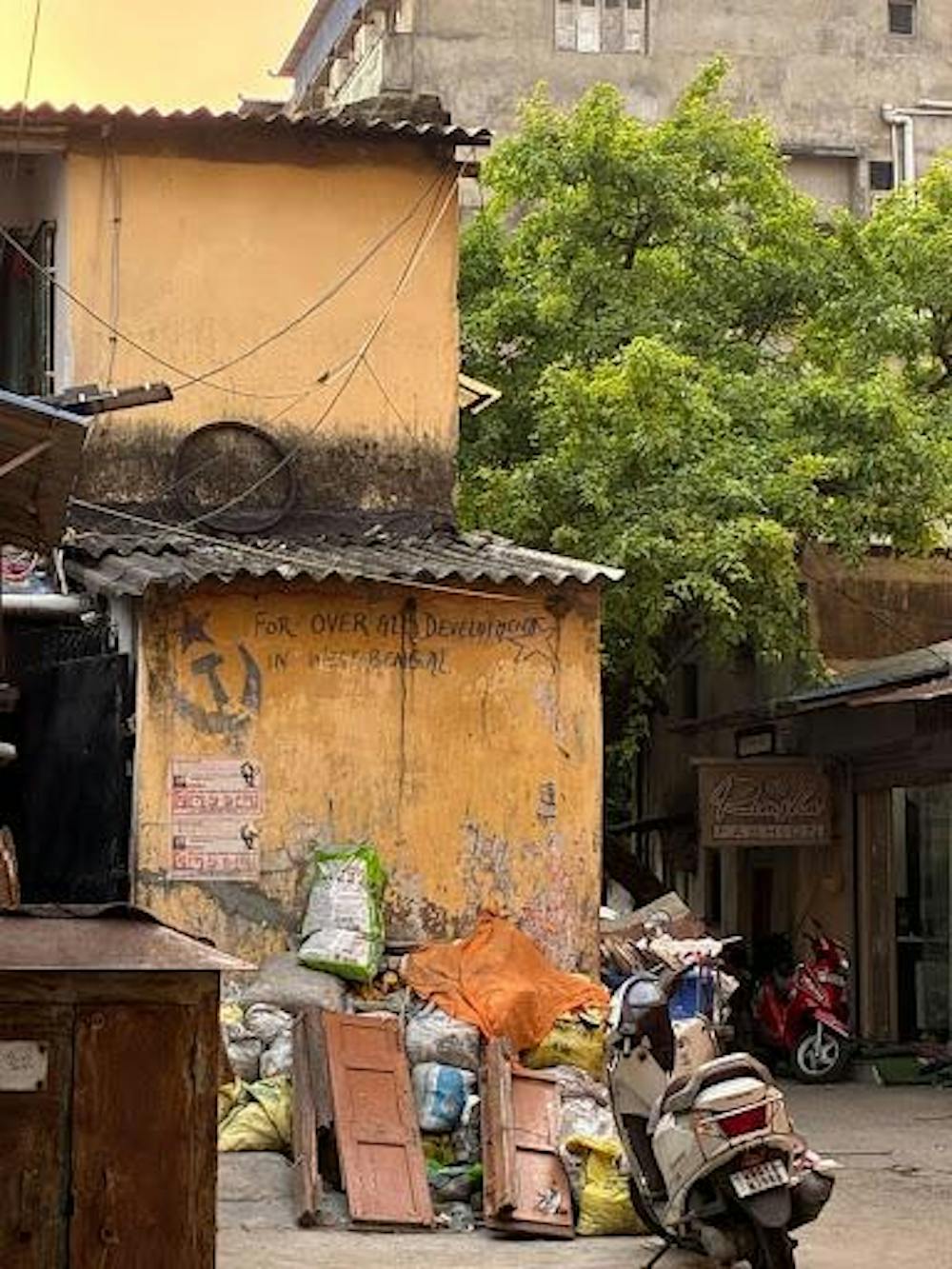
I noticed the hammer and sickle symbol’s presence in Kolkata on my first day there. At the end of the alleyway where I was to live for the summer, the logo was painted in black next to the phrase, “For over all development in West Bengal.” The next morning as I walked to join the Missionaries of Charity for their morning Mass, I absentmindedly snapped a picture to send to my parents.
Soon, I began seeing the hammer and sickle everywhere. It was graffitied on walls in every alleyway, flying on crimson flags on street corners and even painted into the murals on the buses. Before I left for India, the Institute for Social Concerns gave all of the fellows an assignment to research the area we would be living in this summer, to promote cultural awareness and humility. From that research, I knew that India was a democratic republic with a parliamentary form of government, and therefore was shocked by the seemingly overwhelming communist representation. On one of my first calls home I mentioned it to my Dad, who prompted me to look into it more.
From a quick search on Google, I found out that India was the first country to democratically elect a communist party into government. In 1957, the Communist Party of India (CPI) won the assembly elections in Kerala, marking a new frontier merely ten years after India was freed from colonial rule by England. Communists were active in the fight for independence from Britain, and the party’s main focus at the time was attempts at reconciliation after the conflict. Its presence evolved into the fight against class and caste, garnering support from rural peasants fighting against feudalism.
In its evolution, Communism became a force in West Bengal, where I was living in Kolkata, as a reflection of the working class’s disenchantment with the seemingly perpetual inequity of their labor. The Center of Indian Trade Unions (CITU) emerged from the communist movement in West Bengal, and is active in the fight for worker’s rights. Despite its insistence on socialism as the solution, CITU still uses the classically communist crimson and hammer and sickle as their symbol.
Although the CPI has not held a governmental seat since 2011, it still makes sense that communist ideals are present in Kolkata today. Even my limited experience this summer felt pendulous; I went from 40 hours a week working among the unhoused community in Kalighat to grabbing lunch at The Tollygunge Club, one of the most prestigious country clubs in the world, with an ND alumni on one day off. From my short two months there, I could see the tension between classes as an outsider. I won’t pretend to know what the lived experience of the average West Bengali resident is, but I will say that the disparity between the lives I got to share in was alarming.
LMICs (lower- and middle-income countries) tend to be drawn towards communism as the party theoretically offers a fast-track to equity, wealth distribution and stability in the face of poverty and post-colonial struggles. As the difference between the “haves” and the “have-nots” continues to grow, so does the desire to eliminate that divide. Further, India still suffers from a “colonial hangover,” where the lingering effects of British rule have perpetuated even further economic inequalities. Colonization left its mark in both social and industrial structures, where India’s impoverished workforce is largely dedicated to exports, such as textiles and electronics, to countries like the United States and the United Kingdom.
Many of the women I encountered this summer were unhoused due to a lack of affordable housing, fractured infrastructure and mass migration from rural areas in hopes of finding employment in the city. The aftermath of colonialism had touched every single life in some way, making the pull towards communism even more understandable. Occupation by a foreign empire and the dismantlement of any trace of autonomy in Indian government, society and culture compels one to try and reclaim power to the people.
“For overall development in West Bengal” speaks volumes to the motivations of the people. What may have started as a reaction to colonial rule and being deemed a country incapable of self-governing, has now evolved into the constant, and at times Sisyphean fight, for workers rights and escape from poverty. Despite communism’s decreased presence in the politics of West Bengal, Bengalis still search for equity and hope for a better future.
Ivy Clark is a senior pre-med studying neuroscience and behavior with a minor in global health and the Glynn Program. Despite living in the midwest her entire life, she has visited 11 countries and is excited to share her most recent endeavors working with the Missionaries of Charity in Kolkata, India. If Ivy could get dinner with any historical figure, it would be Paul Farmer or Samantha Power, whose memoir inspired her column name. You can reach her at iclark@nd.edu.