Fourteen surgeries.
That’s the number of operations Holy Cross senior Hugh O’Sullivan has had throughout the past four years. Despite moving halfway across the world, countless nights spent “staring at the ceiling” and constant uncertainty, O'Sullivan never wavered in his mission.
To play college tennis.
“I spent a lot of time sitting, staring at the wall, thinking about what could’ve been,” O’Sullivan said. “It sort of ruins you mentally if you keep thinking ‘what if.’”
A highly touted prospect from Cork, Ireland, O’Sullivan committed to play for Holy Cross in late 2021. With Holy Cross offering top class facilities and a pathway to finish with a graduate degree from the University of Notre Dame, O’Sullivan was buzzing for the opportunity to play tennis on scholarship in the United States.
One week after signing his letter of intent, everything changed.
O’Sullivan broke his fibula and tibia while playing Gaelic football. Instantly, his college tennis dreams were put on hold.
“I was meant to come in January of 2022. I ended up prolonging that and coming in the fall because I thought by then it would be healed. I came in August, and I was still so far away. My bone wasn’t healing properly,” O’Sullivan said.
What was supposed to be a six-month recovery turned into a four-year process.
“The tibia, there was a gap in it. It wasn’t healing like a normal, young, healthy person would heal,” O’Sullivan said.
O’Sullivan underwent surgery after surgery, but none seemed to provide permanent relief.
“I had nerve issues. Then, I ended up having a big frame called the Taylor Spatial frame. That ended up getting infected in my bone, and it went all wrong,” O’Sullivan said.
During the entirety of O’Sullivan’s seemingly never-ending journey of recovery, he remained a constant presence on the sidelines. Taking on the role of “hype man and assistant coach,” O’Sullivan’s ear-to-ear smile and loud cheer provided the Saints with a spark that lifted the team up, on and off the court.
“I can say that for someone else in his situation, it would be heartbreak,” O’Sullivan’s teammate, Calvin Golmei, said. “But Hugh always carried himself well, and more than that, he supported us. That’s the biggest thing. He was always there for us, even though he was in a brace.”
Despite being known by his teammates as upbeat and full of spirit, it wasn’t always that easy for O'Sullivan.
“Sometimes I remember, in the middle of the night, when we were meant to be lengthening the bone so the callus would form, I was frozen with pain – I couldn’t move an inch. If I did, it would be absolute agony, the worst thing I’ve ever experienced,” O’Sullivan described.
No matter how long it took to recover, he could never find it within himself to quit.
“Some moments I thought maybe it’s time to hang the boots up, per se, but I always wanted to come back,” O’Sullivan said. “I always had that little bit of hope and that fight. As tennis players, we do have an ego and want to prove people wrong. I definitely wanted to do that, so I had a little fight in me.”
Every day for nearly four years, O’Sullivan chipped away at his goal of returning to the court, spending long hours in Holy Cross’ gym at the Pfeil Center.
If he wasn’t working out, he would be talking to doctors, on the sideline supporting his team or working toward his degree in mathematics.
“Hugh never missed a day of rehab. It's insane,” Holy Cross’ head tennis coach Eric Mahone said. “Every time I would be in the Pfeil, he would be in there by himself, lifting, working out. Who does that? It's a rare thing for a 40-year-old to have that kind of perseverance, let alone an 18 to 19-year-old kid.”
Four years of consistent perseverance finally culminated in the breakthrough O’Sullivan had been praying for.
“I ended up getting surgery, and they had to take a bone graft from my upper thigh and put it into the gaps, and it ended up healing,” O’Sullivan said.
From there, O’Sullivan slowly but surely began his journey back to playing. To get up to match fitness was a challenge, but if he had come this far, there was no stopping him now.
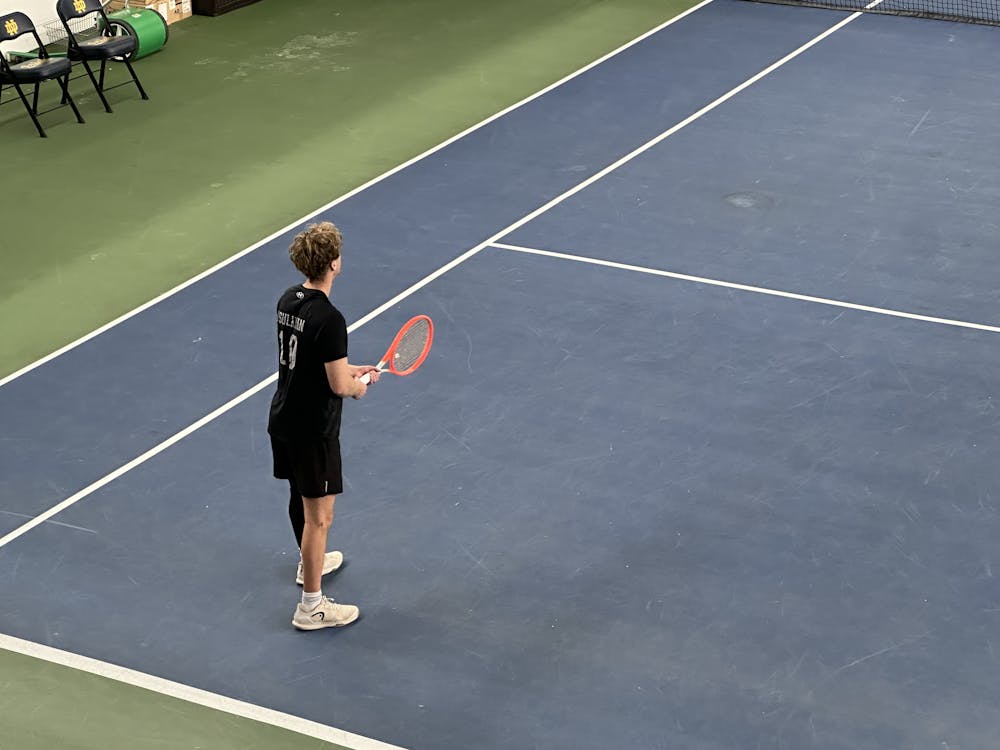
On Feb. 13 in Rome, GA, at ITA Indoor Nationals, 4,300 miles away from his home in Cork, O’Sullivan returned to the court.
A week later, he made his long-awaited home debut at the Eck Tennis Pavilion.
Apart from a compression sleeve on his leg, O’Sullivan showed zero signs that he had been injured for four years. The former Irish youth national champion delivered several key hits for the Saints, helping lead Holy Cross to an important win over Huntington College.
Most importantly, he had a grin on his face.
“It’s just an unbelievable feeling to be back on the court,” O’Sullivan said. “I spent a lot of the last four years watching my favorite player, Gaël Monfils, and liked to live vicariously through him and pretend I’m playing. But, there’s literally nothing you can do to recreate that feeling.”
O’Sullivan’s comeback, an entire collegiate career in the making, is improbable. To have 14 surgeries requires a physical and mental toll that is simply unheard of.
“At the end of the day, everyone else would’ve given up,” Mahone said. “At least by the third or fourth surgery, nobody does 14 surgeries over four years.”
O’Sullivan’s girlfriend, Sophia Rocha, a sophomore on the Holy Cross women’s tennis team, echoed a similar sentiment.
“It’s always going to be my goal in life to have the same mindset as him because thinking about everything he went through, it’s amazing to see that he’s still here. With everything that he went through, he never lost his hope,” Rocha said.
With plenty of tennis left to play, O’Sullivan has his eyes set on becoming a fixture for Holy Cross on the court. Regardless of what happens, he understands that he’s living out a dream deemed impossible by many.
“I could’ve easily gone home and started again in Ireland,” O’Sullivan said. “But I always wanted to live this out, and I’m glad I did.”