
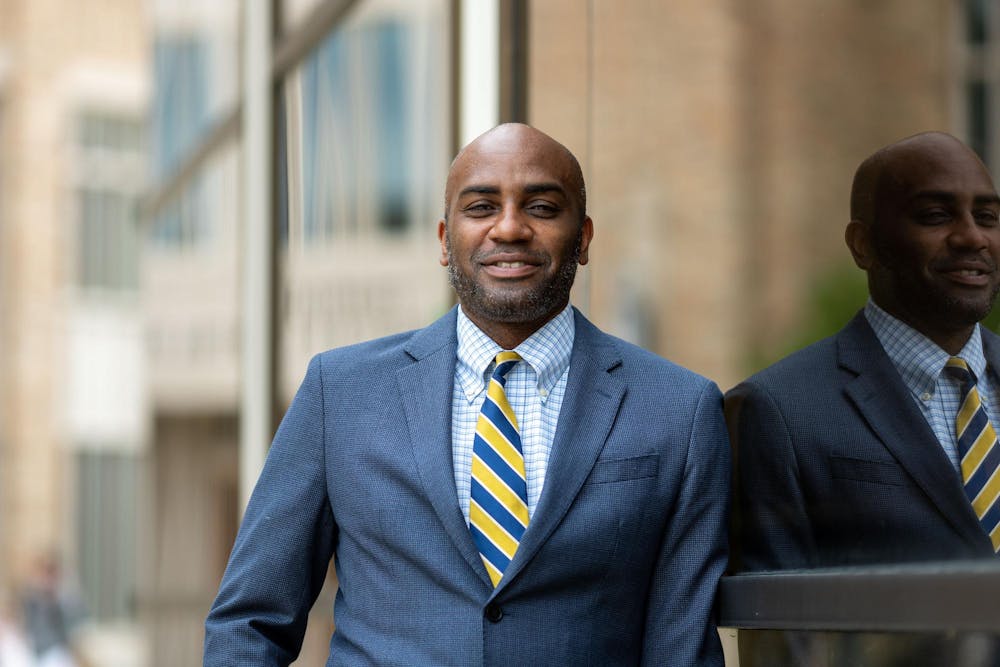
Ernest Morrell, professor of Literacy Education, passed away on Feb. 6 after a long battle with cancer. He was 54.
The National Council of Teachers of English, where Morrell was a member for over three decades, was the first to announce his passing early Friday morning.
“Dr. Ernest Morrell, a legendary scholar in our field and multifaceted leader who helped pave the way for critical English education as a practice, passed away surrounded by family members,” its statement read. “His reputation as a scholar, as a mentor, and as a respected colleague is unparalleled.”
Morrell worked for NCTE for more than three decades, serving as its president in 2014. He was director of the organization’s Office of Policy Research since 2020.
Morrell was a recipient of the NCTE’s James R. Squire Award in 2025, as well as its Distinguished Service Award. Morrell was also a member of the National Academy of Education, an elected fellow of the American Educational Research Association and the American Academy of Arts and Sciences.
Alfredo J. Artiles, president of the National Academy of Education and professor at Stanford University, wrote a statement to the Observer on Morrell's passing, saying, "Ernest Morrell was a leading and influential scholar who advanced the field of literacy studies, and in particular, ways in which critical pedagogical approaches can improve learning and deepen civic engagement. As a National Academy of Education member, he was also generous with his time spent mentoring early career scholars and heavily involved in career development activities focused on their needs."
The University released a press statement that included a message from University President Fr. Robert Dowd and many of Morrell’s colleagues.
“‘On behalf of the entire Notre Dame community, we mourn the passing of Ernest Morrell, a beloved faculty colleague, dedicated administrator, and cherished friend to many. As a renowned scholar who made significant contributions to his discipline, a superb teacher who inspired and challenged his students, and a visionary administrator, he enriched the Notre Dame community and all who knew him,’” Dowd’s statement read. “‘Ernest’s life reflected a deep integration of the life of the mind and matters of the heart. Our prayers are with his family, especially his wife, Jodene, and their three sons, Skip, Antonio, and Tripp, and all who grieve his passing. We are grateful to God for Ernest’s life and presence among us, and his example will continue to inspire us.’”
The release also noted Morrell will posthumously receive the 2026 President’s Award.
Joyelle McSweeney, chair of the Department of English, wrote in a statement to The Observer, “To those of us in the English department, Ernest was a friend, colleague, and mentor, as well as an advocate, leader, and scholar. He played many roles at Notre Dame, and he filled them all with purpose, justice, and compassion. In all he did, he exemplified that the work of the university is and must be good work, humane work, and just work. He remains an exemplary man with an exceptional heart.”
He was married to Jodene Morrell, teaching professor and associate director of the Center for Literacy Education. They were together for over 30 years, worked together and co-authored Freire and Children’s Literature: Joy, Voice, Agency, Responsiveness, & Love in 2023.
“Ernest Morrell was a titan in the field. He could be measured by the articles he has written—in the hundreds—or the dozens of books and book chapters, and that would reflect well how he shaped literacy education. But more importantly, was his message that has a far greater reach directly to young people, teachers, young scholars, and communities—that literacy and words have the power to heal, to reduce prejudices, to bring one closer to God. And therefore, his life's work is ultimately about love. Ernest was also one of the most courageous people I have ever met,” Matthew Kloser, Hackett Family Director of the Institute for Educational Initiatives, wrote.
“For seven years, he fought cancer, and every time I talked to him, amidst the physical toll that this disease took on his body, his enthusiasm about his next project was contagious. He shall be missed greatly, but his life’s work will affect children for decades to come,” Kloser wrote.
Morrell arrived at the University in 2017 and served in various capacities, including as a member of faculty in the English and Africana Studies departments, director of the Center for Literacy Education and associate dean for the humanities and faculty development in the College of Arts and Letters. He previously worked at Columbia University’s Teachers College, UCLA and Michigan State, as well as being a high school English teacher in Oakland, California.
“Ernest clearly loved being a teacher, which is why he devoted his life to the classroom and making the experience of being in it better. In his latest book, Critical English Education: Enduring Voices, New Perspectives, he refers to students as ‘beautiful and brilliant minds’ that are in a classroom ‘to do something that is eternal.’ That’s a perfect encapsulation of how Ernest thought about teaching — the daily practice of education could change minds, change lives, and change the world. Being around Ernest, it was impossible not to be inspired by his enthusiasm for teaching and learning, and it’s why his passing has led to such an outpouring of love from his colleagues and former students. In all the classrooms he was in — from an Oakland high school to Notre Dame and at every stop he made in between — what he did was eternal,” Kenneth Scheve, dean of the College of Arts and Letters, wrote in a statement to the Observer.
“For Ernest, education was powerful and life-transforming, and his field-redefining work sought to expand and advance the ways in which literacy could open up the potential of schoolchildren across America,” Scheve wrote. “Ernest was an exemplary leader in the Arts & Letters Dean's Office over the past five years, providing invaluable advice and support to the dean, our department chairs, and faculty throughout the College. As associate dean for the humanities and faculty development, he had a massive portfolio, with 11 departments and several centers and institutes to oversee, but he was a constantly inspiring and strategic partner to the leaders of all those units.”
“Ernest valued excellence, and he demonstrated a deep understanding of what it takes to foster it among faculty. He supported departments in recruiting high-quality scholars and teachers who continued to elevate the quality of our departments, and once we got great people here, Ernest was the one to consider ways to foster and strengthen their research and teaching. In all that he did, Ernest made Arts & Letters and Notre Dame better,” Sheve’s statement concluded.
Morrell received his bachelor’s degree from the University of California, Santa Barbara and his doctorate in language, literacy and culture from the University of California, Berkeley. “Since 2015, Ernest has been annually ranked among the top university-based education scholars in the RHSU Edu-Scholar Public Influence Rankings published by EdWeek,” according to the Department of English’s website. Morrell was also the author of 17 books, including “Educating Harlem: A Century of Schooling and Resistance in a Black Community,” “Stories from Inequity to Justice in Literacy Education,” “New Directions in Teaching English and Critical Media Pedagogy: Teaching for Achievement in City Schools.”
“Professor Morrell’s contributions as a critical literacy scholar will be felt for decades to come. His impact on the field is, of course, significant, but his impact on the cadre of scholars he generously mentored, wrote with, and amplified cannot be overstated,” wrote Maria McKenna, director of undergraduate studies in the Department of Africana Studies, in a statement to The Observer. “Perhaps most importantly, Professor Morrell was a devoted parent and husband, demonstrating to many of us how to balance a professional calling with a devotion to family, friends, and community. This example of balance is one all students would do well to remember. We will all miss his larger-than-life presence, his keen mind, and his kind, inclusive disposition.”
Laura Betz, director of undergraduate studies in the Department of English, also shared a statement with The Observer.
“Ernest was a very rare instance of someone who excelled not only in scholarship and teaching, but also in administration. I was so happy when he joined the English Department and became our colleague. When he became a dean, I missed seeing him around, but at the same time, I was grateful that someone like him was assuming that role. Ernest was a natural leader who overflowed with both wisdom and kindness. He lived out faith, hope, and love on a daily basis. He was simply extraordinary — an outstanding example to us all,” she wrote.
The University indicated in its statement that all condolences should be sent to the College of Arts and Letters Dean’s Office and that, in lieu of flowers, donations may be made to the literacy nonprofit LitWorld. They also announced a wake on Feb. 20 at Kaniewski Funeral Home in South Bend and a funeral Mass celebrated by Dowd at the Basilica of the Sacred Heart on Feb. 21.
Editor’s note: This story was updated to include the comment from Alfredo J. Artiles, president of the National Academy of Education and professor at Stanford University.


