
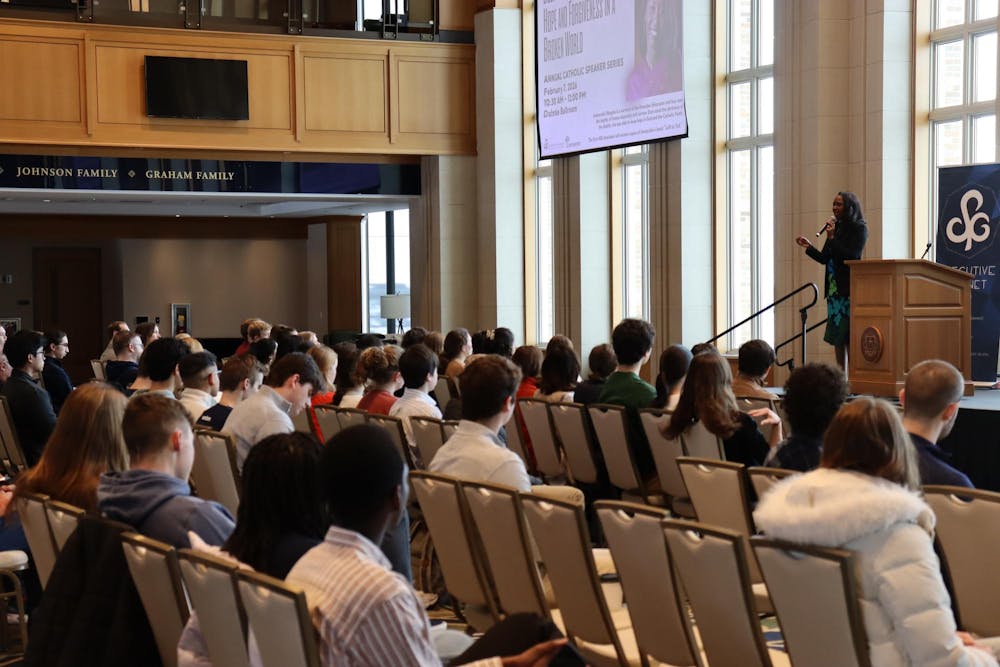
“What do you do when you have lost everything?" Immaculée Ilibagiza shared to the audience, clutching the rosary in one hand.
On Saturday morning in Dahnke Ballroom, Ilibagiza described how living through the Rwandan genocide helped her turn to God. This lecture was a part of Notre Dame’s annual Catholic speaker series, a Campus Ministry and student government collaboration.
Sophomore Matthew Mrosla, co-director of the department of faith within student government, helped organize the event. He stated that it was time for the series to have a female guest speaker who met the theme of this year.
“In the past, we have had Fr. Mike Schmitz, Bishop Robert Barron and last year was Marcus Freeman. This year, we really wanted to get a female speaker out — the first one ever,” Mrosla said. “So we thought Immaculée’s story of hope and forgiveness was just perfect, especially with this year’s theme of cultivating hope.”
Ilibagiza remembered growing up hearing about apparitions of Mary at the school of Notre Dame in Kibeho, Rwanda in 1982, 12 years prior to the genocide. The teenagers who saw the apparitions described the Blessed Mother warning of coming danger and bloodshed if the country did not develop their faith. These apparitions were recognized by the Catholic Church in 2001.
“I remember one time my parents were there and Our Lady said, ‘A terrible thing is going to happen to the country if you don't come back to God.’ That's all she was doing. She was calling us to come back to God,” Ilibagiza stated.
She further described instructions that Our Lady told them for her tribe to do in order to be saved.
“She said, ‘Make prayer groups in every village and pray for peace in this country. If you do, this will not happen. And for those who will remain, if it happens, then nothing will console them, only by the grace of God.’”
Ilibagiza recounted the preparations of her tribe and her family as the radio started to broadcast the deaths of countless families in Rwanda. As reports of organized massacres were broadcasted over the radio, Ilibagiza shared her final interaction with her father before going into hiding in a neighbor’s house.
“My father came to me and gave me a rosary … He sent me to a neighbor who was from the other tribe and who was a good man,” she said.
She described the challenges in hiding for safety and the impact that it had on her as a child.
“He put me to sit in this tiny bathroom, three by four feet. When I thought it was too small for me, we became eight people in three by four feet … At the end of the week, I remember, I thought I’ve had it, I was still just a kid somewhere,” she said.
The women hid in the bathroom for 91 days. They learned the scope of the atrocities through a radio in the room next door.
“[The leaders] were out on national radio calling everyone to kill everyone in my tribe,” she recalled. “I remember one government minister said … ‘Don’t forget children. Don’t forget elderly people. We are going to remove everybody, so we can live in a paradise,’” she stated.
She said she felt trapped in her situation but knew there was no other way to maintain her safety.
“You think it was bad to be in one place for a week. But to know that somebody is going to come to hunt for you, it was the worst pain I’ve known,” she said.
Ilibagiza described the terror as the house she was hiding in was searched by a large group from her village. She recounted how she learned that the killers had searched the entire house, even opening suitcases to check for babies, but stopped right in front of their hiding spot.
“I remember asking for a specific sign ... ‘If you can hear me, don’t let the killers open the door of the bathroom.’ [Later we were told] one of them touched the handle and before he pulled, he looked at [the owner] and said, ‘You know what, we trust you, you are a good man. You cannot hide these bad people,’” she shared. “And he turned around and left. I remember, [the man hiding us] said, ‘I don’t know how you are praying, but whatever you are doing, keep doing it.’”
After their miraculous survival, Ilibagiza remembered how her trust in God and faith was renewed.
“For the first time in my life, I said, ’Okay, God is real. It’s up to me now to really do the work,’” she said.
As she accustomed herself to the pages of the Bible, Ilibagiza discussed how difficult it was to read about reconciliation after the genocide.
“One thing that was jumping from the pages of the Bible … was forgiveness,” she said. “Love those who hate you. Close that page! How do I love somebody who’s hating me? What do you deserve? Close that page.”
Unable to process the command to love her enemies, Ilibagiza described how she put down the Bible and picked up the rosary, praying it constantly.
“I prayed 27 rosaries every single day. So after time praying the rosary, I feel sheltered [and] I feel like my heart is together … I felt Jesus was there. He really was there with me throughout the whole genocide, especially when I was praying,” she said.
Despite this comfort, she still struggled with the ‘Our Father’ prayer, especially the line: ‘Forgive us our trespasses as we forgive those who trespass against us.’
“Anytime I said those words, it was like a red flag. You’re lying, you’re lying to God … I still didn’t know how I could forgive,” Ilibagiza said, “So I started to skip that part.”
She drew strength from her faith to recognize the humanity of her killers and turn to love over hatred.
“Then something that followed that changed my heart. [Our Lord] told me, in that place of love for Him, they don't know what they do … They truly don’t know what they’re doing,” Ilibagiza said. “I realized that those killers were also the children made by God … They can maybe repent, they deserve mercy. So instead of waiting for them, I started to pray for them.”
This revelation fueled her life’s mission after the genocide. Ilibagiza described going into the refugee camps and helping those who were sick or struggling. Serving and uplifting, Ilibagiza spread the love of the gospel in the midst of extreme suffering.
As a parting call to action, Ilibagiza left valuable lessons with the Notre Dame community. She asked the audience to reconnect with their faith, harness the power of the rosary and consistently live out God’s word.
“I want to encourage you to please love God … Go to Mass, not because others are looking, [but] because you know you receive the graces from God. Please pray the Rosary, love the Rosary, the Rosary is a power,” she said. “It is a weapon.”
She shared that forgiveness is essential towards living and it was what allowed her to grow.
“Lastly, if I can forgive, anyone can forgive. Please dare to go there. There’s so much joy there, let it grow. Forgive every day, little things,” Ilibagiza said.


