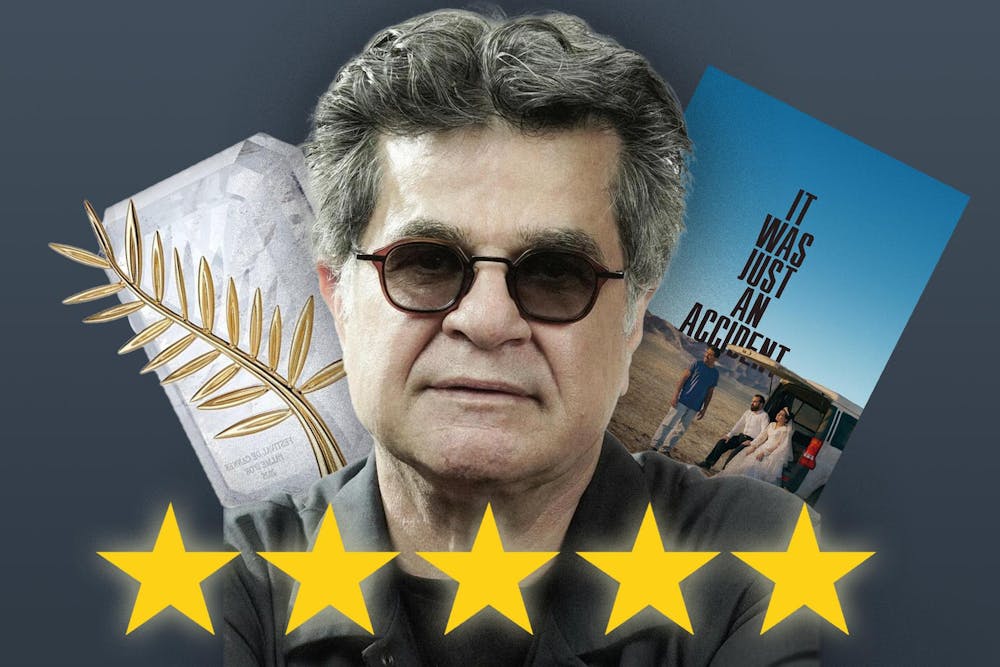
A few hours before winning three awards at the 35th annual Gotham Film Awards in New York City, Iranian director Jafar Panahi was sentenced to a year in prison, a two-year ban on travel and a prohibition on association with any political group from his own home country. His Oscar-nominated film “It Was Just an Accident” has won several awards this season, including the famous Palme d'Or: the most prestigious award in cinema, the highest honor at the Cannes Film Festival and the first major award won by an Iranian film at Cannes. But one might ask: why is the Iranian government so against this film?
“It Was Just an Accident” is a 2025 Iranian suspense thriller following Vahid, a mechanic who was arrested under the pretense of “propaganda and collusion against the regime” after protesting for unpaid wages. He encounters a man in his garage who he believes is his former prison torturer, known as “Peg Leg” by the unique squeaking sound of his prosthetic leg. Fueled by revenge, Vahid follows the man and his family to his house until the right moment occurs, and he takes him captive. As Vahid rounds up fellow ex-political prisoners to confirm the identity, the group finds themselves lost trying to figure out what to do with him. Through the journey, the film explores themes of the lingering effects of trauma, the morality of revenge and the tyranny of an authoritarian regime. It is a character-driven story with a powerful commentary on justice and oppression. The audience not only sees acting from Iranian artists and locals, but also the raw emotion of battling injustice and rage. Through intense dialogue, Panahi goes beyond showcasing the story of a group of innocent ex-prisoners. He is telling the world a message: they will not be silenced.
Shooting the movie in secret through the streets of Tehran and in remote desert locations across the country was no easy task. Because of the danger the crew faced while filming without government permits and featuring actresses not wearing the mandatory hijab, the process of filming was different from most outstanding pictures. To evade detection, it was shot with a compact camera, allowing for discreet filming in public spaces and cramped vehicles. These include effortless single unbroken takes and static shots, reminding the audience that talent lies behind the camera as well, such as cinematographer Amin Jafari. He uses claustrophobic framing often inside a crowded van, emphasizing the emotional and physical closeness of the characters. Several scenes are filmed in crowded, confined settings, while others juxtapose wide shots that capture the beautiful openness of the Iranian desert. With the bustling streets of Tehran and the sole sounds of the city, the film shows how simplicity is, on its own, art. As much as critics and audiences from all over the world enjoyed this powerful film, the Iranian government may believe the contrary.
Jafar Panahi is known for his critically acclaimed clandestine films. With his film debut, “The White Balloon” (1995), he began achieving international recognition. Not only has he become one of the very few directors to win top prizes at all three major European film festivals, but he has also attained a 20-year ban on filmmaking, scripting, giving interviews and traveling abroad by his own government due to his support for opposition protests. Being a leading figure in the Iranian New Wave, Panahi has faced several obstacles, and yet he continues to create films secretly, smuggling them out of Iran on flash drives. Because of the film’s anti-authoritarianism work that directly tackles state violence, torture and the potential downfall of the regime, the government has considered it “propaganda against the state.”
Currently, Panahi is traveling internationally, specifically between France and the United States, to promote his new film, still with the intention of returning to his home country. Unlike Panahi, his co-writer, Mehdi Mahmoudian, was just detained this past Saturday in Tehran after signing a letter with 17 other prominent lawyers, artists and activists that blamed Iran’s supreme leader, Ali Khamenei, for the recent killings and arrests of thousands of protesters who took to the streets across the country. Mehdi met the film director behind bars, later inviting him to refine the screenplay’s dialogue, drawing on his experience during his nine-year sentence in prison.
These arrests of individuals such as Panahi and Mahmoudian, who are simply using their form of expression, ironically mirror the characters in the film, who are arrested for voicing their own opinions. The collaboration between Panahi and Mahmoudian, the international recognition and the courage of the crew serve as a response to the government’s attempts to suppress “It Was Just an Accident” as well as other clandestine films for their rebellious message. However, Jafar Panahi has proven that artists can be imprisoned but never silenced. One can never prohibit an artist from creating art, especially art that carries the deep longing for freedom.