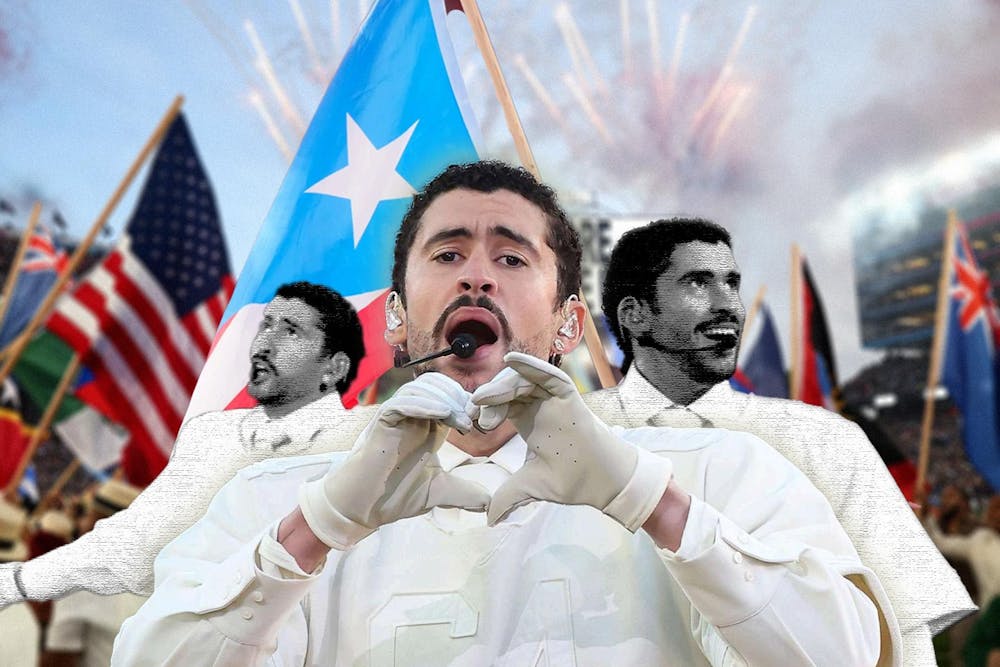
“Together we are America.” This was the core message Puerto Rican rapper and singer Benito Antonio Martinez Ocasio, commonly known as Bad Bunny, highlighted during the 60th edition of the Super Bowl halftime show on Sunday, Feb. 8, at Levi’s Stadium in Santa Clara, Calif. Following the performance, President Donald Trump, who skipped the Super Bowl and instead attended a watch party in Florida, wrote in a post on Truth Social: “The Super Bowl Halftime Show is absolutely terrible, one of the worst, EVER! It makes no sense, is an affront to the Greatness of America, and doesn’t represent our standards of Success, Creativity, or Excellence … There is nothing inspirational about this mess of a Halftime Show.”
President Trump wasn’t the only one who has publicly criticized Bad Bunny since his selection was announced in September. YouTuber-turned-boxer Jake Paul called Bad Bunny “a fake American citizen performing who publicly hates America,” later asking his followers two hours before the kickoff to boycott the show entirely, pushing fans to realize that they “have power” to use their voices. It’s surprising to hear this from a man who currently resides in Puerto Rico as well. Similarly, there were many other accounts on social media that were calling the artist out, such as u/EdwardArnett4 on Reddit: “the worst performance I’ve seen. Who the hell thought this was a great idea?”
Despite Puerto Ricans having U.S. citizenship since 1917, social media users, “professional” boxers/influencers and even politicians still question if they deserve to perform at the “All-American” halftime show. Could this backlash be tied to Bad Bunny’s recent success? He has been named Spotify’s #1 Global Artist for 2025 for the fourth time, claimed the #1 spot on US Apple Music with his track DtMF (DeBÍ TiRAR MáS FOToS) and won the Grammy Award for Album of the Year, becoming the first Spanish-speaking album to win the prestigious award. In his speech, he used his time on stage to deliver a political message: “Before I say thanks to God, I’m gonna say: ‘ICE out!’” The phrase “ICE out” has been used to protest against the U.S. Immigration and Customs Enforcement (ICE) agency, advocating for its abolition or restriction.
“We’re not savage, we’re not animals, we’re not aliens, we are humans and we are Americans,” he continued. “The hate gets more powerful with more hate. The only thing that is more powerful than hate is love.”
Alongside Ocasio, other artists, including Billie Eilish, Kehlani and Best New Artist Olivia Dean, addressed this political issue in their acceptance speeches. Along with praise towards immigrants, “ICE OUT” pins were worn by Justin and Hailey Bieber, Finneas and Amy Allen. Benito’s speech touched many but infuriated others, including President Donald J. Trump, who labeled the 2026 Grammy ceremony as “garbage” and “unwatchable” on Truth Social and even threatened to sue host Trevor Noah. Ocasio’s Grammy win and halftime performance are massive professional peaks, yet they are deeply rooted in a personal history that remains tied to the island he defends. Who is the person behind the stage name ‘Bad Bunny’?
"Buenas tardes, California, mi nombre es Benito Antonio Martinez Ocasio. Y si estoy aquí en el Super Bowl, es porque nunca — nunca — dejé de creer en mí, y tú también debes de creer en ti. Vales más de lo que piensas.” He opened the staging, telling the world who he is: "My name is Benito Antonio Martinez Ocasio, and if I'm here today, it's because I never — never — stopped believing in myself, and you should believe in yourself too. You’re worth more than you think.”
Ocasio was born on March 10, 1994, in Vega Baja, Puerto Rico. He was raised in a lower-middle-class household in Vega Baja’s Almirante Sur neighborhood. His father was a truck driver, and his mother taught English. He has two younger brothers, Bernie and Bysael. He got the name “Bad Bunny” because of his childhood. In an interview with ET in 2018, he shared that he once had to dress up as a bunny in school, and there’s even a photo of him in the costume with an annoyed face. “It’s a name I knew would market well. A bunny is something so common that I thought to myself, every time someone sees one, they’ll remember my music.” After gaining popularity in 2016 through sharing his music on SoundCloud while still in college, he began getting calls from producers. With collaborations with Maluma, J-Balvin and Cardi B, Ocasio rose to fame.
A decade later, he announced on live television, “The only thing more powerful than hate is love.” The performance set a new record with over 135 million viewers and is considered the most-watched NFL halftime show of all time. Boosted by surprise appearances by award-winning pop icon Lady Gaga and legendary Puerto Rican singer-songwriter Ricky Martin, the show was a mix of Latin culture and English music that proved his point: “Together we are America.” With a real wedding, cameos by Karol G and Pedro Pascal and his newly won Grammy, the show was a significant moment for Latin representation, showcasing the Puerto Rican culture. It builds a bridge between cultures, breaking racial barriers and uniting people across the Americas. By naming all of the South and North American countries with their flags at the end of his performance, he gave significance to all of the people of America. And just like Benito Antonio Martinez Ocasio, let me end with, “God bless America! O sea, Chile, Argentina, Uruguay, Paraguay, Bolivia, Peru, Ecuador, Brazil, Colombia, Venezuela, Guyana, Panamá, Costa Rica, Nicaragua, Honduras, El Salvador, Guatemala, Cuba, República Dominicana, Jamaica, Haití, Las Antillas, México, United States, Canada, and Puerto Rico!”