Not so long ago, Notre Dame was a place for athletic prosperity across the board, not just on the gridiron inside Notre Dame Stadium. Those days, especially for the University’s second most financially important and historically successful athletic program, are no more.
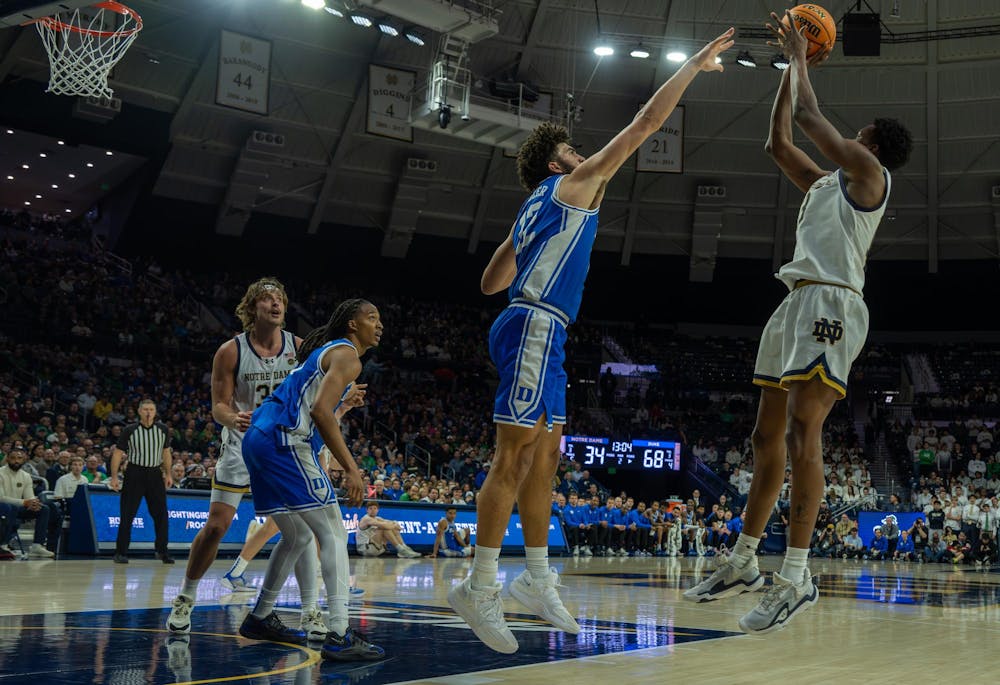
On Tuesday night, top-ranked Duke, a self-identified academic and athletic peer of Notre Dame, came into Purcell Pavilion and absolutely blasted the sputtering Irish. The “sellout” crowd, a first for this season, was lifeless from the tipoff. Once again without its top two players, the team looked disconcerted and disoriented. In what seems to be a trend dating back to the end of the Brey era, students couldn’t be bothered to stay more than 10 minutes. One word can describe the general attitude surrounding Notre Dame men’s basketball: apathy.
The problems for this program are systemic, running much deeper than just the head coach. Although every keyboard warrior on social media has called for Micah Shrewsberry’s job since he charged at an official following an astonishingly awful call that cost Notre Dame a game at Cal in early January, I truly believe the third-year boss has done the best he can with the hand he’s been dealt.
Simply put, men’s basketball has not been made a priority at Notre Dame, a sad reality for a program ESPN listed in its top 20 all time just 15 years ago. It hasn’t always been this way, but in the revenue-sharing venture capitalist era of college athletics, it may be unavoidable.
I understand that basketball at Duke is the number one priority, just as football is at Notre Dame. But success in the two sports isn’t and shouldn’t be mutually exclusive. That is especially true for an athletics department with as deep of pockets and as insatiable a desire to succeed as Notre Dame.
According to data compiled by nil-ncaa.com, Notre Dame paces the Atlantic Coast Conference in athletic department operating expenses at north of $200 million. In December, athletic director Pete Bevacqua boldly stated that Notre Dame would provide the resources necessary for Marcus Freeman’s football program to compete for national championships. In a world where football pays the bills and serves as the University’s most public-facing entity, Bevacqua’s decision is logical and reasonable. But at the same time, it is fair to ask whether the decision to go “all in” on football has left Shrewsberry and his program behind the eight ball in a rapidly evolving college basketball landscape.
As Notre Dame now positions itself at the top of college football spenders, ready to compensate its student-athletes at and beyond the revenue-sharing cap, its resourcing on the hardwood has fallen behind. With Duke spending upward of $10 million on their roster, and other schools such as Kentucky and Louisville reportedly pushing toward $20 million, Shrewsberry shouldn’t be expected to compete on that level unless his program is funded to a similar level.
Despite these financial inequities between the programs both within the University and in the greater context of the ACC, competing in both revenue-generating sports shouldn’t be an impossibility. Schools of differing levels of prowess, from Alabama and Michigan to BYU and Miami (OH), have adapted to the professionalization of intercollegiate athletics and positioned both football and men’s basketball to sustainable success. Even the hated Blue Devils, perhaps Notre Dame’s most indistinguishable resemblance, have thrived with both the pigskin and the roundball.
Let’s look at Duke football as a comparison for Notre Dame men’s basketball. Although the Blue Devils football program has never reached the heights that Digger Phelps led Irish hoops to in the 1970s and ‘80s, Manny Diaz has guided Duke to consecutive nine-win campaigns over his first two seasons. That impressive 18-9 mark is a stark contrast with the 40-54 record posted by Shrewsberry’s Irish.
Instead of demanding for Shrewsberry to be fired, Irish faithful should exhibit the same pragmatic approach demonstrated by Duke head coach Jon Scheyer in his postgame press conference. “Obviously, that’s not Notre Dame’s team. You know they’ve had terrible injuries this year,” Scheyer said.
And it’s true, at full strength, the Irish were 8-3 with three quality wins over Power Five opponents. Despite a limited budget, Shrewsberry seemed to have constructed a competitive roster around star guard Markus Burton. It’s just that without Burton, the glaring holes from an under-resourced roster have been exposed, hurling 2025-26 into “a season from hell,” as Shrewsberry described it following Tuesday’s defeat.
According to reports by ESPN’s Jeff Borzello, Notre Dame will retain Shrewsberry for a fourth season. It’s a wise decision, as slashing the four remaining years on his contract and eating the nearly $15 million he would be owed would set the program back even further. But the decision to retain the coach can’t be the only smart financial decision Notre Dame makes this basketball offseason. It has to demonstrate a level of investment similar to what it ensured Freeman in December 2025 and similar to what its peer institutions have ensured their own basketball coaches.
Losing by 44 on your home floor and sitting idle while chants of “Let’s Go Duke” reverberate across Purcell Pavilion is not only unacceptable; it is embarrassing. Alongside its revered post in football lore, Notre Dame boasts a storied men’s basketball tradition. It’s a tradition at risk of fading away and fermenting into afterthought. It’s time to not only go “all in” on football, but also for the student-athletes of the University’s other 25 varsity programs. If Notre Dame doesn’t start to pay like a champion, its basketball program may never play like a champion again.