
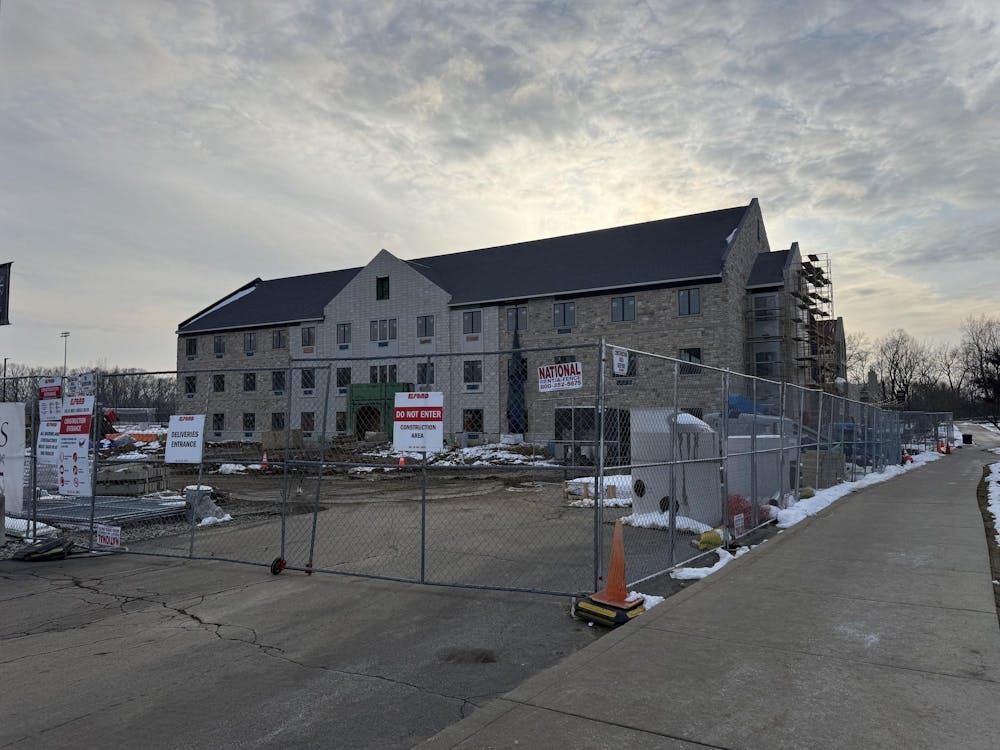
As Holy Cross College prepares to open a new residence hall in fall 2026, administrators have outlined several updates that will reshape campus housing. While plans for the $12 million residence hall were first announced in May 2025, recent decisions clarify how the space will be structured and how other housing will adjust.
The new residence hall will open as an all-male dorm housing students from multiple class years. Pulte Hall, currently a coed residence with women on the second floor and men on the first floor, will transition to become an all-female residence hall.
The college will also reduce its use of off-campus housing at University Edge, reserving approximately 80 beds with preference given to seniors. In addition, six-person apartments in Legacy Hall will convert to four-person units.
Allen Machielson, dean of student engagement, said the decision to designate the new building as all-male reflects enrollment trends and long-standing housing goals.
“We strive to have single-sex residence halls,” Machielson said. “We hear this preference both from families coming in through admissions and from students here. The reason for it being male is that we have 60% males and only 40% females.”
Machielson said enrollment data from the past five years informed the decision and that if projections remain steady, the new residence hall will fill quickly. He described the designation as a “natural” response to current demographics and said the College could consider an all-female residence hall in the future, as well as the possibility of a mixed-use building.
The transition will mark the first time Pulte Hall operates as an all-female dorm. In recent years, the hall has housed students of all genders on separate floors. Before that, it served as an all-male residence.
Katherine Steele, a freshman living in Pulte Hall, said she was “ecstatic” when she heard the news.
“I love Pulte to death,” Steele said. “When I found out, I was excited.”
Steele said she hopes the shift will strengthen community among residents.
“I have hopes that it will cause a stronger community within the girls,” she said. “We’ll have an upstairs and downstairs and it’ll just feel more like a sisterhood.”
Steele acknowledged that some students may initially question why the new residence hall is designated for men.
“I think there will be a few students who are annoyed, like ‘Why don’t the girls get the new dorm?‘” she said. “But realistically, Pulte is a nice dorm, too.”
The College’s reduced reliance on University Edge also reflects a broader goal of increasing on-campus engagement, Machielson said.
“In order to create an engaged community, we really want as many students on our main campus as possible,” he said. “Students who settle in at Edge for the night don’t necessarily want to come back for activities here.”
Machielson added that while off-campus housing can be a positive option for seniors, keeping underclassmen on campus encourages involvement.
“Having more first-years and sophomores and some juniors on campus will start to create that greater community on our direct campus,” he said.
Carlos Vera, a junior living at University Edge, said the change has financial and community implications.
“By bringing more students back on campus, Holy Cross can save funds, and that money can be reinvested into campus and into future projects,” Vera said.
Vera noted that University Edge offers greater independence, including private bedrooms, kitchens and living spaces.
“You can really make that place your own home,” he said.
However, he said living off campus can present logistical challenges.
“If you don’t have a car, it’s definitely difficult,” Vera said. “Last year, I didn’t have a car and I had to walk in the weather, rain or snow. Even relying on the shuttle could be difficult sometimes.”
Machielson acknowledged that some students may find the transition back to campus housing challenging but said he anticipates mostly positive outcomes. Another point of discussion has been the limited number of single rooms in the new residence hall, which will carry a $1,000 upcharge. Machielson said the pricing reflects trends at other institutions and the premium nature of new facilities.
“A brand-new building, a single room being a lot nicer, it’s kind of like a premium, like getting a better seat on an airplane,” he said.
Only a small number of single rooms will be available outside of resident assistant assignments. Students with documented medical needs will not be charged the additional fee. Machielson also addressed past concerns regarding the housing lottery process.
“We’re trying to make it as clear as possible about how we give priorities,” he said. “There have been issues in the past with mistakes, lottery numbers and systems not working the way we want them to. We’re really trying to work through all the bugs ahead of time.”
Despite the changes, administrators and students expressed optimism.
“The thing about college is, it’s not just the education portion, it’s the campus life,” Vera said. “By having more people here, there’s more activity and vibrancy.”
Machielson echoed that sentiment.
“Living on campus is central to fully engaging in our college,” he said. “We’re excited about what these changes mean for our growing community.”


