
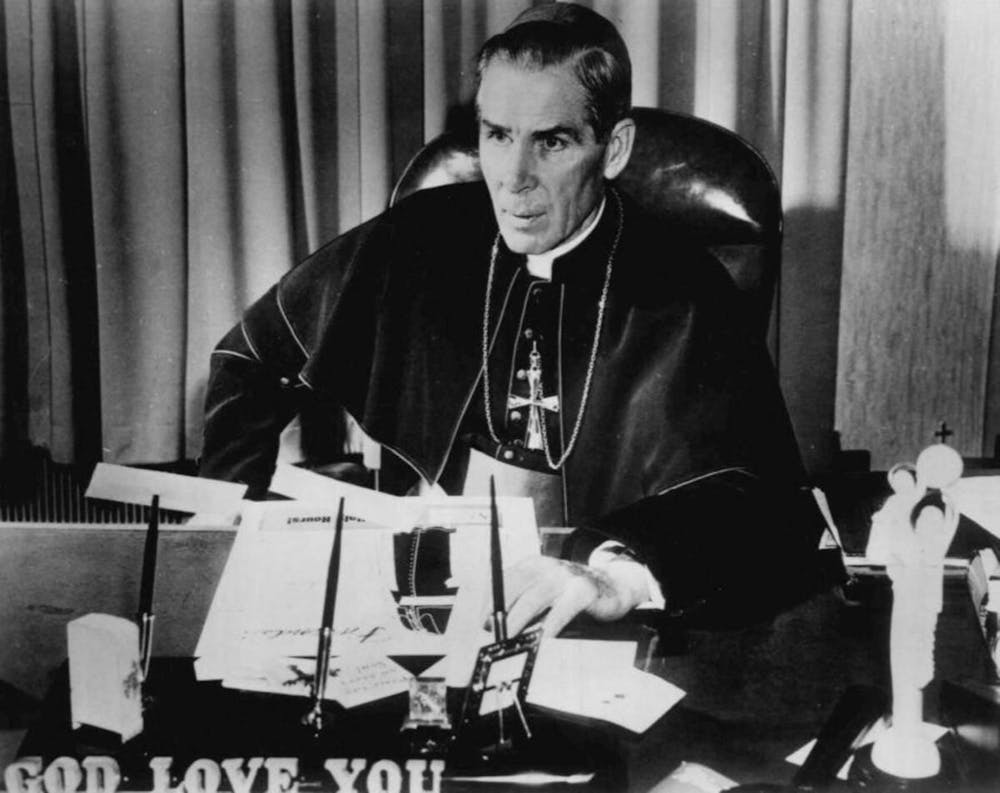
After delays confirming that Archbishop Fulton Sheen was not connected to clerical sexual abuse allegations, Pope Leo XIV has agreed to move forward with his beatification. A date has not yet been set, but it is expected to occur sometime this year.
The Life of Fulton Sheen
Sheen was born in Peoria, Illinois, and later served as Archbishop of Rochester, New York. He was an important religious figure, but also a common name in the media, successfully making the transition from radio to television.
Rev. Brian Ching, director of liturgy in Campus Ministry and rector at the Basilica of the Sacred Heart, shared how widely known his name was and the impact he had in household media.
“He is a great witness to us about the power of the gospel. We do not often see religious figures in the media the same way that Fulton Sheen was present on television and radio,” he said. “Back then, there were only like three TV channels and a number of radio channels, but he was a household name.”
Ann Astell, a theology professor and member of the Secular Institute of the Schoenstatt Sisters of Mary, personally remembers the impact of Fulton Sheen’s programming being a part of her family’s regular routine.
“[My dad] was a Catholic convert. He did not really know that much about Catholicism, but I would come down the stairs and I would find my dad sitting in front of the television after working his night shift, watching Fulton Sheen,” Astell stated. While unsure exactly which program it was that he watched, she suspects it was “The Fulton Sheen Program," which ran from 1961 to 1968.
Kathleen Sprows Cummings, professor of history and American studies, discussed the significance of having someone like Sheen representing Catholicism during an unaccepting time period.
“At a time when there was some pretty significant anti-Catholicism, it was pretty remarkable to have a bishop be a primetime star on national television,” she mentioned.
Astell added that some people credit Sheen with helping President John Kennedy be elected because of the attractive presentation of Catholicism.
Outside of his evangelization media work, Sheen rallied his following in support of Catholic causes.
“He led the campaign when they were doing a lot of the fundraising to build the national shrine of the Basilica, the Immaculate Conception, in Washington, D.C., which is the Catholic church for the church in America,” Astell said.
Canonization Process Overview
The process of canonization has four stages to reach sainthood: servant of God, venerable, blessed and saint.
The process begins no earlier than five years after the death of an individual, outside of specific extenuating circumstances such as martyrs and those who lived extraordinarily holy lives, including Pope John Paul II and Mother Teresa. The diocese, usually where the person lived, begins an investigation into the candidate’s life. At this time, the candidate’s title is “servant of God.”
Fr. Stephen Koeth, assistant professor in the Department of History, explained that this five-year waiting period is to see if they still have a large earthly following even after some time from their death.
If, in this investigation of the servant of God’s writings, teachings, actions and other documentation available, it is deemed that they lived a life of “heroic virtue,” then they receive the title of "venerable.”
Ching explained that once a person is venerable, the church is looking for cases of miraculous healing after death attributed to this candidate’s intercession. The process of certifying a miracle is not only through a story but through a much larger process involving medical professionals and theologians to ensure that there is no other possible medical cause for this revival.
If the church certifies that a miracle occurs and can be attributed to the intercession of a venerated person, then the church can pronounce that person beatified. At this time, the candidate's title becomes “blessed.”
Ching noted that once they receive the title of blessed, the candidate can have a feast day and “a larger cult or life of devotion in the church.”
Finally, if another miracle occurs attributed to the blessed’s intercession, it goes to the Dicastery for the Causes of Saints.
“It is a group of cardinals and bishops, with some lay people and theologian consulters who basically read the case file and then vote as to whether it should be sent to the Holy Father or not for his approval,” he explained. “If he approves, that is when the determination is set to schedule their canonization and make them a saint.”
Cummings shared how the process looks like following the beatification.
“An important part of the process is that the second miracle has to have occurred after the beatification takes place, because it is a sign that God wants the saint to be canonized,” Cummings said.
Koeth explained that canonization is a confirmation that the individual is now in Heaven based on a miracle that occurred following the person’s death.
“Ultimately, canonization is a declaration that the church believes with absolutely no doubt, with utter certainty, that the person, who is a saint, is in Heaven,” Koeth said. “How do we know that? Well, we know that, in the church’s thinking, by a miracle happening at the request through the intercession of the saint whom we are talking about.”
Sheen’s Intercessory Miracle
Astell explained that in 2010, Bonnie and Travis Engstrom, a couple living in Peoria, Illinois, were expecting a baby boy. They planned to name him James Fulton Engstrom.
At full term, he was born at home as a stillborn. They rushed him to the hospital, but medical professionals were unable to revive him. 61 minutes after the birth, his heart started to beat just as they were about to certify death.
Miraculously, he sustained no significant organ damage despite being oxygen-deprived for over an hour.
“His mom says you know, Fulton Sheen was famous for doing every day, a holy hour — an hour of prayer before the Blessed Sacrament. In fact, when he died, he was found dead on the floor of his private chapel, praying in front of the Blessed Sacrament. He passed away while he was having his holy hour. She said, ‘And at the 61st minute, my son finally breathed, finally had a heartbeat. We had been praying for Fulton Sheen’s intercession, and his holy hour was finished,’” Koeth said.
This miracle was officially certified by Pope Francis on July 6, 2019.
Beatification Delays
One of the first delays was a fight over the remains of Sheen.
Koeth outlined the issue by explaining that he died in New York “and his will states that he wants to be buried in the archdiocesan cemetery at Calvary.”
However, the Archbishop of New York at the time wanted to put him in the crypt of the high altar at St. Patrick’s Cathedral, and the niece agreed to this plan. When the process of canonization opened in Peoria, Ill., Bishop Daniel Jenky suspended the canonization process, awaiting the return of the remains to Peoria. A legal fight ensued, and eventually it was determined that the body could be returned to Peoria so that the canonization process could continue.
Later, once these issues were resolved and his miracle was confirmed, he had a date set for beatification on Dec. 21, 2019. However, on Dec. 3 of that year, the beatification was canceled. Koeth said that Bishop Salvatore Matano had raised concerns that New York state was in the middle of an attorney general investigation regarding Catholic Church clergy sexual abuse.
“There had been accusations against priests in Rochester. There had been no accusations of any kind of sexual misconduct against Sheen, but for three years he had been the bishop of Rochester,” Koeth said. Questions emerged about what he knew and if he had mishandled anything, not accusations that he had engaged in abuse himself.
Cummings said that this investigation into New York was one of many at the time, following an investigation into six dioceses in Pennsylvania, which uncovered some findings.
”I actually made a prediction at the time that he would never be beatified because the risk of a revelation was too high … I did not think the Vatican was going to proceed with a cause that has a possibility of scandal attached to it, particularly in this climate where the Catholic Church and others are very aware of sexual abuse.” She admits that she was wrong, noting that she probably did not account for how much Sheen’s supporters would rally for his cause.
According to Koeth, the conclusion of the report confirmed Sheen to be without fault. The only relevant finding to Sheen was that Gerard Guli, a now-former priest who had been accused of sexually abusing an adult woman, had asked Fulton Sheen to be reassigned as a priest. However, Sheen never reassigned him, and only the bishop who replaced him, Joseph Hogan, reassigned Guli.
He explained that the church handles issues of clerical sexual abuse by guidelines outlined in the Dallas Charter, which involves immediately reporting to local public authorities, administrative leave for the involved individual and canonical investigations.
The Diocese of Rochester filed for bankruptcy to support the victims and had only completed its bankruptcy proceedings last year. Koeth hypothesizes that this exit from bankruptcy proceedings was the final sign that the Vatican needed to move forward with Sheen’s beatification.


