2026 has already been a breakneck year for generative artificial intelligence. Anthropic has been on a hot streak, releasing powerful new Claude models and software integrations that have moved the automation of white-collar labor ahead of schedule; OpenAI has refined and relaunched Codex, which enables any layman to code and build anything to their heart’s desire using autonomous agents; and last week, Google released Gemini 3 Deep Think, which lapped all the existing models on most academic benchmarks.
I think many people don’t realize how much these models have improved recently. They’re not just highly knowledgeable and articulate chatbots you use in a web browser, but fully-integrated workflows. This rapid rate of advancement is likely because we’ve reached a point where these models are so good that they can now improve themselves – things will only get crazier from here. But amid these incredibly impressive improvements, there has been one new generative AI development that has completely blown my mind: Seedance 2.0.
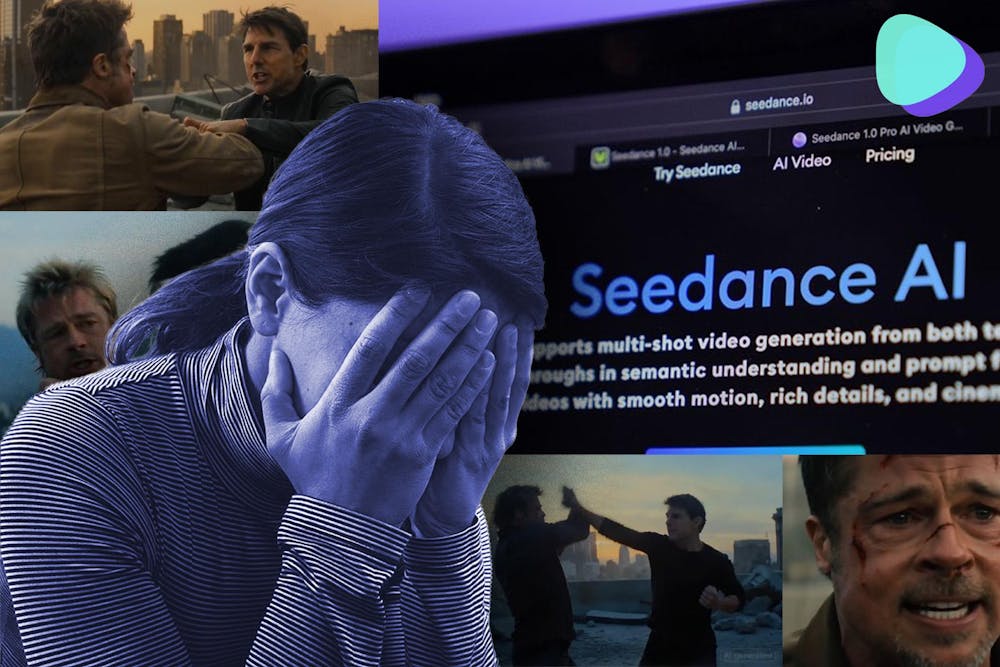
Seedance 2.0 is a generative AI video model developed by ByteDance, the owner of TikTok, and I couldn’t believe my eyes when I first started seeing videos from the model on my Twitter feed last week. It’s really good. Like really good. Like really, really good. It’s not just that the graphical and audio fidelity are exceptional; the model also has a sense of style. It knows how to frame a shot, edit with rhythm and craft a decent mise-en-scène. In other words, it has the instincts of a competent filmmaker, and that’s what makes it truly terrifying. Please don’t dismiss this as hyperbole or fearmongering; many in Hollywood are thinking the same thing I am.
The Motion Picture Association released an incredibly defensive and startling statement condemning the model, and Rhett Reese, writer of the “Deadpool” films, commented on one of the videos, saying, “I hate to say it. It’s likely over for us. In next to no time, one person is going to be able to sit at a computer and create a movie indistinguishable from what Hollywood now releases.” I think Reese is right on the money. While institutional inertia and lawfare will slow this down a little, the dam will eventually break. It’s over for Hollywood.
You can put your head in the sand and dismiss Seedance 2.0 all you want; it won’t change the fact that it and similar video models will change everything about film and television. I saw this same song and dance when ChatGPT was first released in 2023: “The prose is so stiff; it hallucinates all the time; all the hands have six fingers!” But the models only got better from there, and their seams only became more imperceptible. And now, we are confronted with a video model that can convincingly generate videos that look like $200 million Hollywood productions with only a two-sentence prompt. That is why it’s over. These models can mimic an entire production apparatus that requires thousands of people and tens of thousands of man-hours, and they will only get better from here. The only limit to what they can make is your prompting skills.
So what now? It’s over for Hollywood as we know it, but where do we go from here? What does film and television look like in this new paradigm? I see two likely possibilities, the first very dystopic and the other neutral. The first possibility is the “Infinite Jest” scenario, which I’ve named after David Foster Wallace’s exceptionally prescient and brilliant novel (seriously, the guy accurately predicted the next 30 years of American culture back in 1993). In the novel, Wallace envisioned a future addicted to entertainment born from a profound lack of purpose; America becomes so alienated from meaningful existence that people need constant stimulation to escape the discomfort of their own consciousness – sound familiar? I’m looking at you, Instagram Reels. Anyway, the culmination of this phenomenon in the book is a controversial film called “The Entertainment.” It is so utterly captivating that the viewer cannot pull themselves away, resulting in them watching the film over and over until they die of dehydration. I believe generative AI video models like Seedance 2.0 will become “The Entertainment” that Wallace predicted.
With Seedance 2.0, a person can have an instant, endless stream of content hyper-personalized to their desires. #Conformitygate truthers can have their secret “Stranger Things” finale that proves all their theories correct; right-wing cultural warriors can make their own version of “The Odyssey” where Lupita Nyong'o is replaced with Sydney Sweeney for “historical accuracy;” and “The Pitt” fans can generate episodes where all their ludicrous romantic pairings actually come true. Who could ever pull themselves away from such a delectable stream of content perfectly tailored to all their wishes, fetishes and politics?
It’s the natural conclusion of many separate social phenomena: Art reduced from an expression of the human soul to commoditized entertainment; The rise of fandom that transfers ownership from authors to fans; The infantilization of the average consumer to crave regurgitations of established IP; And algorithms that have destroyed monoculture and encouraged atomized silos. If you think Instagram Reels and TikTok are debased, get ready for this new world where people are hooked on the addictive and soothing output of AI models that can cater to whatever they desire. Art will no longer challenge you or give you something unexpected; it’ll only give you what you want.
The other possibility is the “Indie Renaissance” scenario, and it’s a little more hopeful. Seedance 2.0 and generative AI video models that follow it will allow anyone with a computer to produce any kind of movie they want; just think about that for a second. There’s no need for extensive fundraising, location management, photography expenditures, visual effects wizardry or really any kind of labor. It’s just you and that video model. This crazy democratization of the filmmaking process could lead to a surge in indie filmmakers releasing all kinds of ambitious, exciting features. If there are indie filmmakers out there with a genuinely terrific script and vision, and they spend the time meticulously prompting a video model, they could theoretically make a great film, the likes of which they never could have made otherwise under the traditional filmmaking apparatus.
Legendary filmmaker Paul Schrader anticipates that we’ll see these AI indie breakthroughs very soon, saying, “One year from now photorealistic AI dramas will be running through film school bodies like diuretics.” While this could lead to an indie wave comparable to the 90s and give us the next Quentin Tarantino or Kevin Smith, it would also introduce many complications. Would these AI films truly be accepted by the filmmaking community, even if they were produced from a human-written script under the prompt supervision of a genuine auteur? How much human contribution does art need to be valid? What would happen to actors and all the below-the-line workers who rely on the traditional filmmaking apparatus and would lose not only their jobs, but their vocations? Would these ambitious AI indie films be drowned out by the slop in the aforementioned scenario? At what point does AI stop being a tool and also become the hand using the tool? I don’t really know the answers to these questions, but a world where anyone can make a film isn’t absolutely disastrous, even if there are a lot of difficult issues that would need to be addressed.
Seedance 2.0 is a sneak peek of a future where the very identity and purpose of art will be turned upside down. We all must begin fortifying our minds for a world that will make very little sense. So the question isn’t, “Will everything change?” The question is: “Are you ready for it?”