
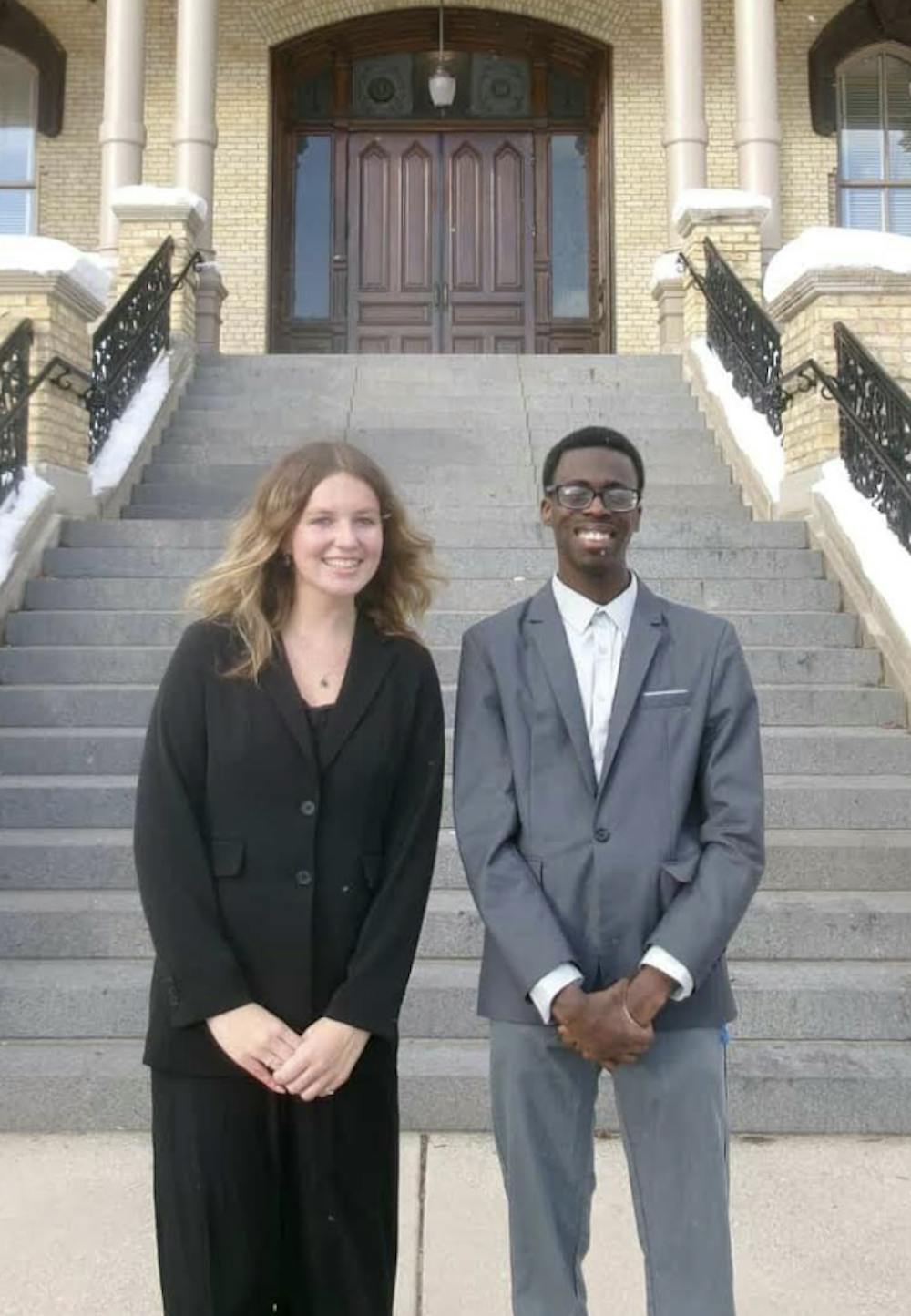
Elijah Jones, Judicial Council president, and Riley Evers, a student senator, are running for student body president and vice president respectively on Wednesday, Feb. 4. Last week, The Observer interviewed both candidates on their views and goals for their positions.
Jones is a computer science major and a junior living in Alumni Hall. He has been recused from his duties as Judicial Council president so he can run for student body president. His running mate and vice presidential candidate, Evers, a sophomore living in Pasquerilla West Hall, is a program of liberal studies (PLS) and classics major. She also serves as her dorm’s representative in the student senate.
While the two were unable to interview together due to scheduling issues, both sat down with The Observer to discuss their run. Jones began by explaining that he had launched his campaign with the hope of making the most of his senior year at Notre Dame.
“I know some people, when they first come in, they’re like, ‘Yes, I want to run for student body president!’” Jones said. “Mine was more that my friends encouraged me to run, and said that they thought that I was the most qualified to be able to help as many Notre Dame students as possible in a one-year term.”
In her interview, Evers said Jones’s decision to select her as his running mate came as a surprise, but she described it as an exciting honor, feeling that their unique backgrounds made for an especially strong ticket.
“We have similar goals and policy ideas, but we’re different people … so that makes our partnership important,” she said. “We live on opposite sides of campus, major in pretty opposite fields and are involved in different organizations. It’s a chance for us to represent the overarching best interests of the campus.”
Jones emphasized that while he and Evers did not advocate for any structural changes to student government and its various departments, they planned to break from prior administrations by taking a “policy-driven” approach if elected.
“One of the things that I am actually running on is the fact that a lot of people feel like student government doesn't do anything,” Jones said. “I'm going to agree with that sentiment, having been inside student government. So the way to change that, I guess, is to actually start passing policy.”
The Jones-Evers campaign released an extensive policy platform document, available on their Instagram bio. While much of the document reaffirms existing policies, it also includes new policy proposals, such as working with campus dining to improve the cleanliness of dining hall utensils and making it easier for students to run for positions like student body president.
“We want to lower [the petition requirements] to 500 because we are of the opinion that it is way too hard to run for student body president. Last year … there was only one ticket that could even get on the ballot,” Jones said. “We believe that 500 is a fair enough number to show that you care enough to get those signatures, but it's also not impossible.”
Another component of the Jones-Evers policy platform is club promotion. Jones expressed disagreement with the Student Activities Office's approach to clubs, considering it too strict. The pair hope to change this by lowering club signature requirements and by redirecting a larger share of student government allocations toward club funding.
“We want clubs and organizations to be more accessible to all students. Finances shouldn’t be a barrier against students exploring their interests and passions,” Evers said. “We want to promote these clubs as best we can – after all, there are around 500 student clubs. That’s something to be proud of and celebrated.”
When asked how he would get the Notre Dame administration and student senate on board with his policies, Jones said that he planned to leverage his “working relationship” with figures within the University departments. As for the senate, Evers hoped their administration could leverage the vice president’s agenda-setting powers and maintain a healthy relationship with the body’s representatives.
“I’ve been Pasquerilla West’s senator since last April, so I’m very familiar with the senate and its operations,” Evers said. “I think the most important thing I’ve realized is that encouraging senators to voice their opinions and do so excitedly and firmly is the best way to get results for everyone … I’d be more than happy to work with senators who have different views and ideas – then we’d get the chance to compromise and represent the student body as best we can.”
When it came to promoting faith on campus, Jones felt it was essential to highlight Notre Dame’s Catholic identity, citing his role leading prayer in the senate. He also acknowledged, however, the importance of representing Notre Dame’s non-Catholic community.
“Our official stance is that we are going to uphold the Catholic mission of the university … so I want to encourage people to express their Christian faith,” Jones said. “But we also want to welcome people of different faith backgrounds … meaning that even if you're not Catholic, you still have a voice in this administration.”
Overall, Jones framed their campaign as one that could appeal to all Notre Dame students.
“We're the ticket that is going to fight to make sure that every student's voice is heard,” Jones said. “I would say we have the policy platform that would help the most Notre Dame students … and so if you read over it again, you'll find that there's something for you in there too.”


