
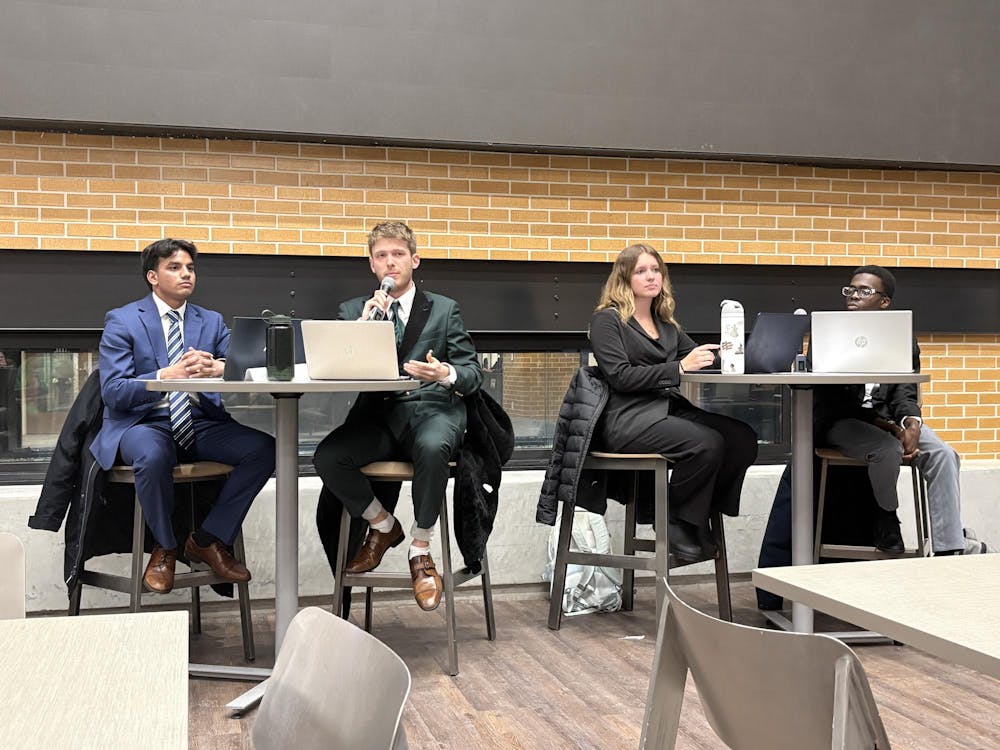
With elections for student body president looming, the two tickets battled it out in a Feb. 1 debate held in Midfield Commons in Duncan Student Center.
The debate was moderated by Madeline Hutson, Judicial Council vice president of elections, and Sam Robinson, Student Union parliamentarian. The debate lasted roughly an hour, consisting of four-minute opening statements followed by a series of student-submitted questions. Each side had two minutes to answer per question. Due to the number of submissions, not all submitted questions could be addressed, but students were encouraged to email the tickets with further questions. The debate concluded with four-minute closing remarks.
The Jones-Evers campaign spoke first. They outlined key goals of their campaign, ranging from clean plates in the dining hall to expanded grab-and-go services. Elijah Jones, head of the Jones-Evers ticket, proposed using the senate and campus life council as a means to spark other changes, calling on the University to “hire more counselors, [get] more funding for clubs, reduce club dues and make it easier to get excused absences.”
When the Campus Life Council passes resolutions, they go directly to Fr. Jerry Oliger’s desk, and he has two weeks to respond. Jones conceded that in the two years he has been on the council, they have never passed a resolution, but he believes that this can change with his leadership.
Under their campaign, students can expect weekly emails to be restructured to include surveys about issues with different campus organizations, promote events of underfunded clubs and include a Bible verse.
According to Jones-Evers vice presidential candidate Riley Evers, the Jones-Evers campaign also “[wants] to reintegrate the Diversity Council, Knights of Columbus and PrismND into the senate,” according to Evers, noting that these groups are in the constitution but not presently represented.
The McCart-Parikh campaign’s opening statement focused on community more than policy, describing the debate as a discussion between their ticket and students. Parikh emphasized a student-oriented focus, claiming to have contradicted the narrative of student government inefficiency — highlighting their experience in “getting things done.”
“We have been able to vet our seven new initiatives within our two pillars, quality and accessibility, which are the foundation of our policy,” Parikh said.
As questions began, the McCart-Parikh campaign began to explain its specific policy objectives. Their first key goal is to raise the University’s standard showerhead to a balanced pressure, hosting dorm focus groups to test different showerheads in pursuit of this aim.
Parikh also outlined their plans to provide “free off-campus transportation for our students by expanding Transpo,” and implement free buses running directly to the South Bend International Airport during student breaks. They also expressed plans to support a Notre Dame thrift store that would enable students to sell used clothing to one another through an online platform.
McCart responded that he did not know about the Campus Life Council, but he was willing to learn about it.
“I am willing to engage whatever resources possible that I can talk to every single person that I can, to understand every single experience of our students at this University," McCart said.
The McCart-Parikh campaign elaborated on their campaign pillar of accessibility with a particular focus on increasing transparency through office hours. They plan to host these three times per month in addition to monthly town halls, where students can air their grievances. Jones said his administration plans to listen to students through surveys sent out in the weekly email.
"On day one, the first survey will go out. 'Notre Dame students, give me all your concerns with residential life.' Then we will call the Campus Life Council, we will pass a resolution and deal with residential life," Jones said.
Regarding managing finances, the McCart-Parikh campaign believes that the current allotment of funds is workable, aiming to maintain the status quo. The Jones-Evers campaign highlighted the nearly $1 million deficit between funds requested and funds received, believing that their executive cabinet could request less money so that clubs can have more.
Both sides expressed a commitment to support the LGBTQ+ student body, McCart supporting the continuation of LGBTQ+ student mixers and Jones offering to invite PrismND to come speak to Campus Life Council. A commitment to strengthening Notre Dame’s Catholic culture also remained a centerpiece of both tickets, as well as a commitment to support for students of differing faiths.
Both campaigns drew on experience as qualifiers for the student body presidency. Jones has served as president of the judicial council, while Evers serves as a senator for Pasquerilla West Hall. McCart has worked in the executive cabinet for three years, and Parikh is currently a member of the Department of Communications. Parikh added that in the past, he had served as a proxy for Dillon Hall senator Richard Kamau, adding to his qualifications to run the body’s operations as vice president.
In response to specific individuals, Evers announced that she will decline her study abroad program next year if she is elected, and Parikh emphasized that, first and foremost, he and McCart are friends and do not only care about Dillon Hall's intentions.
Students will be able to vote for their preferred candidate between 8 a.m. and 8 p.m on Feb. 4, 2026. The judicial council will send an email with details at 8 a.m. on Wednesday, directing students to vote on NDcentral using their Notre Dame credentials.


