
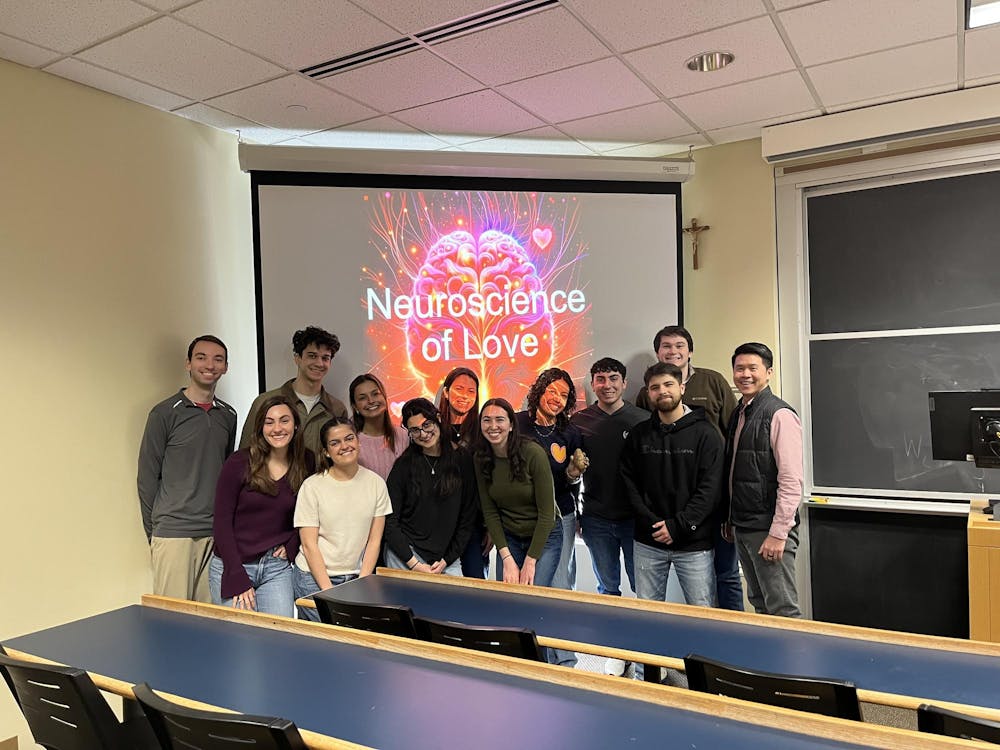
Every February, conversations about love tend to drift toward flowers, chocolates and the familiar chaos of “cuffing season.” But in Notre Dame’s neuroscience department, love is being examined through a very different lens, one grounded in brain circuits, hormones and decades of behavioral research. This spring, postdoctoral research associate Shang Lee is teaching The Neuroscience of Love, a one‑credit directed readings course that asks students to look past the clichés and into the biology that shapes human attachment.
Lee describes the class as an exploration of the psychology and neurobiology of love, where students learn about brain regions, pathways and hormones involved in social bonding. The course relies heavily on primary literature and group discussion, pushing students to think critically about scientific claims and the way love is portrayed in the media.
“Students collaborate with their peers and really learn to understand the results, limitations and methodology of these research papers,” Cecilia Pino, a junior neuroscience and behavior major, said.
The idea for the course traces back to Lee’s postdoctoral research at Emory University, where he worked with socially monogamous prairie voles. Unlike mice and rats, prairie voles consistently choose their long‑term partners over unfamiliar strangers, a behavior that fascinated Lee and shaped his interest in the biology of attachment. Oxytocin, he explains, plays a major role in this process, but not in the way pop culture suggests. Calling it the “love hormone,” he said, is misleading.
“Injecting oxytocin doesn’t make people fall in love, and perfumes labeled as ‘love potions’ don’t work the way people think. Oxytocin really enhances social salience: It makes social cues more meaningful,” he said.
Before coming to Notre Dame, Lee taught a version of this course in Atlanta to students from Spelman College and Morehouse College. The enthusiasm he saw there motivated him to bring the class to Notre Dame.
One topic that always sparks discussion is whether “cuffing season” is a real phenomenon. According to Lee, data from dating apps and social media show noticeable spikes in dating activity in early winter, especially during the first weekend after New Year’s. Students analyze these trends to understand how environment, culture and biology interact to shape romantic behavior.
The class also looks toward the future of love, examining how AI companions, chatbots and social robots might reshape intimacy. Research already shows that humans can release oxytocin when interacting with robots, raising questions about how technology might influence bonding, companionship and even the definition of partnership.
For many students, the class offers an opportunity to connect neuroscience with everyday life. Brody Rolston, a senior neuroscience major, said he finds the course “fascinating,” especially in how it explains why we find certain people attractive. “Everything from the smell of someone’s t‑shirt to where they are in their menstrual cycle can influence attraction,” he said. “Things we assume are random actually have scientific explanations.”
Amelia Parisi, also a senior neuroscience major, says she appreciates the class for its focus on interpersonal connection and wishes it were more than one credit. She points to topics like hormonal contraceptives, which can influence bonding and mate selection. “It’s definitely worth taking this class, especially at a school that emphasizes pre‑med and research,” she said. “It helps you understand the science behind these experiences, but also how they show up in real life.”


