
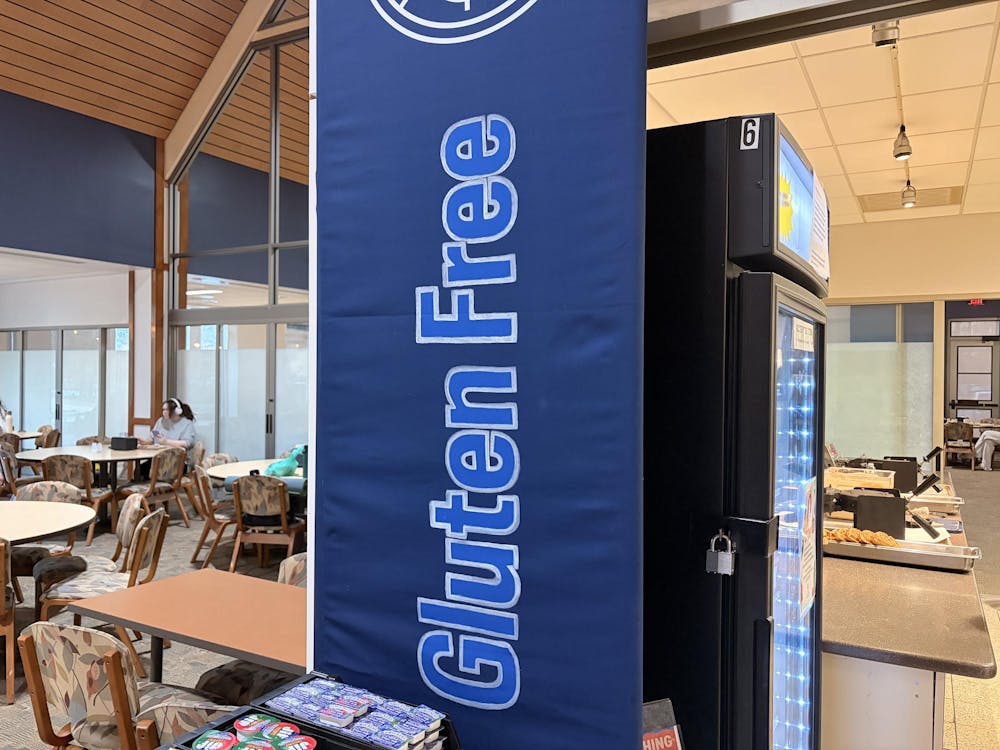
The Noble Family Dining Hall at Saint Mary’s College serves breakfast, lunch and dinner to much of the campus community. For students with food allergies or dietary restrictions, navigating the dining hall can require additional planning.
Chef Charu Pant oversees the dining hall and works to provide allergy-safe accommodations by adapting daily menus to avoid the nine most common U.S. food allergens: milk, eggs, fish, shellfish, tree nuts, peanuts, wheat, soybeans and sesame.
“We go the extra mile ... to go as far as we can accommodate them by giving them special meals ... If there’s any kind of allergens in it, we’ll try to take them off. We always go with the nine allergens,” Pant said.
Still, students with celiac disease say eating in a shared dining space presents challenges. Senior Lily Wilder said even a crumb of gluten triggers her immune system. While the gluten-free fridge increases access, she said it does not eliminate the difficulty.
“There are some days where I have to just, ‘salad-it’ kind of thing,” she said.
Student Clara Venia, who also has celiac disease, said cross-contamination, when gluten-free food comes into contact with gluten, is her primary concern.
“[Cross-contamination is] normally kind of, like, how I get sick at the dining hall,” Venia said. “Let's say there's something like some sausages in the morning, and they put it right next to the gravy. Why can't I eat the sausages? Because the chance that the gravy has gotten into them is very, very high.”
Wilder also said labeling inconsistencies can create confusion.
“The soy sauce, for example,” she said. “They will say it’s gluten free [at the stir-fry station] and the other soy sauce [packet] isn’t. I just feel like it’s a general miscommunication on what is and isn’t.”
Ava Hess, a junior, is gluten, dairy, egg and red meat-free and also has pollen-food allergy syndrome. She said her dining experience varies depending on the menu.
“Some nights are great,” Hess said. “But then you have nights where everyone’s excited about pho night, and it’s made with red meat broth that I can’t have. It’s not like I’m starving. It’s just tough when your option is the same option for every meal.”
Pant and the Notre Dame Dining team have taken steps to promote safe food systems for students. Online menus at all dining halls in the tri-campus community can be filtered to eliminate items with certain allergens and food options for each day can be viewed for students to make a plan.
Dining staff members said they undergo food safety training to help manage allergies. Staff member Tommy Netabong said employees complete ServSafe certification and periodic refresher courses.
“We take a ServSafe test and classes every five to six years,” Netabong said.
Crystal Scheilbelhut, another staff member, said the dining hall uses separate pans and utensils for gluten-free preparation and changes gloves between orders. She said she tries to build relationships with students who have allergies.
“I try to get to know the ones that have an allergy,” Scheilbelhut said.
All students are required to have a meal plan while on campus. Students must notify dining staff in order to accommodate their needs and find a solution to dietary restrictions.
“We have good staff, good cooks and everybody in here and we can come up with something all the time,” Pant said. “We can accommodate anything and everything. I tried to make things that would not have flour in it. If we have to do sauces, we will do corn starch or things that would not have any kind of wheat or any allergen of that sort.”
Students said the efforts are noticeable. Hess said separate cooking stations and utensil protocols provide some reassurance.
“I think Saint Mary’s really tries. We do have separate stations where we can, like, have our own pans for stir-fry, we have our own separate pans, separate utensils. They do glove changes and they won’t touch anyone else’s food while they're making our food,” she said.
Venia said consistently stocked items in the gluten-free fridge including pasta, bread and desserts make a difference.
“It’s something very small,” Venia said, “but it makes a lot of difference at the end of the day.”


