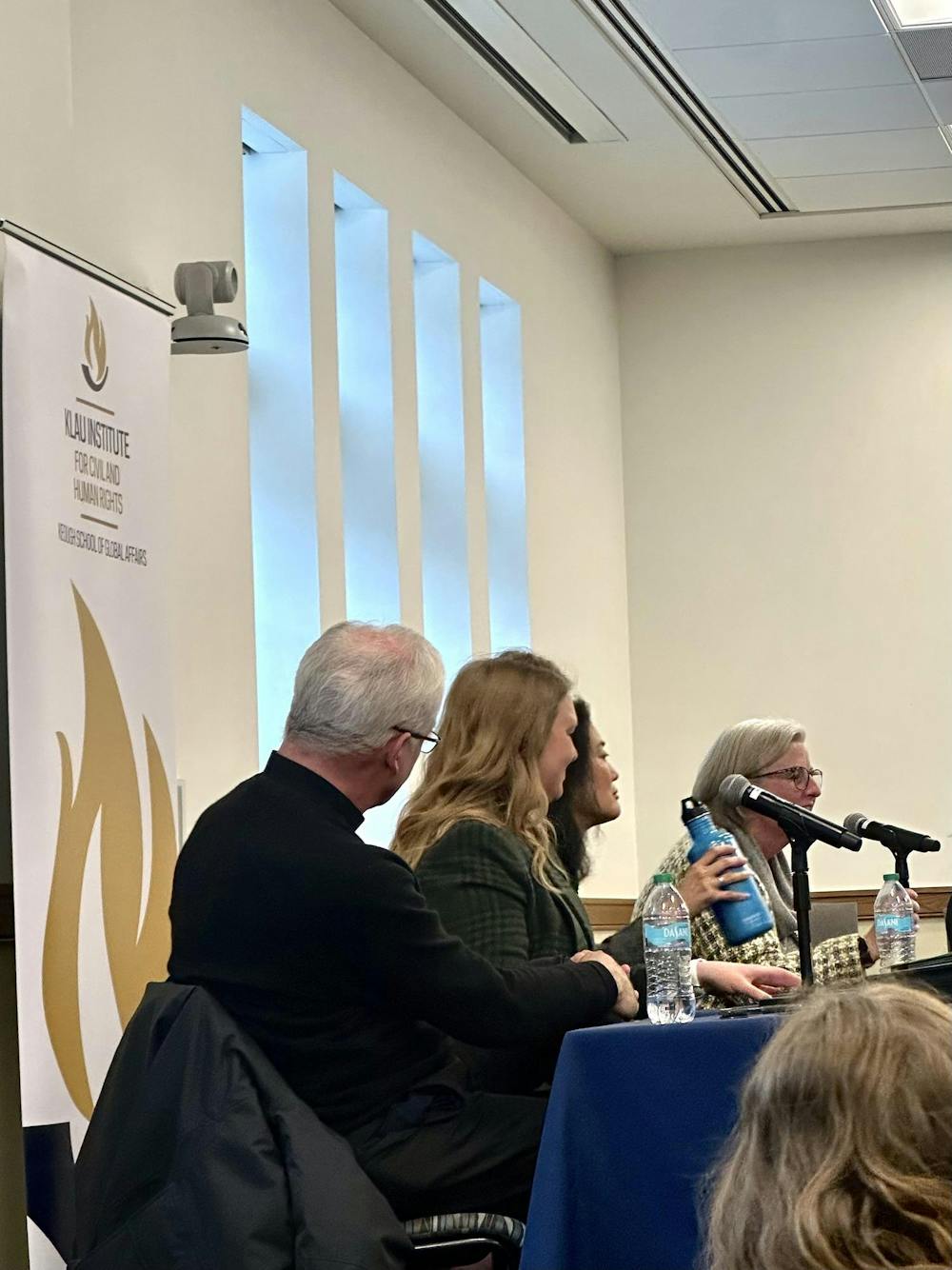
A panel of Notre Dame professors spoke on the current U.S. immigration crackdown on Monday afternoon in Jenkins Nanovic Hall, hosted by the Klau Institute for Civil and Human Rights’ Migration Research Initiative. The panelists discussed the theological, moral and legal implications of migration, situating current U.S. immigration policy within its historical and political context.
Father Dan Groody, a professor of theology and global affairs and the vice president and Associate Provost for Undergraduate Education, opened the panel, urging communities of faith to “think about our unity and our connection to one another against this very contentious and dehumanizing debate around migration.”
Father Groody explained how nations have the right to control their borders, but there are larger considerations about the goods of the earth belonging to the whole of creation.
“Migration is not the problem. Migration is actually a symptom of deeper imbalances,” he said.
Ashley Sanchez, an Associate Clinical Professor of Law and the Director of the Notre Dame Law School Immigration Clinic, focused on explaining the legal processes of immigration. She described how removal proceedings are the official administrative process within the Department of Justice that is used to deport people from the country. Usually, people who entered this process were apprehended at the border, stopped at a traffic stop or had a criminal violation. They can live their normal lives and attend court hearings when needed, or they can be placed in immigration detention for the entire removal proceeding, regardless of how long it takes.
Currently, there is a $3.4 million backlog of cases, meaning it can take up to a decade for an individual to have their day in court. Sanchez discussed an alternative, faster process: expedited removal. This policy applies to people apprehended in a border zone, which includes areas within 100 miles of the U.S. border. Under this policy, people can be removed from the country within 24 hours without a trial.
“No one has ever pretended that these are fair, while there is some type of due process, the judges and the prosecuting attorneys are both ultimately accountable to the President of the United States,” said Sanchez. “So the thumb is always on the scale against the person who is in the middle of these proceedings.”
Currently, Sanchez described how the Trump administration has deported anywhere between 500,000 and 600,000 people since taking office. There are around 11 to 14 million people in the U.S. with an unknown immigration status, and the Trump administration’s goal is to deport one million people per year.
“So obviously, they’re falling pretty short,” she said. “Actually, the number of people that have been deported over the past year is lower than the numbers under the Biden administration, but it feels so much worse, and there’s a reason for that.”
According to Sanchez, the vast majority of removals under the Biden administration occurred at the border, meaning people were apprehended and deported under the expedited removal policy; however, today, there are fewer people coming to the U.S. border.
“In order to hit that annual quota, they have to turn to the interior of the country because there’s nobody at the border,” Sanchez said.
The Biden administration also used prosecutorial discretion to prioritize three specific groups of people in their deportation agenda: people with significant criminal histories, threats to national security and recent arrivals into the U.S. If one fell outside of these three categories, one was not immune from deportation but also not the focus of the efforts.
Alternatively, under the Trump administration, they have rescinded prosecutorial discretion, meaning everyone is a priority under the administration’s deportation agenda. Additionally, the Trump administration has revoked certain classifications, such as Temporary Protected Status (TPS) and humanitarian parole, and has expanded its authority to place people in the expedited removal process without court hearings or due process.
Sanchez explained how the administration has also removed memos about safe zones, which typically include hospitals, schools and courtrooms. Rescinding safe zones has led to people being detained by Immigration and Customs Enforcement (ICE) when attending green card interviews or asylum trials.
“It’s almost impossible to follow the rules these days,” Sanchez said. “All of these different policies have led to mass chaos in the country, and a lot of people have decided it’s not worth sticking around and potentially being thrown in detention.”
Amy Hsin, a professor of migration at the Keough School of Global Affairs, discussed undocumented children as a common ground across the political spectrum. She explained how there has typically been bipartisan support for the fact that children who grew up in the U.S. should not be punished for a decision they did not make.
“The logic was simple: if young people were brought to this country as children, attended U.S. schools, avoided serious trouble and built their lives here, they should have the opportunity to become citizens,” Hsin said.
Hsin explained how this consensus led to the creation of the Dream Act: a bill that would have allowed people who entered the country as children, graduated from high school and had aspirations to attend college to apply for legal permanent residency and become citizens.
“They wouldn’t skip the lines, [but] at least there would be a place for them to stand in the line to wait to become citizens,” she said.
According to Hsin, this bill was the closest the country has come to enacting immigration reform that would have provided these people pathways to citizenship. After the Dream Act did not pass, undocumented youth activism emerged to push the Obama administration to come up with a solution. This led to the creation of the Deferred Action for Childhood Arrivals (DACA) policy, which offers work authorization to undocumented youth. While it did not offer pathways to citizenship, the opportunity of work authorization allowed young people to plan for their futures. Current DACA recipients can continue renewing their work authorization every two years, but the program no longer accepts new applications, and many do not renew out of fear of disclosing information about their undocumented immigration status.
Jennifer Mason McAward, the Director of the Klau Institute for Civil and Human Rights and an Associate Professor of Law at the Notre Dame Law School, offered insight into the events taking place in Minneapolis. Recalling the killings of Renee Good and Alex Pretti, she stated how “the story will say something like, the shooting of Alex Pretti, an American citizen. ICE officers cannot kill or abuse anyone regardless of their citizenship or immigration status.”
For McAward, ICE’s excessive force has violated the dignity inherent in every person and the U.S. Constitution:
“There are other constitutional situations where there are differences between citizens and non-citizens, like due process, but excessive force is not one of those issues,” she said. “A police officer may not shoot an unarmed, non-dangerous suspect by shooting him dead, even if the suspect has committed a crime that we’re concerned about.”
She added that balance was needed, and while law enforcement should be able to do their job, they should not be allowed to violate citizens’ constitutional rights. Hsin concluded the talk, highlighting the need to find such a balance.
“It’s important to remember that this is not how things have always been, and it’s not how things need to be. Policies are choices that people make; they reflect values that can be shifted, coalitions can be rebuilt and ideas about belonging can be expanded. And so remembering that history matters because it reminds us that the present may not be our future.”