
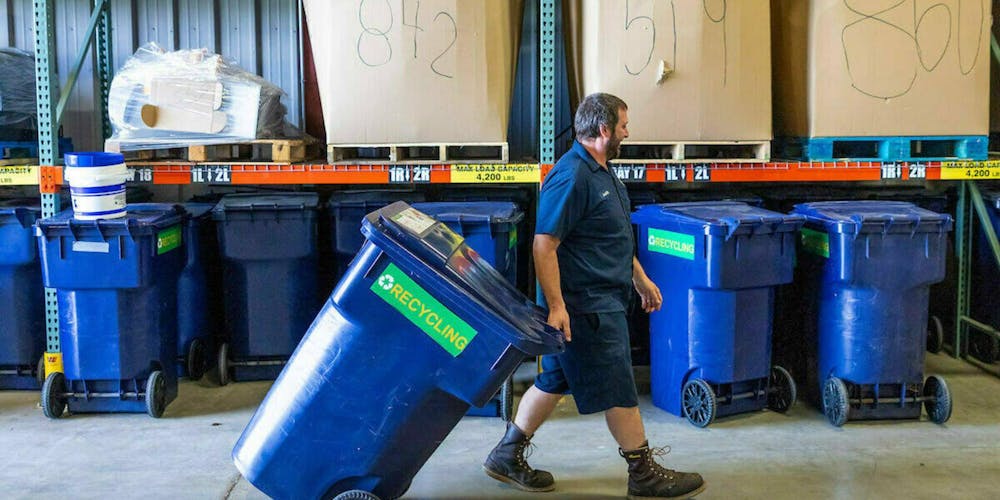
The University of Notre Dame continues to make progress in its sustainability efforts through strategic planning, new initiatives and collaborative work. These developments build upon the University’s Comprehensive Sustainability Strategy, which was published in 2016. Despite touting improvements in campus dining and recycling, the University’s progress toward other stated goals, including reducing emissions, has slowed.
“2026 marks 10 years since the University’s initial Comprehensive Sustainability Strategy was published,” sustainability program manager for operations and analysis John Kalemkerian said. “As the semester proceeds, we plan to spotlight key Notre Dame milestones while also recognizing and honoring the hard work that goes on behind the scenes to bring these initiatives to life.”
In summer 2025, the University highlighted four key focus areas: increasing food waste diversion, intentional eating, single-use materials and recycling.
Uneaten food from the dining halls that is safe to consume is being diverted from landfills and donated to Cultivate Food Rescue. In the fall, 39,860 meals were provided from campus food donations.
However, sustainability efforts by Campus Dining have been mixed. South Dining Hall has recently replaced bulk condiment dispensers with single-use condiment packets and eliminated coffee mugs last year. Paper cups are still available for hot beverages.
Other initiatives like paper shred events and single-stream recycling services support the University’s long-term sustainability goals.
Compared to fall 2024, “everyday recycling collection has increased by 62%,” Kalemkerian said.
On Jan. 14, Dunne Hall senator Kyle Lauckner and Ryan Hall senator Elena Rossen sent senate letter 2526-01 to the Office of Sustainability, formally requesting information about recycling expansion efforts across campus.
“We wanted to make students aware of what their options were regarding being more sustainable, especially with the disposal of hard-to-recycle items,” Rossen said.
“The University has made a ton of progress in their sustainability and waste diversion programs,” Lauckner said. “A lot occurs behind the scenes, which can be discouraging, but there is real progress every day.”
Lauckner believes the initiative to divert waste produced by football games this past season has been extremely successful. With thousands of people on campus for game days, the plan to manage waste included increased recycling options and signage. Football game day recycling reportedly improved by 98% this past fall.
Another development from the second half of last year was the completion of the West Campus Solar Project, which supplies approximately 1% of electricity campuswide. Additionally, two new green roofs were put on South Dining Hall and the Rockne Memorial.
“These new constructions bring our campus green roof area up to four acres,” Kalemkerian said.
Notably, even with the new solar project, renewable energy currently makes up less than 20% of Notre Dame's energy portfolio. Reducing emissions, both direct and indirect, has been a stated goal for the University since before the 2016 report was published.
“Through the end of fiscal year 2025, the University has seen a 48% reduction in carbon emissions since a 2005 baseline,” Kalemkerian said.
While carbon emissions are decreasing, progress has ultimately slowed in the last decade. In 2013, the University was already at a 40% emissions reduction from the same baseline. With McCourtney Hall and the Raclin-Murphy Museum of Art among major construction projects to be completed since then, campus has grown by 40% since 2008. However, ”Notre Dame has been able to stave off significant GHG emissions,” according to the University's sustainability website, green.nd.edu. Notre Dame has also invested in additional fossil fuel infrastructure in recent years, beginning operation of two new natural gas-fired turbines in 2019. The University still aims to achieve carbon neutrality by 2050.


