
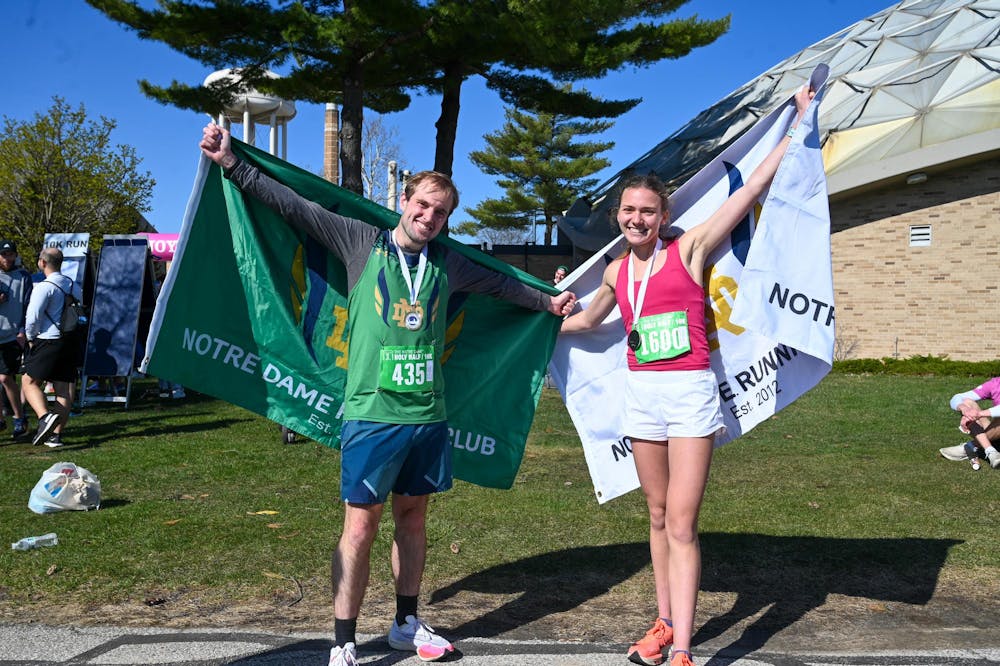
This year’s Holy Half Marathon has not yet reached the starting line, but technical difficulties have already complicated the race. After a surge in website traffic caused a server crash during registration, more than 800 people remain on the event’s waitlist as organizers prepare for race weekend.
Nadia Grierson, a freshman in Pasquerilla West Hall, said she logged on shortly after registration opened but was unable to secure a spot.
“I was hoping to register, but unfortunately I logged on too late and everything had already filled up,” Grierson said. “I was kind of bummed about that.”
Grierson said the registration site initially malfunctioned. After organizers sent an email announcing it was back online, she logged in about five minutes later, only to find student registration had already closed.
Cecilia Pino, co-president of the Holy Half Marathon, said high traffic overwhelmed the system.
“There was such high traffic that there was actually a nationwide crash on the server,” Pino said. “SAO was awesome and worked with us to create an entirely new website for the second round of registration.”
Katherine Millett, a sophomore in Welsh Family Hall, secured her bib as a SoleMate charity runner but said many of her friends struggled to register.
“It was just a mess,” Millett said. “When they rescheduled to drop the link, it was in the middle of a really busy class time, and everyone was really upset.”
Pino said registration was moved from a Saturday last year to a Tuesday this year after previous directors warned that weekend registration made troubleshooting more difficult.
When asked how quickly bibs sold out, Pino said “minutes.”
Nora Cronin, Pino’s co-president, estimated student spots filled in under 20 minutes and all entries closed within about 30 minutes.
After registration closed, organizers launched a waitlist, which Pino explained was created in order to help people who wanted to run the marathon still but were unsure what to do after the crash.
Pino later clarified that while the waitlist is not new this year, demand has surged. Within two minutes of going live, 300 people had joined. As of Feb. 2, 880 people were on the waitlist.
“I actually did not know there was a waitlist,” Grierson said.
Pino said organizers are working with the Notre Dame Police Department to determine whether additional runners can be accommodated, though safety limits pose challenges.
“We would have the whole student body run if we could,” Pino said. “It’s just not up to us.”
Keri Kei Shibata, assistant vice president for campus safety and chief of police, emphasized safety considerations in an email statement.
“With any large event, the maximum number of participants is determined in close collaboration with a number of stakeholders,” Shibata wrote. “From a Campus Safety perspective, our No. 1 priority is ensuring we have the necessary resources to support the safety and security of everyone involved.”
Some students have discussed running without registering. Pino discouraged that approach.
“If you run without a ticket, you are not getting a shirt. You are not getting a pre-race package,” Pino said. “It is not the right thing to do.”
Race details and beneficiaries
The race will follow the same route as last year. The 10K will complete one lap, and the half marathon will complete two, looping around the lakes, near the Grotto and past the Dome, Cronin said.
This year’s race supports four beneficiaries: Girls on the Run Michiana, the Andrew McDonough B+ Foundation, Center for the Homeless and A Rosie Place for Children.
All beneficiaries receive a portion of bib sale proceeds. Girls on the Run Michiana will also have 30 to 40 SoleMates raising additional funds specifically for the organization.
Girls on the Run Michiana
Laurel Hamilton, a sophomore in Walsh Hall and student intern for Girls on the Run Michiana, described the program as an after-school initiative for girls in grades three through five.
“It teaches young girls in the South Bend–St. Joseph County community ways to be their authentic selves,” Hamilton said. “It helps them form relationships and navigate those awkward years of childhood.”
Ruth Roeber, development director for Girls on the Run Michiana, described how their organization utilizes these funds.
“In 16 years, we have never turned a girl away for her inability to pay,” Roeber said. “Every year we give away about $92,000 in scholarships, and a good chunk of that comes from Holy Half.”
The partnership has lasted five or six years, Roeber said.
Ellie Carroll, a sophomore in Welsh Family Hall running as a SoleMate, said the cause resonated with her.
“It is super fun and a great cause,” Carroll said. “I am all about female empowerment and sports.”
Andrew McDonough B+ Foundation
Ashley Wagner, senior program manager for college partnerships at the Andrew McDonough B+ Foundation, said the pediatric cancer nonprofit provides direct financial assistance to families.
“We do direct bill payment in the form of mortgage payments, rent payments, car payments — whatever we can do to subsidize a family’s income while their child is in treatment,” Wagner said.
This is the organization’s second year partnering with the Holy Half. Wagner said the foundation also hosts a pasta dinner the night before the race for runners.
Andrew McDonough, the foundation’s namesake, dreamed of playing soccer at Notre Dame before his death from cancer at age 14, Wagner said. The organization’s connection to the University has remained meaningful.
Center for the Homeless
Steve Camilleri, executive director of Center for the Homeless, said the organization’s primary mission is “to break the cycle of homelessness.”
From Nov. 1 to May 1, the center operates a weather amnesty program, increasing nightly capacity to between 200 and 300 people. In January, Camilleri said, the center saw an additional 120 people per night during extreme cold.
The organization aims to keep federal funding below 20% of its $4 million annual budget, relying heavily on diversified community support.
Camilleri said Center for the Homeless was a beneficiary in the race’s early years and is “blessed to be part of it” again.
A Rosie Place for Children
Mark Waltz, executive director of A Rosie Place for Children, said the organization provides respite care for families of medically complex children.
“At A Rosie Place, we provide respite for families of medically complex children,” Waltz said. “There is no cost ever to families.”
The six-bedroom, 10-bed facility operates as a licensed specialty hospital but is designed to feel like a home. Children from infancy to age 21 can stay for three- to five-night visits.
The organization relies primarily on philanthropy and receives minimal federal funding due to the unique nature of its services, Waltz said.
This is its first year partnering with the Holy Half.
“We are very excited and quite honored,” Waltz said.


