
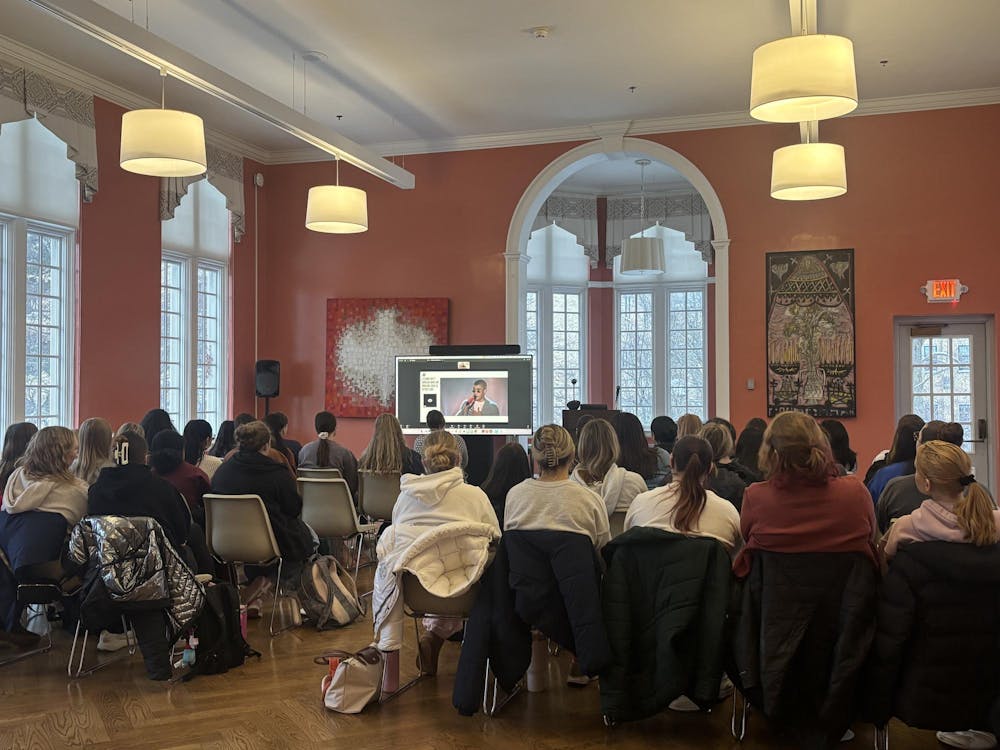
On Monday evening, the Saint Mary’s Global Education Office virtually hosted Petra Rivera-Rideau, associate professor of American studies at Wellesley College and expert in reggaetón, for a lecture on world-renowned artist Benito Antonio Martínez Ocasio, also known as Bad Bunny. Rivera-Rideau used her 2026 co-authored book, “P FKN R: How Bad Bunny Became the Global Voice of Puerto Rican Resistance,” as an outline for her lecture of the same name. With Bad Bunny’s sweep of awards at the 68th Grammy Awards Premiere Ceremony hosted the night before and his upcoming halftime performance at the Super Bowl LX, it’s no wonder Haggar Welsh Parlor was a full house.
“It’s a very timely moment to learn about Bad Bunny’s most recent album, given that he won Album of the Year last night at the Grammys ,and I think his songs and the lyrics are so tied to Puerto Rico and Puerto Rico’s history and Puerto Rican identity that I think it’s a really good way to learn more about the island and about its history,” Jennifer Zachman, global studies department chair, said.
This book marks the third of Rivera-Rideau’s authorships. She has also published articles in The Washington Post and PBS’s American Experience and co-created the Bad Bunny Syllabus, a website hosting academic resources and media for higher education. She has won several awards for her research and contributions to Puerto Rican culture and history, including the inaugural Blanca Silvestrini Prize for Best Article in Puerto Rican Studies from the Latin American Studies Association.
Opening with a brief discussion of Bad Bunny’s Grammy-winning album, Rivera-Rideau declared “DeBÍ TiRAR MáS FOToS” as his “most worthy” political album, saying, “We see his political rhetoric really mature and become more refined in a lot of different ways, [especially] the types of historical references to Puerto Rico and Puerto Rican figures that he makes.”
Puerto Rican rapper, singer and music producer Bad Bunny, who has been hailed as the “King of Latin Trap” and considered one of the best Latin rappers of all time, rose to popularity in 2016 with his song “Diles.” Originally a SoundCloud rapper, he gained global fame with his debut studio album “X 100pre” reaching No. 11 on the U.S. Billboard 200, with his second and third studio albums breaking the record of highest all-Spanish album charting at two and one, respectively.
Less known, however, is Bad Bunny’s political activism in Puerto Rico. From advocating for aid for the survivors of Hurricane Maria to Telegramgate, he has used his songs such as “El Apagón” to become anthems for protesting against the gentrification, displacement and mistreatment of Puerto Ricans by their government.
“There’s a lot of conversation about him as a political figure and what we want to convey is that this is not new,” Rivera-Rideau said.
One of the most notable political protests Bad Bunny attended was a summer of 2019 protest, where over one million people flooded the streets calling for the resignation of governor of Puerto Rico at the time, Ricardo Rosselló. According to Rivera-Rideau, demonstrators protested against the privatization of electrical grids, the closing of hundreds of Puerto Rican public schools, and the lack of aid and assistance offered after Hurricane Maria.
Displaying a picture of Bad Bunny at the protest, Rivera-Rideau said, “This is one of the really iconic pictures of this protest, where you see Bad Bunny holding up the [Puerto Rican] flag … and he had left his tour to join the protests.”
In the last part of her lecture, Rivera-Rideau provided a close analysis of Bad Bunny’s 2025 song and music video, “LA MuDANZA,” which includes references to Law 53 of 1948, or Ley de la Mordaza (The Gag Law), that prohibited the ownership or display of the Puerto Rican flag, the singing of patriotic tunes or holding an assembly in support of Puerto Rican independence. Though the law was repealed in 1957, it remains in the political and cultural memory of many Puerto Ricans.
“He says, ‘If I die tomorrow, I hope they never forget my face and that they play one of my songs the day they bring Hostos with the light blue flag on the coffin’ … The light blue triangle is understood to be the original Puerto Rican flag and someone who makes a concerted effort to carry the light blue triangle is understood to be someone who’s advocating for independence,” Rivera-Rideau said.
Assistant professor of global studies and anthropology Nell Haynes, who helped organize the event, believes this lecture on Puerto Rico and modern-day pop culture is important for students to expand their global and political knowledge outside of the classroom. She added that it had special significance “in a climate in which Latinx folks are being discriminated against and targeted.”
“Bad Bunny as the voice of resistance in Puerto Rico is a message of hope, and I feel like that’s important right now,” Haynes said.


