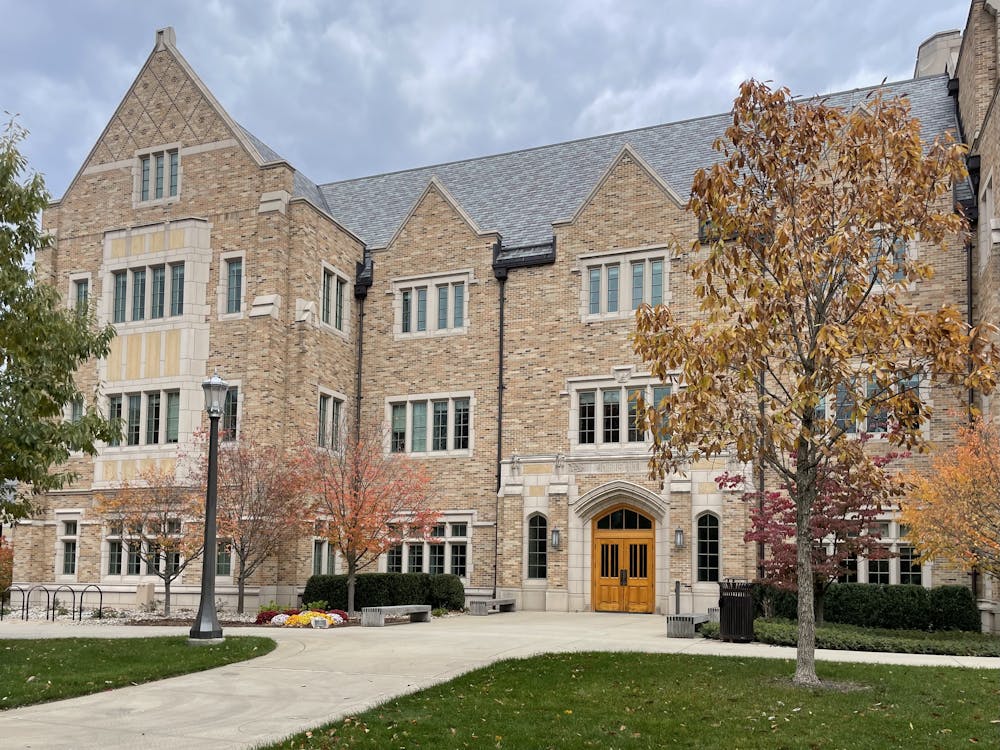
Once a week, students meet for Philanthropy and the Common Good, a credit-bearing course at the University of Notre Dame that meets on Mondays from 6 to 8:30 p.m. in Room B079 of Jenkins Nanovic Hall. The course is classified as an experiential learning class and centers on student-led grantmaking to local nonprofit organizations.
Jonathan Hannah, an assistant teaching professor of political science and assistant director for strategic partnerships at the de Nicola Center for Ethics and Culture, founded the course in 2019.
“I launched the course and founded it, and we first offered it in 2019,” Hannah said. “We are part of a network of schools with The Philanthropy Lab … They approached us back in 2017 about possibly having a course here at Notre Dame. Some schools in their partnership include Harvard, Stanford and Baylor.”
The course is offered through the Hesburgh Program in Public Service and is cross-listed with political science and the Potenziani Minor in Constitutional Studies. Hannah said the structure intentionally combines academic coursework with applied learning.
“I’d actually say it’s both,” Hannah said. “I would say the course is half theory, half practice … We read some books, read some articles, so we actually do quite a bit of the theory.”
Students in the course are assigned to site visit teams and meet with local nonprofits during the semester. Organizations visited by students are then invited to submit full grant proposals. The class typically selects between three and five nonprofits to receive funding each semester.
“I tell people all the time, my main goal teaching this class is to not in any way influence the grantmaking,” Hannah said. “This is the students’ money to give. I have nothing to do with what they decide.”
Funding for the course’s grants is provided largely by The Philanthropy Lab with additional support from campus partners and donors. The Philanthropy Lab is a nonprofit organization that partners with colleges and universities to teach students about philanthropy through hands-on grantmaking.
“The vast majority of our funding comes directly from the Philanthropy Lab,” Hannah said. “Their goal is to spark and ignite the next generation of not only philanthropists, but nonprofit champions.”
Since the course began in 2019, students have directed more than $450,000 to nonprofit organizations in the Michiana area. Grant totals have varied by year, though recent semesters have awarded approximately $50,000. The selected nonprofits for 2025 were Camp Kesem Notre Dame, Green Bridge Growers, A Rosie Place for Children, Hannah’s House of Michiana and Corvilla, each receiving $10,000.
Enrollment in the course is capped at 25 students. Hannah said the cap allows for discussion-based decision-making during board meetings.
“We’re having a lot of board discussions saying, ‘What do we learn on the site visit? What do we want to do with this money?’ If our class were bigger than that, voices would be lost,” he said.
Hannah said one of the primary challenges of teaching the course is fitting site visits, proposal reviews and board deliberations into a single semester.
“The calendar,” he said. “We have 35 hours as a group … That’s a challenge, but we always make it work.”
For the first time this academic year, the University approved both a fall and spring section of the course. Hannah said this will allow students to distribute additional grant funding annually.
“I want students to leave the class thinking about how can they be people that advance the common good in their community after Notre Dame,” he said.
One student currently enrolled in the course, Annabelle Tautges, said she decided to sign up because of her involvement with Camp Kesem Notre Dame, an organization that supports children whose parents have or have had cancer. Tautges serves as one of the organization's development coordinators.
Camp Kesem Notre Dame received a $10,000 grant from the course in fall 2025, funding that Tautges said made up a significant portion of the chapter’s annual budget. She said the grant allowed the organization to accept more campers.
“It was like an eighth of our funding for the year,” Tautges said. “It had a really huge impact for us.”
Tautges said she was drawn to the course’s experiential format and emphasis on understanding the South Bend community before awarding grants. “We talk about issues in South Bend and the neighboring areas to fully understand the context of where we’re donating money,” she said.
Tautges added that the class broadened her understanding of philanthropy beyond fundraising alone.
“You realize philanthropy isn’t just one path,” she said. “There are so many ways to be involved in advancing the common good.”
Editors note: a previous version of this story misidentified Tautges' title. She is a development coordinator for Camp Kesem Notre Dame.