
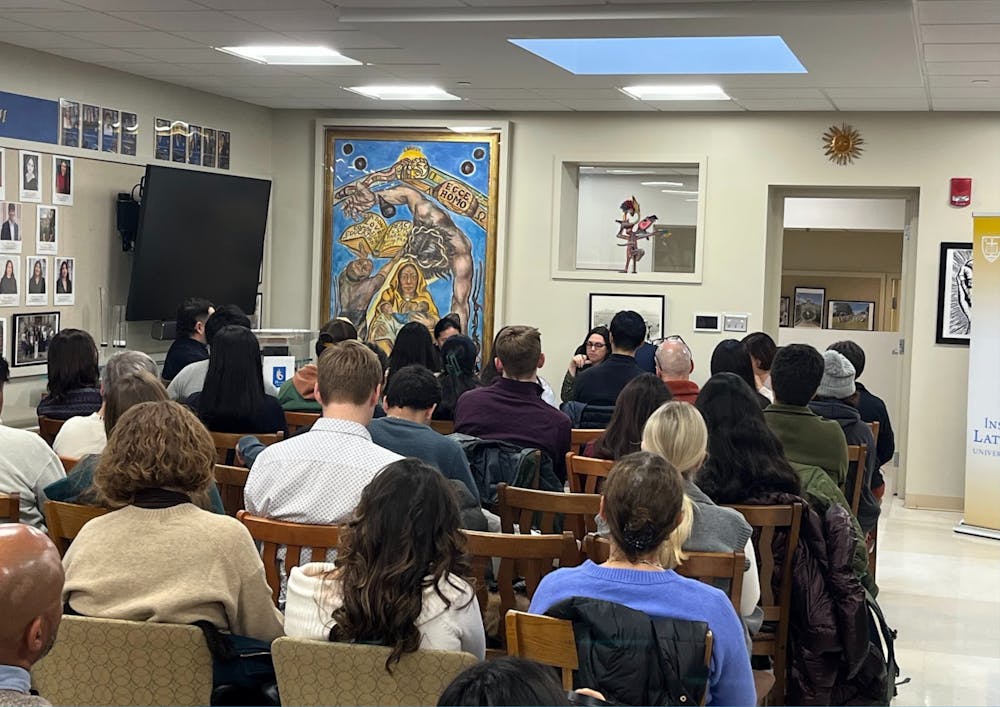
The Kellogg Institute for International Studies and the Institute for Latino Studies hosted a lecture session titled, “Immigration and Democratic Backsliding in the Americas,” for the Democracy in Dialogue series on Thursday evening at Bond Hall. Panelists Lindsey Carte, assistant professor in the School of Politics and Global Studies at Arizona State University and Helena Maria Olea Rodriguez, deputy director of Alianza Americas, explored how the economic and social impacts of migration policies affect migrants in the United States and across the Americas.
The conversation, moderated by Abby Córdova, associate professor of global affairs, provided insight into current migration trends. She provided insight on how policies regarding immigration enforcement have shifted over the past several years amid a period of growing political polarization.
The lecture began with an overview of migration trends throughout the Western Hemisphere, not only related to the United States but to Central and South America as well. The panelists emphasized how many migrants fleeing countries such as Venezuela and Columbia attempt to seek asylum in other South American countries, such as Chile, instead of making the arduous journey to the United States.
“Actually most of the Latin American migration that we see takes place within Latin American countries,” Carte said.
The panelists also sought to challenge misleading narratives surrounding immigration discourse and discussed how migration is often the result of a series of complex social, economic and political factors.
“It could be that you do need a job, but it could also be that you want to reunite with your family. It could be that you want to care for your family better,” Carte said. The discussion then shifted to the evolution of immigration policy in the United States and how it has changed over the past thirty years.
Carte emphasized that the current immigration policy of the federal government has its roots in the late 20th and early 21st centuries, with the passage of the Illegal Immigration Reform and Immigrant Responsibility Act of 1996 and later, the establishment of the Department of Homeland Security and Immigration and Customs Enforcement in the aftermath of the 9/11 attacks.
“I think it’s very important to contextualize what we’re seeing right now as a build up that’s been happening. It has its roots in the ’80s, maybe even farther back we look at the cycles of anti immigrant policy and sentiment in this country,” Carte said.
The lecture moved toward more contemporary issues related to migration and immigration enforcement, namely ICE’s increased presence in several American cities. When asked to respond from a legal and human rights perspective on current ICE activity and broader U.S. immigration policy, Olea Rodriguez was critical of current immigration operations.
“Before, we were explaining the asylum process to people preparing to arrive at the border. Now we are visiting reception centers for deportees. It’s a complete shift in the work we’re doing,” Olea Rodriguez said.
She argued they violated human and civil rights and lacked sufficient accountability measures.
“Communication with their families is restricted, particularly in these processing centers and individuals are being moved very swiftly from where they are apprehended to a completely different part of the country,” Olea Rodriguez said.
Ultimately, both panelists urged students to be attentive to developments in immigration policy and their implications for democracy, especially in moments of political polarization.
“This is a moment where I don’t think we can be passive,” Olea Rodriguez said.
The panelists shared that the current immigration enforcement is not respecting the humanity of the people they affect and their civil rights.
“Unfortunately, we are observing massive human rights violations in the United States that are not named as such,” Olea Rodriguez said.
Editor’s note: This story was updated to reflect that the lecture was co-sponsored by the Institute for Latino Studies and not just held by the Kellogg Institute for International Studies.


