Notre Dame’s Order of Christian Initiation of Adults (OCIA) class of 2026 has so many participants that they relocated their upcoming Rite of Election to ensure adequate space. With 76 participants in the year-long OCIA course, 60 participants in the spring short course and 27 participants in the fall short course, Notre Dame’s OCIA class of 2026 is the largest in the school’s recorded history.
This year's numbers surpass last year's record-breaking 55 participants who received baptism, first Holy Communion and/or confirmation through Notre Dame’s OCIA process.
Brett Perkins, Campus Ministry’s assistant director for evangelization and religious education, said, “It kind of throws people off … The narrative was always that the Church is dying. What’s all this about? Like, all these young people joining the Church?”
Sunday’s Rite of Election, the ceremony wherein unbaptized participants affirm their intent to be initiated in the Church, was moved from South Bend’s St. Matthew Cathedral to St. Pius X Church in Granger for more space. The need for change reflects a growing number of people joining the Catholic Church this year, both at Notre Dame and in the Fort Wayne-South Bend diocese as a whole.
“The message of Jesus is ever-ancient, ever-new, right? It’s the message that the world always needs, that always points to: you are here for a purpose,” Perkins said. “That is a message that is compelling for every person, for all people, for all places, all times.”
Notre Dame’s OCIA participants come from a variety of religious backgrounds. Some come from Catholic families but have yet to receive all the sacraments, some come from other Christian denominations or faiths and some had no exposure to Catholicism or other religious traditions prior to arriving at Notre Dame.
“At some point they were introduced to Catholicism. I would say, more often than not, it came through a friendship or relationship,” Perkins said. Perkins said his introduction to the Catholic Church came when a friend from high school invited him to Mass.
“Here at Notre Dame, a lot of times it's the residence hall system, right?” Perkins said. He pointed to roommates, section culture, and “having the dorm chapel there to have an opportunity to experience mass in a non-threatening environment,” as typical entry points for participants.
Mathias Mazzocco, a junior biochemistry major from Los Angeles, joined OCIA this school year to receive his first Holy Communion and confirmation.
“I just felt like it was the right time to do it. And I guess I got a little bit of a push from some of my friends,” he said.
Mazzocco’s friend, who he has lived with since freshman year, is now his sponsor in the OCIA process. OCIA participants are paired with other students with experience practicing Catholicism, who mentor them and sponsor them for the sacrament of Confirmation. They attend Mass together at the Basilica of the Sacred Heart each Sunday, followed by lessons about what Catholics believe and what the sacraments are.
“The overall feeling of deepening my faith has been really nice. And also, just like, getting close to my roommate … is really nice and rewarding,” Mazzocco said.
Darius Colangelo was an OCIA sponsor last year and is now part of a team leading the small groups for catechetical instruction during OCIA. In this role, he leads lessons on topics such as discipleship, the moral life and the Church.
“It really is a unique opportunity, both to guide another or to accompany another person through their growth, and also to grow in your spiritual life and your development,” Colangelo said.
The OCIA process is designed to prepare participants to join the Church by receiving the sacraments of Baptism, First Holy Communion and Confirmation and encourages students to discern the Catholic faith generally. Participants discuss fundamental arguments for belief in God as well as questions or struggles that participants may have with Catholic teachings.
“People generally have a better understanding [of Catholicism] by the end of the process and can even step out in faith and say, you know what, I might still wrestle, but I would rather wrestle within the Church and guided by the grace of the sacraments and a life of prayer,” Perkins said. As a convert to Catholicism he typically starts the first information session by saying “I was once in your shoes not that long ago.”
Perkins said fellowship is a major focus of the curriculum, and that no one discerning the faith has to do it alone.
“What does it mean to be part of a community of believers, to know that you’re not just doing this on your own ever, that you are doing it with a body of others who are meant to encourage you in the life of faith? And what a beautiful example we have of that within Notre Dame,” he said.
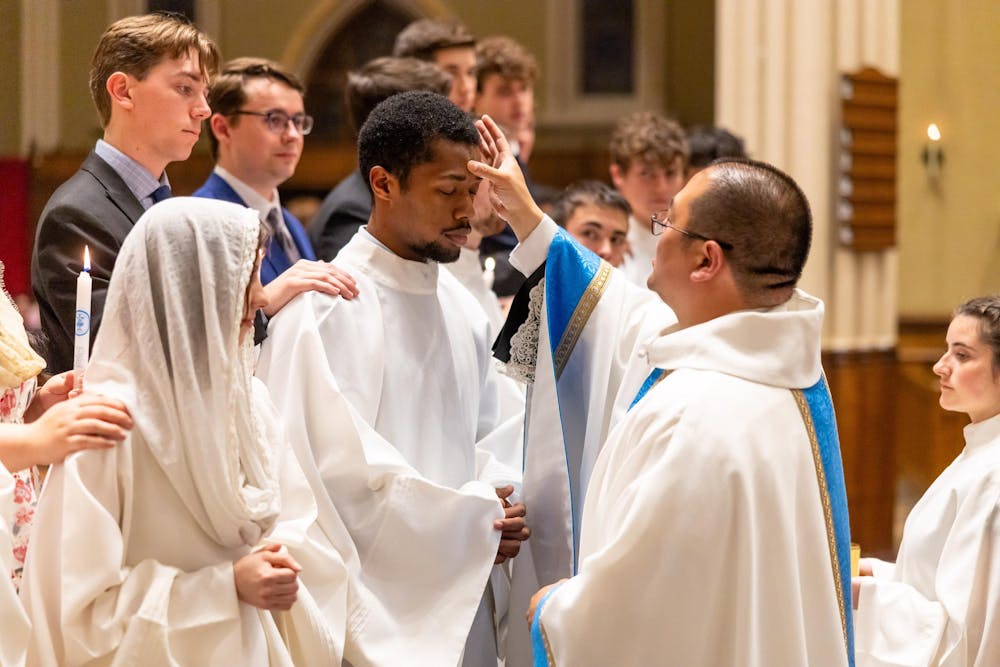
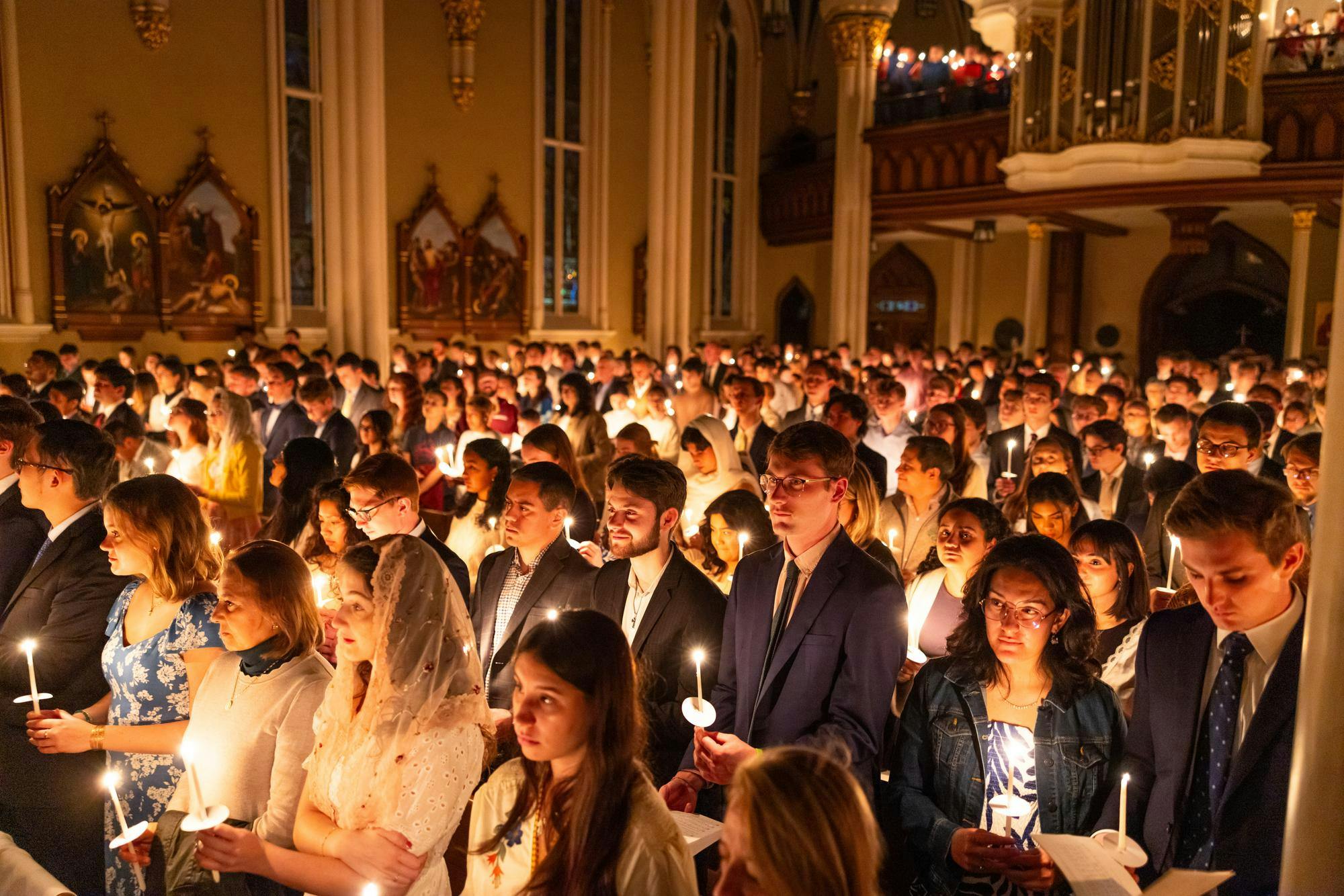
A pivotal moment of the OCIA process is the Easter Vigil Mass on Holy Saturday, where participants receive the sacraments. Perkins recalled the moment last year when Fr. Brian Ching, rector of the Basilica of the Sacred Heart, invited the congregation to welcome the new Catholics and the Basilica burst into applause.
“The veil between heaven and earth is very thin,” Perkins said. “I feel like that’s what heaven is going to be like.”