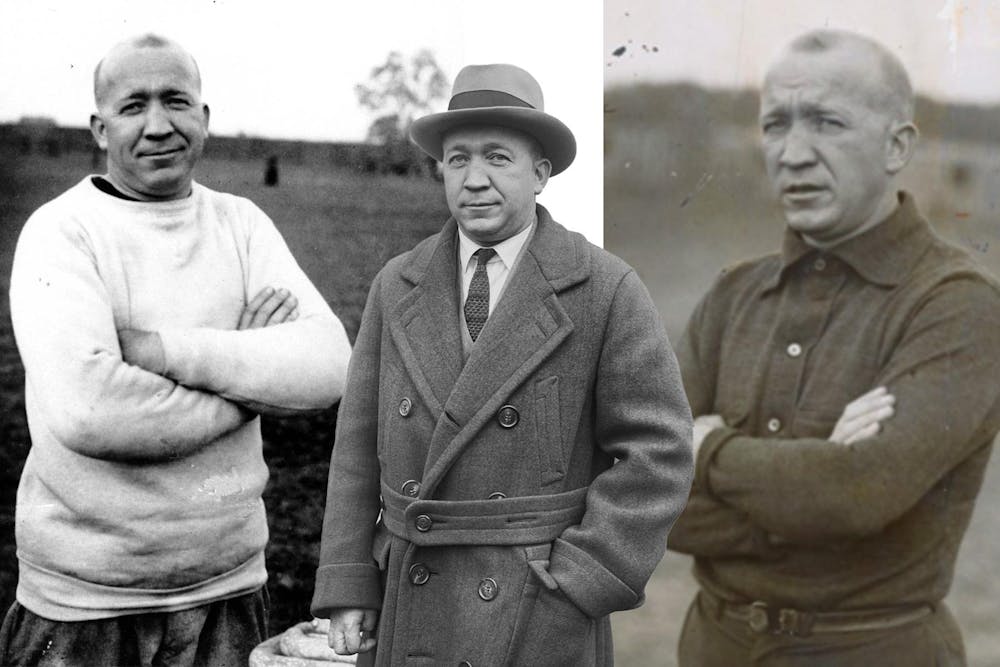
Notre Dame’s football program is one of tradition, legend and lore, and much of its legacy is thanks to coach Knute Rockne. His name is all over campus, from the Rockne Memorial on South Quad to the Notre Dame Stadium’s main gate. But how much do you know about the man’s life beyond football? Right now, The History Museum, located in downtown South Bend, is having a special exhibition on the coach: “Rockne: Life & Legacy.” Rockne’s life was far deeper than athletics, and the exhibit wonderfully provides a holistic view of a man who forever changed Notre Dame.
I thoroughly enjoyed my trip to The History Museum, spending nearly an hour and half in the Rockne exhibit. Whether going as a Notre Dame history buff, football enthusiast or out of pure curiosity, there is so much to take in.
I appreciated how the exhibition portrays Rockne beyond his football accomplishments, offering a complete view of his life. In my opinion, the most interesting stories were about his academic and business careers. He majored in the department of pharmacy and was a skilled chemist, working in Fr. Julius Nieuwland’s lab — Nieuwland notably discovered synthetic rubber — and holding a chemistry professorship before becoming football coach. A unique item in the collection was Rockne’s chemistry lab book, and it was fascinating to read his procedures and diagrams and see the burns and chemical spills on the pages. Certainly, his scientific, analytical writing influenced his written football plays, which are also on display.
Additionally, football was not Rockne’s first sports ambition. He was a skilled track athlete, participated in rowing and founded a boxing tournament that would become Bengal Bouts.
Rockne was quite mischievous in undergrad. Allegedly, he and his roommate, quarterback Gus Dorais, charged students wishing to escape parietals a toll to use their Corby Hall room’s first floor window.
With 2026 being an Olympic year, I was amused by “Knute Rockne’s Olympic Tour.” In summer 1928, Rockne was the “tour guide” of a luxury European tour with sightseeing across the continent as well as admission to the Games.
It isn’t a trip into South Bend without seeing a Studebaker. Rockne was, for a while, employed as a spokesman for the company and, before his death, was going to be an officer of Rockne Motors, an affiliate. The “Rockne” car was built from 1932 to 1933 by Studebaker following the coach’s death, and the museum has the most refurbished Rockne Model 10 in existence. It was wonderful to see Rockne’s involvement with South Bend beyond the University, showing his dedication to the community and its success.
The exhibit features AV components with several videos on repeat. Among them are authentic interviews with the coach interspliced with in-the-moment footage of him at practices, old tapes of Notre Dame games and the 1950s documentary “The Rock of Notre Dame.” Between these videos was an image slideshow accompanied by a recording of the “Notre Dame Victory March” circa the 1920s, and this soundtrack added an aesthetic layer to the whole gallery. There were also some tactile, interactive exhibits, encouraging encounters with history.
Don’t let me understate the presence of football in the exhibition; Rockne is one of the greatest coaches in history. Part of Rock’s enduring legacy is how he revolutionized — not invented — the forward pass. One summer, Dorais and Rockne were lifeguarding at Cedar Point resort in Ohio, and, during their breaks, they practiced the technique before implementing it at the famous 1913 Army game, forever changing how football is played.
The early legends of Notre Dame were all present: George Gipp, the Four Horsemen and Jack Elder. Game tickets, handwritten plays and period posters were on display. I was honestly surprised that Gipp wasn’t featured more, receiving pretty much only an information board. There weren’t many artifacts of his nor was the “Win one for the Gipper” speech deeply covered.
At Scene, arts and culture are our focus, so I was delighted to discover Rockne was an avid patron. As a student, he played flute in the band, founded the Monogram Club Absurdities (a Follies-style show featuring athletes singing and dancing) and was known for his acting abilities. A humorous photo is on display of Rockne in costume as Mrs. Smith (being pre-1972 Notre Dame) in “David Garrick.”
Some of the fashion of Rockne’s day was highlighted, including, varsity sweaters, a leather helmet, the coach’s crewneck he sported at practice – displayed with a photo of him wearing it – and one of his signature fedoras on display.
Tragically, Rockne passed away on March 31, 1931 in a plane crash. The museum has a model of the plane, photographs of the crash, pieces of the plane and the cuff links worn by Rockne at the time of the crash on display. His funeral was held in the Basilica of the Sacred Heart on April 4, 1931. Rockne’s death stunned the nation and the cultural impact was evident in the many newspaper clippings and telegrams sent to his widow, Bonnie, on display. Notably, CBS broadcasted the Mass over the radio, making it the first funeral to be broadcast nationally over the radio.
Rockne’s legacy was a major theme of the exhibition. Leaving the museum, I had the impression that the coach’s reach goes far beyond football. He is portrayed in the exhibit as an all-around American hero, shaping the culture of sportsmanship and the importance of emphasizing the student in student-athletics. Through reading newspapers and interviews, one gets the sense that Rockne was dedicated to the success of others: a devoted father, coach and loyal son of Notre Dame.
Before “Rudy,” the signature campus film was “Knute Rockne, All American,” starring Pat O’Brien as Rockne and Ronald Reagan as Gipp. As a Scene writer, I was particularly interested in the film memorabilia present, including Lloyd Bacon’s director chair, a Notre Dame football uniform costume and a contract signed between Warner Brothers and University representatives.
I highly recommend a trip over to The History Museum this semester to see “Rockne: Life & Legacy” before it closes on May 31. The museum is also hosting several speakers related to the exhibit and sponsoring a podcast series, “Rockne: The Legend Lives On.”