
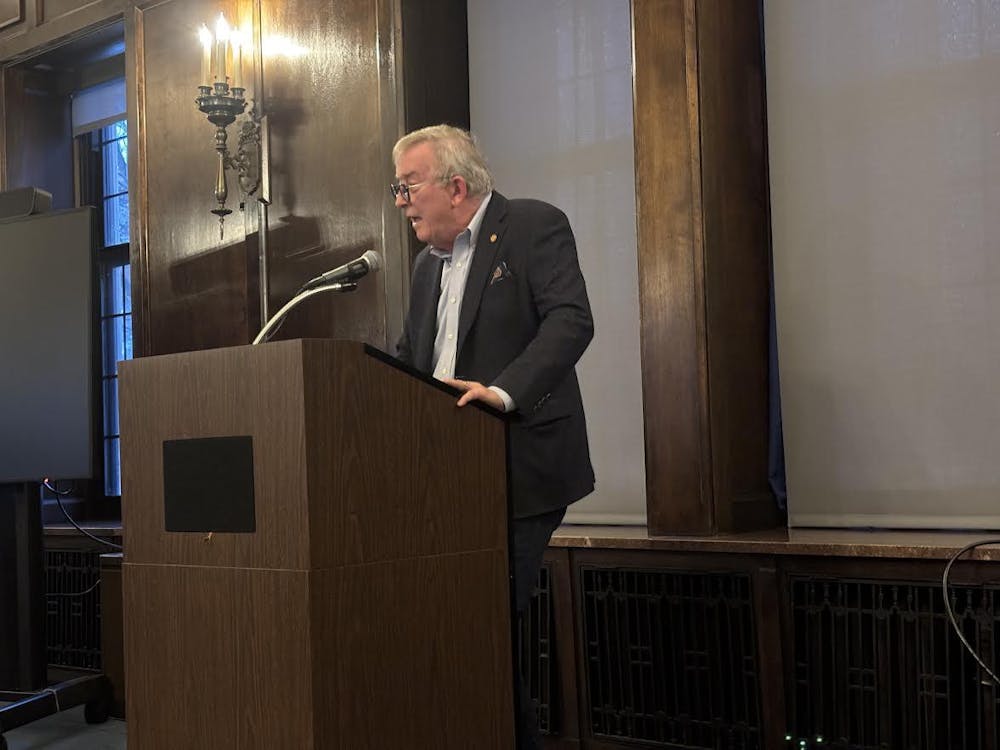
The final installment of the 2025-26 Visiting Writer Series at Saint Mary’s College concluded with a book reading and Q&A session from poet and scholar Thomas O’Grady on Tuesday evening in Stapleton Lounge. O’Grady is married to College President Katie Conboy.
Reading from his newest collection of poetry titled “Coming Ashore: New & Selected Poems,” director of the Visiting Writer Series and associate professor of English Rebecca Lehmann said she believed O’Grady to be an excellent example of poetry within the Saint Mary’s community.
“We try to find somebody whose work will speak to things that students are interested in and then we’re also always trying to line writers up with what we’re teaching in the creative writing program at the time,” Lehmann said. “This semester, we’re teaching a poetry workshop, and it worked out so well to have Tom O’Grady here, who is a poet.”
Since 2023, O’Grady has been editor for Avenues, Saint Mary’s alumnae magazine. He served as the director of Irish studies at the University of Massachusetts Boston from 1984 to 2019 before moving to South Bend. In addition to his newest collection released in 2025, O’Grady has published two other books of poetry, “What Really Matters” in 2000 and “Delivering the News” in 2019.
“With his book just having come out in 2025, we also wanted to celebrate one of our own,” Lehmann said. “When we do have faculty come out with books, we do try to do an event like this, [offer a] reading and to have a celebration here with everybody at Saint Mary’s,” she said. “One thing that I noticed in his work is a deep appreciation for nature and finding peace in small details, and an exploration of spirituality that I thought would appeal to Saint Mary’s students.”
O’Grady opened his lecture by introducing and later reading the poem his newest collection is named after, “Coming Ashore,” which he said is also the name of the etching by David Blackwood found on the front cover. O’Grady said he felt inspired by the artwork, which he bought for Conboy for Christmas in 2023, and wrote the entire poem in one sitting.
Later in the evening, O’Grady read his poem, “Spuds,” where he imagines himself back home on the shore of Prince Edward Island digging up potatoes while he is, in reality, finding stones along a pebble beach. The paralleling pictures draw on the idea of dualism and what O’Grady called the “Irish imagination.”
“There’s a wonderful Irish philosopher at Boston College, who I know a little bit of, and for me, one of his most profound observations about the Irish imagination, which I think I contain some ownership of, is the capacity to be in two places at the same time, or to be in two times in one place. And I find that that happens a lot in my real life, but also in the life of my poems,” O’Grady said.
O’Grady also discussed the title poem of his second book, “Delivering the News,” which focuses on grief and loss. Just two days after finishing this poem, Nobel Prize winner, playwright and poet Seamus Heaney passed away. Since Heaney was a huge influence on O’Grady’s life, he felt it fitting to dedicate this poem to his late inspiration quietly in the back of his second book.
“Heaney is a major influence on my writing and actually a major influence in my life, because I wrote so much on Heaney that I got tenure, promotion and a career basically on Heaney’s back,” O’Grady said. During his Q&A, he later elaborated on his appreciation of Heaney’s work and writing style.
“When I started to spend more time with Heaney, what I loved about him, as much as anything, was that he wasn’t afraid to write something that sounded good. He wasn’t afraid of being a male poet, using rich musical language, using internal rhymes, using alliteration, just taking advantage of everything that’s out there,” he said.
Sophomore Jocelin Raygoza, who attended the event, enjoyed O’Grady’s poetry and his complimentary anecdotes he offered throughout the lecture. As one of the students in the poetry workshop O’Grady attended on Wednesday, she said she felt particularly excited to listen to more of his work aloud.
“It’s one thing reading it, but actually hearing about his life, him [reading it aloud], made it so much more impactful,” Raygoza said.
For his final thoughts at the end of his lecture, O’Grady advised poets and writers to stay open and “pervious” to even the mundane surrounding them and practice putting their inspiration into words.
“We usually think of the word impervious, that you’re impervious to something. But if you’re pervious, it means that you’re open, open to the possibilities, open to what is around you, and observant of whether it’s birds or cats or horses or or music or whatever else in your life,” O’Grady said. “I think for me, it really is that awareness that almost anything can become a poem. But there’s a process by which you need to be attentive to it, and then you try to find words to put it down.”


