If you had to pick one defining theme of media from this decade, it would be “generational trauma.” Our Best Picture winners are about generational trauma (“Everything Everywhere All at Once”). Our critically acclaimed shows are about generational trauma (“The Bear”). Even our Disney films are about generational trauma (“Encanto”). I’m not saying these are bad — far from it — but the topic has been exhaustively mined this decade. So when I heard that another generational trauma film was getting buzz at Cannes last year, I was skeptical. But “Sentimental Value” has only grown in stature since its Cannes debut and emerged as a dark horse at the Oscars, scoring a whopping nine nominations, including Best Picture and spots for all four of its main actors. So when the film came to town this weekend in the DeBartolo Performing Arts Center, I locked in. And as the credits rolled, I was left stunned. Director Joachim Trier’s portrait of a family confronting decades of grief and pain is a radically empathetic look at the ties that bind.
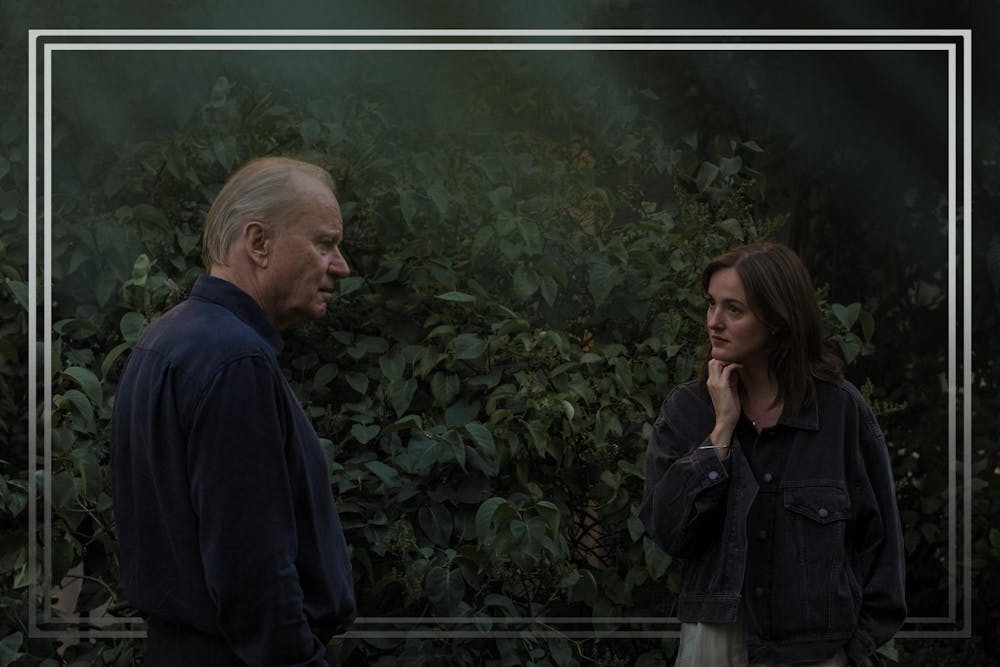
“Sentimental Value“ follows the Borg sisters, Nora and Agnes, whose father, Gustava (Stellan Skarsgård), abandoned them as teenagers to pursue his filmmaking career after divorcing their mother. In the decades since, Nora (Renate Reinsve) has become a successful stage actress, but still suffers from crippling anxiety and a profound sense of loneliness. Agnes (Inga Ibsdotter Lilleaas) is more well-adjusted, with a husband and kids, but still carries an impenetrable sadness. After their mother passes away, Gustava reemerges in their lives, but not just to mourn. He wants Nora to star in his big comeback film, an autobiographical story about his life. Nora, still angry at him for walking out on her and Agnes as kids, refuses his offer. This leads Gustava to eventually give the role to Rachel Kemp (Elle Fanning), an eager young Hollywood star who hopes the project will give her artistic credibility. As Gustava prepares to shoot the film in their old family home with Rachel, the family tensions that have been quietly simmering for decades are finally confronted.
Trier cleverly treats this old family home as a character in its own right. The film opens with a narrator personifying the Borg house and wondering how it feels about the family’s drama that has played out within its walls over the decades: shouting matches between husband and wife, absent parenting, and sisters sneaking out of the backyard. The house has been in the Borg family for generations, and the film frequently returns to flashbacks of the Borgs’ time there to flesh out the unbroken chain of pain that has spanned decades, including Gustava’s mother hanging herself in the home years after being imprisoned and tortured by Nazis. The multigenerational home serves as the film’s central thesis about family: everyone grows up in a family structure that has quietly absorbed generations of pain and grief. You’ll inherit those hallways and rooms, and they’ll shape you in ways you can never fully understand. But the structure invariably determines who you become: in a sense, you never had a choice.
And when the heritage of pain becomes too unbearable, it’s easy to run away and retreat to aloofness and sorrow, which is what the Borgs have done their entire lives. Gustava remains insensitive to the wounds he left behind, while Nora’s acting career becomes a tortured quest for the fatherly validation she never received, her stage fright a symptom of that unhealed need. Skarsgård and Reinsve’s performances as a fractured father and daughter are sensational. They imbue their characters with a rich interiority, each carrying a mountain of emotions in every scene.
Gustava’s autobiographical film is his earnest attempt to confront their family pain head-on and begin the process of healing. This is where the film brilliantly deviates from the typical explorations of generational trauma. It is remarkably empathetic to the older family member, Gustava, who has been quietly dealing with the trauma of his mother committing suicide his whole life. His attempts at reconciliation are framed as well-meaning and brave. Yes, he made many mistakes in the past, but he’s here now and wants to heal.
Conversely, Nora refuses to let go of her resentment, leading Gustava to tell her, “It’s not easy to love someone who has so much anger inside them.” The self-righteous indignation of the millennial that often plagues films about generational trauma is tastefully rebuked in “Sentimental Value.” It’s only when she actually reads his script and sees his profound empathy for both his daughter and his mother’s depression that she lets her bitterness go, a bitterness that was preventing her from healing and even starting a family of her own.
In the film’s final scene that hits you like a ton of bricks, we see Nora accepting the cyclical nature of her pain. We are our parents, who are really their parents, who are also us. The sequence operates on so many levels simultaneously, yet still leaves an immediate devastating impact; it’s definitely an ending for the history books. However, it is not a breakthrough moment of healing for Nora and Gustava, but a mutual recognition of how deep their pain goes. But at least they now have each other.
Trier’s film is a more than worthy addition to the canon of generational trauma films. Its radical empathy, stunning performances and elegant direction make it a layered examination of family and memory.