
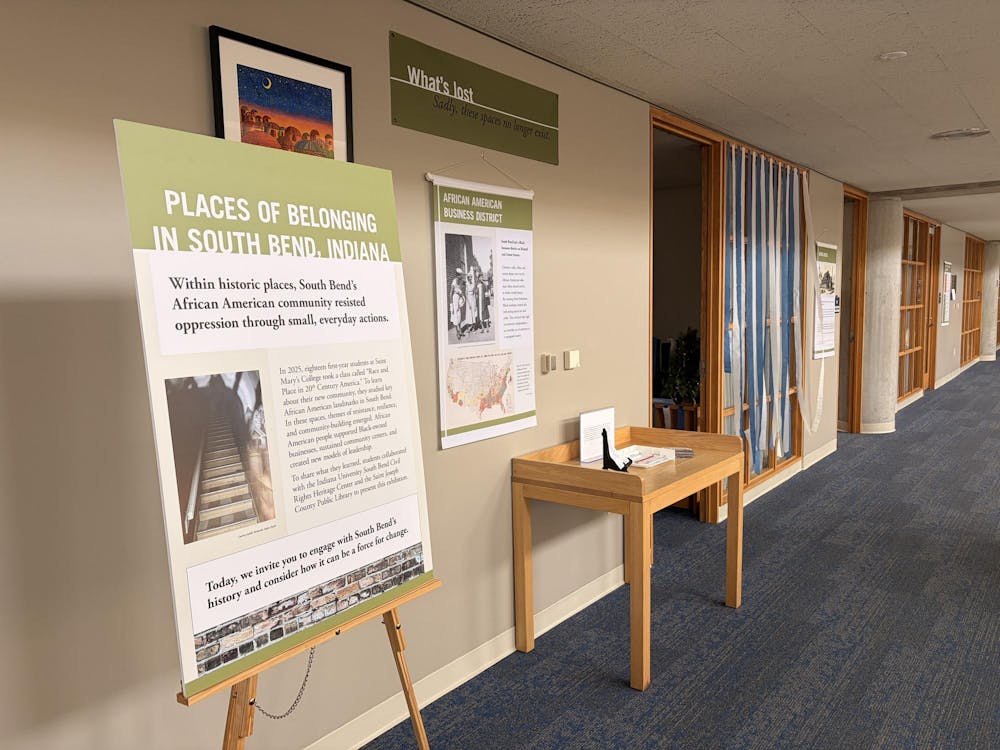
Students in professor Jamie Wagman’s freshman seminar, “Race and Place in 20th Century America,” learned that the history of racism was not confined to the South but shaped communities across the country, including South Bend.
For their final project, students organized an exhibit exploring the impact of racism on South Bend’s history. The exhibit is now on display at Cushwa-Leighton Library at Saint Mary’s College.
Kate Vock, a freshman at Saint Mary’s, helped curate the exhibit with her classmates. She said the project centered on local historian George Garner’s book “Placing History” and offered students a way to better understand the city they now call home.
“For us, it was a way to learn about the city and community that we’re now a part of,” Vock said.
Vock said much of what students learned surprised them, particularly the extent to which discriminatory practices existed in the North.
“I think one thing we kind of realized through the whole class, but especially South Bend specifically, was just how much racism and Jim Crow kind of stuff happened in the North as well as the South,” she said.
The exhibit was first displayed at the St. Joseph County Public Library before rotating to the Cushwa-Leighton Library.
Students worked with Garner, who is also a museum curator, and South Bend activist Ariel Brandy. Through that collaboration, they learned how to interpret historical research and translate it into a public-facing exhibit.
“He helped us a lot with taking the information that we’ve learned and actually putting it into an actual museum exhibit,” Vock said. “We worked with him really heavily on how to make a museum, how to interpret his book, all of that kind of stuff.”
Jill Hobgood, reference and rare books librarian and history liaison for Cushwa-Leighton Library, assisted students in organizing the exhibit at Saint Mary’s. She said the library frequently displays student work and that Wagman’s class is one of three student showcases currently featured.
Hobgood said the exhibit’s layout allows visitors to engage with the material at their own pace.
“There’s no real order, so you can just dive into it however you like,” Hobgood said. “If you don’t have time, come back and read another one. You won’t lose the plot at all. They just all exist on their own, covering one particular aspect of what they were studying for this class.”
Most of the exhibit’s materials are displayed on vinyl banners and include a variety of media and subjects. One display features a 3D model of a formerly segregated natatorium that now houses the Civil Rights Heritage Center, accompanied by a poem.
Hobgood said the concise format makes the history more accessible.
“It’s an easy way to get into the subject because each banner only has maybe a paragraph or so,” Hobgood said. “It just gives you a quick background of it. And that much background is so helpful with your own civic knowledge.”
Hobgood said Wagman often incorporates hands-on projects into her courses, encouraging students to work with primary materials and community organizations.
“It’s not just like reading a book,” Hobgood said. “They really get involved with the materials.”
For Vock, the exhibit underscored the lasting impact of history.
“It made us realize everything is that deep,” she said. “Things that happened 100 years ago are still affecting us and are still present. The work people did then is still impacting us now.”


