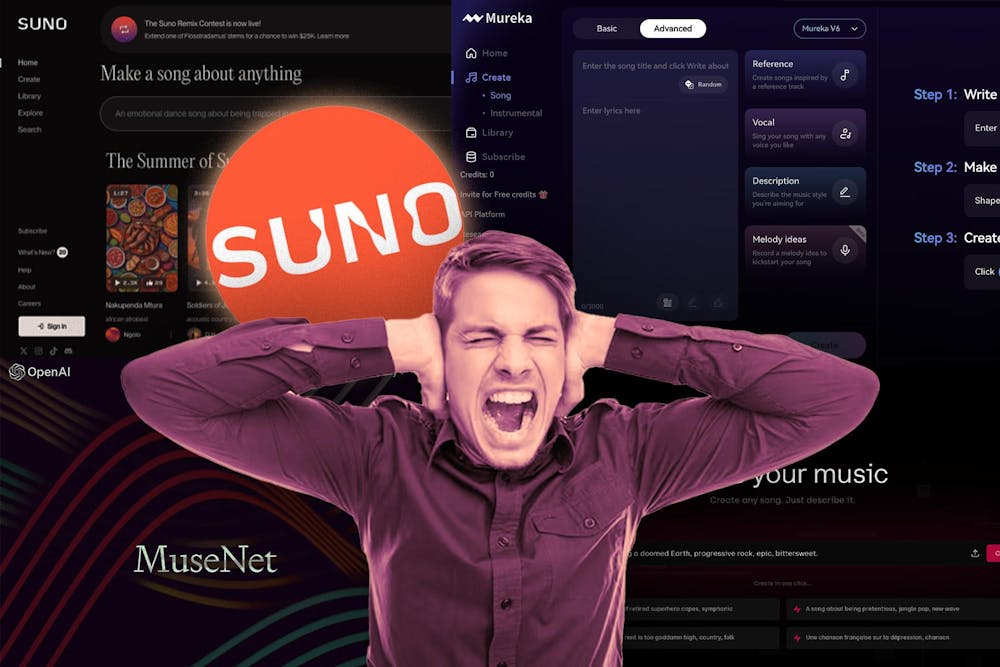
The rise of artificial intelligence in daily life has transformed the way people learn, study and organize their daily tasks and lifestyle; however, instead of simply making mundane tasks easier for the average person, the development of AI has become, in all honesty, scary. Many, myself included, worry that AI is taking over the parts of our lives that are fundamentally human: art, music and theater. What makes these activities worthwhile is the emotion behind them — emotion that a machine could never recreate.
The act of listening to music is personal. You connect the lyrics and tone to your own emotions and experiences. This is why, at different moments and stages in our lives, our music taste changes; we are drawn to what we relate to. How could we possibly form a connection with or relate to something that has no lived experiences? The rise of AI artists, such as Xania Monet, has removed life from music. Not only is the actual music quality emotionless and poor, but AI is also removing artistry and taking away the ability to connect with artists and performers. Many children look up to artists as role models, and pop culture figures traditionally inspire the youth. Without this inspiration, younger generations will not be able to connect with artists and their music. Music will become pure entertainment rather than true art.
Before the development of human language, communication was not merely expressed through gestures but also through art. For example, consider the cave paintings made by early humans. These drawings represented emotion, stories and experience. Music and art created by AI cannot tell these stories the same way a human can. The purpose of art is expression and inspiration.
With this rise of AI, opportunities for musicians are decreasing. While it may be cheaper to use AI for instrumentals, the life and energy a live player brings are ultimately unmatched. Furthermore, using AI for instrumentals will affect performance arts such as dance and theatre. For instance, Broadway musicals are founded on excellent voices and a moving orchestra. In a medium where music drives the story, a mundane, emotionless soundtrack takes away from theatric culture and enjoyment of the performance. In dance, music arguably is the story, while the act of dancing is used to express it.
AI is not only changing theatrical and artistic culture, but also social and urban culture. In places like Chicago and New York where performance, music and art are foundational to the city’s identity, AI removes the personality and life of the city. AI does this not only through not being genuine, but also by copying work of the greats such as Michael Jackson or Elvis Presley. AI can personalize music for its users, and while that seems innovative, the purpose is not for connection to the art, but rather to get “hooked” by the AI and become more dependent on it. A recent survey reported that 61% of American adults have used AI in the past six months, while nearly one in five rely on it daily. This over-dependence on AI and technology in general takes the soul and passion out of our daily lives and further homogenizes humanity. This is not what it means to be human! Being human is imperfectness, making mistakes, emotion and soul. This humanity is what music needs now more than ever.