
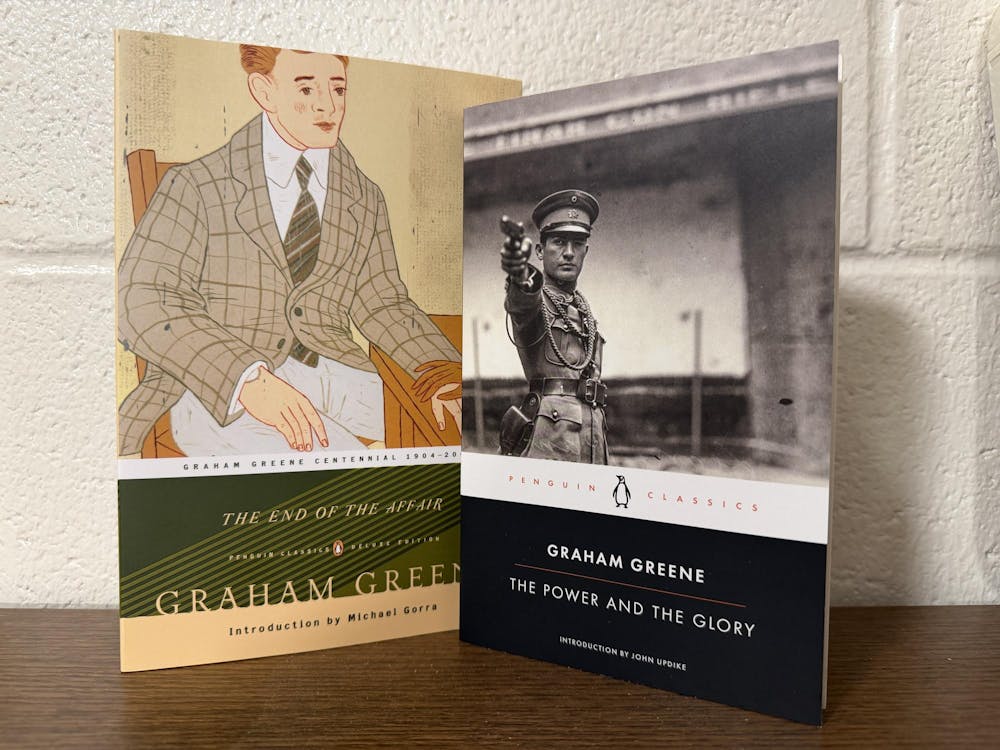
For the third year in a row, the Theology department has hosted a one-credit ‘book club’ course. This year’s class is focused on the 20th century english author, Graham Greene.
Graham Greene, known for theological themes in his books, was born in 1904 and attended the University of Oxford before becoming an author for 67 years until his death in 1991. He was the author of over twenty-five novels, including “The Power and the Glory” (1940) and “The End of the Affair” (1951), which are books that this class explores.
The “theology book club” began three years ago after Fr. Kevin Grove, who is priest-in-residence at Dunne Hall, was asked by undergraduates in that hall to read St. Augustine’s “Confessions” with them. From this group of students, friends were added until Fr. Grove decided it had grown so much that it could be a class. Thus, the one-credit theology book club was born.
This class is part of the initiative, Take a Second Look, within the McGrath Institute for Church Life. The goal of the initiative is to allow Notre Dame students to think about the Catholic Church outside of the Core Curriculum in order to allow students to make meaningful decisions about their faith during the time that is the primary age of disaffiliation from religion.
The Initiative creates in-dorm discussion groups for introductory lecture style theology classes about, “the intersection of Academics and College Life,” Anthony Pagliarini, director of undergraduate studies in Theology, said.
They hold a large lecture for all Foundations of Theology students. This year’s lecture topic has not yet been released. Additionally, they sponsor Bible studies, which attract over one hundred students, all in addition to the spring “book club.” The goal of these courses, as Pagliarini described, “is to enter into a sustained, deep conversation with some of the most amazing minds in theology. You just become a more thoughtful and diligent person sitting with St. Augustine for twelve weeks, or sitting with C.S. Lewis, or sitting with Graham Greene.”
Following Fr. Grove, professor Bill Mattison taught a class last spring semester focused on C.S. Lewis, reading his novel, “The Screwtape Letters.” This year, Pagliarini is teaching the class about Graham Greene, which he described as “a bit of a risk” (compared to the more well-known authors) however, the lectures have still drawn over 200 students. The spring 2027 course will either return to St. Augustine’s “Confessions” or read Dorothy Day’s autobiography, “The Long Loneliness.” The course also purchases the books for students.
Both of this year’s books, “The Power and the Glory” and “The End of the Affair,” are two of Greene’s most well-read novels and, according to Pagliarini, “exemplify the kind of theological things that Greene is doing throughout his other novels and short stories.”
Their current novel, “The Power and the Glory” centers on the period of Catholic persecution in Mexico and the story of an unnamed “Whiskey Priest,” (a term coined by Graham) who is hunted, but “for the sake of everyone in the area, he remains there and exercise his ministry, celebrates Mass, hears confessions and so on,” Pagliarini said.
As the story progresses, it delves into the contrasts between the Whiskey Priest and his contrasting character, the Lieutenant, who is an atheist who desires to remove all memory of the Church and the priesthood. His anger with the Church, Pagliarini described, stems from the way he viewed the Church as a privileged upper class.
In class, students consider the future and morality of the Whiskey Priest with questions about his salvation, about how he exercises his ministry, among other topics.
“The End of the Affair” explores similar themes in a vastly different setting: London, following the Second World War, recounting the story of a five-year affair between protagonists Maurice Bendrix and Sarah Miles, and, as the title alludes, the abrupt ending of their affair.
“I love nothing more than teaching. There’s a good ethos in the room and people talk, but nobody’s hogging the mic,” Pagliarini said. “These are books that are really meaningful to me … It’s just a joy to share it.”


