Despite its distance from our nation’s capital, Notre Dame, like many other elite universities, maintains a presence in Washington, D.C. Beyond sharing the University’s research and institutional values with policymakers, Notre Dame utilizes its own registered lobbyists and the help of outside lobbying firms to advocate on behalf of the University as decisions are made on the Hill.
As the Trump administration has enacted a slew of policies changing the landscape of higher education, from taxes on University endowments to executive orders aiming to eliminate diversity, equity and inclusion programming, Notre Dame and prominent universities across the country have increased their spending on lobbying efforts.
Inside Higher Ed reported in January that major research universities spent over $37 million on federal lobbying efforts in 2025, up from $28.1 million in 2024.
The Observer's analysis of 2025 federal lobbying disclosure reports found that Notre Dame ranked 19th amongst schools in the American Association of Colleges and Universities for expenditures on university-registered lobbyists.
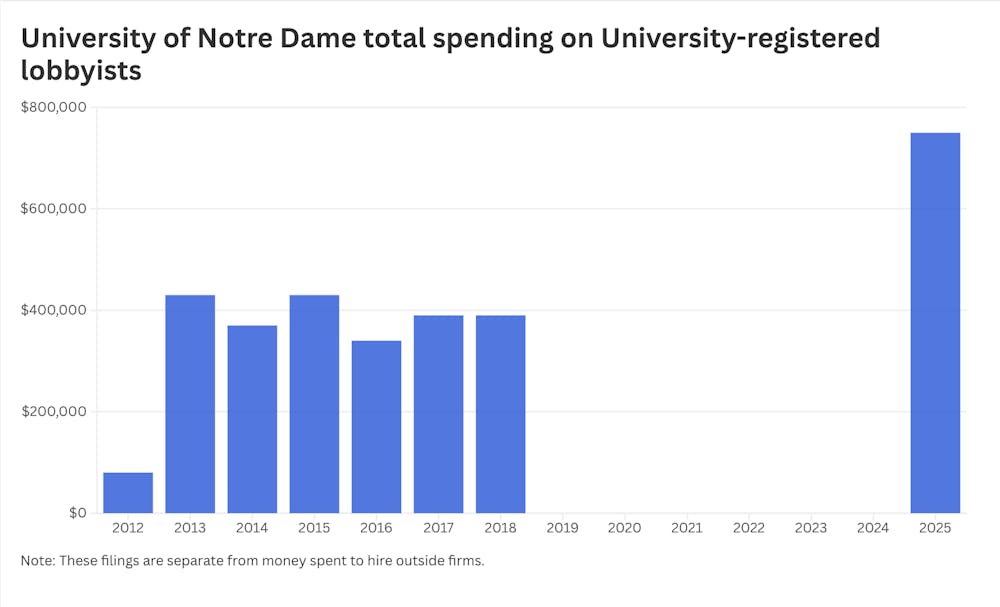
Notre Dame reported spending $750,000 on its lobbyists in 2025. The University of California system topped the list, spending $2,775,000, followed by the University of Washington with $1,341,000, the University of Florida with $1,334,000 and the University of Pennsylvania with $1,320,000. Indiana University came in fifth with $1,314,000.
These disclosures reveal that Notre Dame’s lobbying efforts have focused on a wide range of issues pertaining to research, athletics and immigration, among others.
Notre Dame also hires outside firms to advocate on its behalf and reports this spending separate from their own lobbyists.
In 2024, Notre Dame spent $320,000 on services from BGR Government Affairs and $220,000 on services from Cornerstone Government Affairs. In 2025, Notre Dame decreased its spending at both firms, spending $240,000 and $140,000 at each firm, respectively.
The University also maintains membership in a variety of organizations which advocate for higher education in Washington as part of their work, including the AAU and the American Council on Education.
Notre Dame in Washington
Notre Dame’s office in Washington enhances, “the national and international visibility of our community’s vision, mission and priorities,” per the office’s website.
Lobbying is just one facet of the work done by the office’s staff. The office serves to connect Washington with the University, bringing the University’s voice and research to D.C. while also holding public facing events.
Notre Dame Magazine recently reported that Notre Dame’s leadership frequents the office to make the University more present in Washington, with University President Fr. Robert Dowd meeting with over 70 U.S. representatives and senators just last year.
Vice president of public affairs and communications Pedro Ribeiro explained that only two out of the eight people on staff at the office are registered lobbyists and they dedicate less than 20% of their time to lobbying.
Under the federal Lobbying Disclosure Act, individuals must be registered as lobbyists if they lobby for more than one issue and spend more than 20% of their time on lobbying activities. Under the LDA, time spent lobbying entails direct communication with elected officials as well as the time spent researching and preparing for these conversations.
John Sturm, a former Notre Dame lobbyist from 2012 to 2019, was the first lobbyist hired and registered on behalf of the University. He shared in an interview with The Observer that his hiring marked a decision by the University to be more involved in Washington.
Ribeiro explained the reasoning behind the University’s decision to have two registered lobbyists on staff.
“This decision was made to ensure transparency in our efforts, formally signal our commitment to issues shaping the evolving higher education landscape, and decisively add Notre Dame’s voice to policy conversations that influence ongoing regulation and future decisions, ultimately determining the scope and quality of higher education for generations to come,” Ribeiro wrote.
He explained that the University sees engagement in Washington as “a moral and institutional obligation” in line with the University’s mission to be a force for good.
“The political landscape requires direct, professional participation in the legislative and regulatory processes that profoundly affect our students, our research, and the future of higher education in the United States and abroad,” Ribeiro wrote.
He clarified how the University approaches this engagement in Washington, writing, “Our primary engagement in Washington centers on cultivating enduring bipartisan relationships to proactively share the distinct expertise of our faculty, the intellectual tradition of the Catholic Church, and the practical needs of our students, faculty, and staff. This thoughtful and professional presence ensures that the Catholic intellectual tradition—a vital source of profound wisdom on justice, ethics, and human development—is a consistent and persuasive voice in the complex conversations that shape our nation’s future.”
According to Ribeiro, the University’s top priorities in Washington are to:
- “Sustain Student Access and Success: Ensure robust financial aid and equitable access to education for all students, especially the vulnerable and underserved.”
- “Advance Research and Discovery: Champion federal funding that supports fundamental scientific inquiry and humanities research, guided by an ethical framework that respects life and human flourishing.”
- “Protect Religious Liberty: Uphold the constitutional freedoms necessary for faith-based institutions to maintain their identity and contribute uniquely to the pluralistic American system of higher education.”
These priorities are currently carried out by Crystal Martinez and Allessandra S. Nepola, who both registered as lobbyists in 2025. Martinez previously worked for Democratic senators including Dianne Feinstein, Tom Udall and Barack Obama, and Nepola has previously worked for Republican politicians including senator Mitch McConnell and representative James Comer. Under the disclosure detailing their registration, specific issue areas for general lobbying included budget/appropriations, education and taxation/internal revenue code.
Inside Notre Dame’s spending
The University’s spending in 2025 on individual lobbyists marked a shift from years prior. The University did not register individual lobbyists from 2018 to 2025 apart from Laura McAleer in 2019, who lobbied on the National Defense Authorization Act. McAleer works at the Washington office as the associate vice president for federal and Washington relations.
During those years without registered lobbyists, the University maintained its hiring of outside K Street firms, specifically Van Scoyoc Associates, Cornerstone Government Affairs and BGR Government Affairs.
Prior to the $750,000 the University spent on its own lobbyists in 2025, the University spent $390,000 in both 2017 and 2018 and $340,000 in 2016. Spending in 2015 totaled $430,000.
Lobbying disclosures are filed on a quarterly basis, with the specific issues listed under the total amount of the lobbying activity for the given quarter. In the third quarter of 2012, Notre Dame spent $20,000 on lobbying for the reauthorization of the Higher Education Act, to monitor higher education related issues, the reauthorization of the Elementary and Secondary Education Act and tax reform for charitable deduction issues. Typically, each quarterly lobbying disclosure contains at least ten issues that are being lobbied for.
Sturm described working closely with the University’s research department, the University’s financial offices and athletics, as well as close work with administrators. Other specifics of his lobbying included defense research, student aid, education and the endowment tax.
Notre Dame has lobbied on issues related to defense in 2013, 2016, 2017, 2018 and 2025. One of the bills Notre Dame has repeatedly lobbied for is the H.R. 4016 Department of Defense Appropriations Act. This bill provides appropriations to the Department of Defense (DOD) for military activities including but not limited to military personnel, operation and maintenance and the Defense Health Program.
The University has consistently lobbied for the Departments of Labor, Health and Human Services and Education, as well as the Related Agencies Appropriations Act, which primarily focuses on student aid and student athlete labor related issues. Notre Dame explicitly lobbied for these issues in 2013, 2014, 2015 and 2025.
The Higher Education Act (HEA) was consistently present in the disclosures until the second quarter of 2016. The HEA is supposed to be reauthorized every 5 years, but it has not been reauthorized by Congress since 2008. The federal law is intended to strengthen the educational resources of colleges and universities and also provide financial aid assistance. While Congress continues to fund the programs under the HEA, the nearly 20 year reauthorization delay makes the legislation outdated as significant changes — such as increasing tuition and changes to federal student aid programs — continue to shift the landscape of higher education.
Title IX resides under the HEA, prohibiting sex-based discrimination in any educational program or activity that is federally funded. Notre Dame has consistently lobbied for the Campus Accountability and Safety Act, which seeks to expand upon Title IX to implement various mechanisms to address sexual assault on college campuses, including but not limited to increased campus support services for student survivors, survey transparency requirements and enforceable penalties.
Since 2015, Notre Dame has lobbied against an endowment tax 13 times, with the most recent disclosure report testifying to this in January, 2026. Sturm affirmed this finding, explaining that the University has long been lobbying on issues related to the endowment tax.
Notre Dame advocated for the inclusion of an exemption for religious institutions from the recent endowment tax hike. This exemption passed the House of Representatives; however, the Senate’s version of the bill, which it passed on July 1, removed the religious exemption to comply with the Senate parliamentarian’s ruling that it could not be included in the bill. However, it set more modest endowment tax increases than those included in the House’s version. Notre Dame Magazine reported that the University is continuing to advocate for a religious exemption.
At the time, a University spokesperson told The Observer, “We are deeply disappointed by the removal of language protecting religious institutions of higher education from the endowment tax before passage of the final bill. The Constitution guarantees freedom of religion, and Congress and the courts have historically protected and even expanded that freedom — to the substantial benefit of society. Any expansion of the endowment tax threatens to undermine the ability of a broad range of faith-based institutions to serve their religious purpose. We are proud to have stood with a coalition of these institutions against that threat, and we are encouraged by the strong support for a religious exemption received from both chambers. We believe that faith-based colleges and universities occupy an important and distinctive place in the landscape of U.S. higher education directly connected to their religious nature.”
Sturm reflected on his work on the endowment tax and expressed disappointment in the raise of the rate.
“The initial iteration of the endowment tax was an unfortunate loss for the … 30 universities who got caught up in it. Without going into great depth, at the time that came into effect in the original Trump tax bill, which was inaptly named the TCJA [Tax Cuts and Jobs Act] … carried the initial 1.4% endowment tax,” Sturm said. “It ended up [taking effect at] 30 universities. And I will tell you, and there's no secret about this, this was a bunch of Republican congressmen who wanted to stick their fingers in the eyes of every Ivy League school. That's what the object was, the Ivies, or the ones that look like Ivies and Notre Dame got caught in that crossfire.”
The total value of Notre Dame’s endowment is $20.072 billion, according to the 2025 Annual Report. This makes the University’s endowment the 9th largest in the nation.
“[I]t's going to be around for a long period of time, is the endowment tax. One way or another, once the federal government gets in your pocket, they never leave. I can guarantee you,” Sturm said.
Reflecting on his work as a lobbyist, Sturm said, “It's absolutely essential for a first-class university, like Notre Dame, to be part of having a seat at the table.”