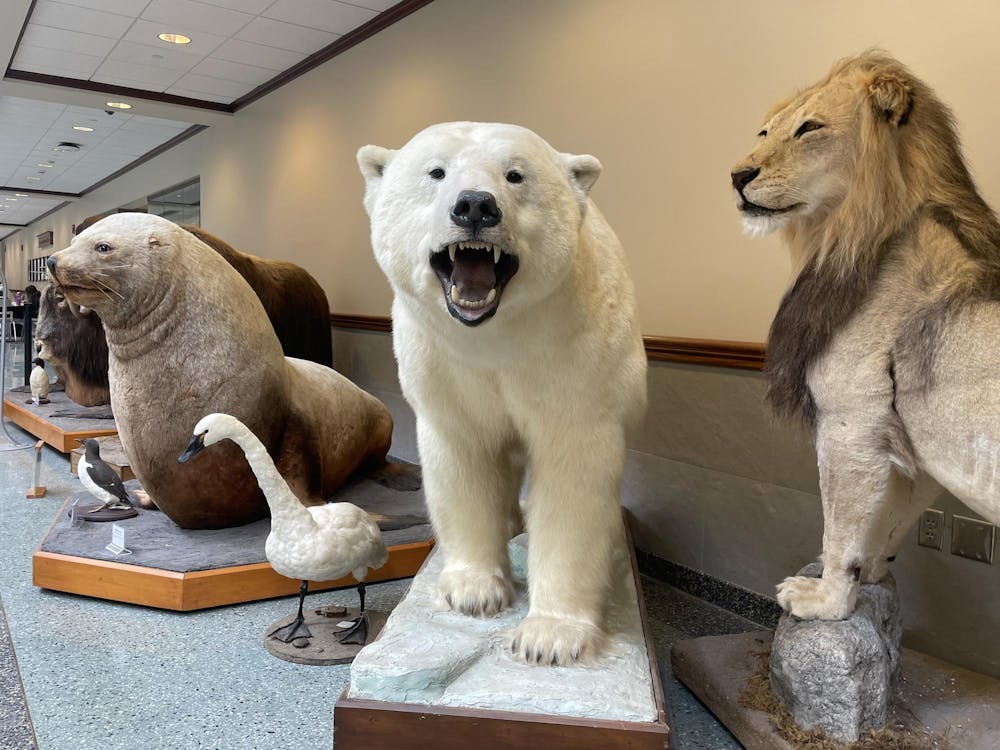
A polar bear, a 500 pound walrus and avian species from around the globe all went on display last month along the galleria of the Jordan Hall of Science.
The Museum of Biodiversity, led by curator Joanna Larson, is in charge of the animals — their care and upkeep, protection from vandalism and their location within the science hall or elsewhere.
“We trust that Notre Dame students are not going to try to ride the polar bear,” Larson said of the exhibit’s open placement in Jordan Hall.
The current collection of taxidermy was taken in two major acquisitions. Giraphael — the 15-foot Masai giraffe that has overlooked gallery visitors since January 2024, as well as a cheetah, hyena and a mountain goat, among others, originated from the Greensboro Science Center’s own biodiversity museum in Greensboro, North Carolina.
The Delbridge Museum of Natural History in Sioux Falls, South Dakota, which closed in 2024, gifted the walrus, polar bear and a zebra last year. The animals were acquired for free, though Notre Dame was asked to charter transportation on its own according to Larson.
Three lions, three tigers, three black bears, a snow leopard, a spirit bear — so-called for its white fur by First Nations peoples in the northwest United States and Canada — crocodiles and “a whole pack of wolves,” Larson said, also feature in the museum’s collection.
The biological collection of the University stretches back to its formative years, and when some specimens were added isn’t always clear.
In 1845, University founder and President Fr. Edward Sorin traded land he owned in Detroit for a collection of animals, birds, fish and other antiquities. Most of the collection went up in flames when the Main Building burned down in 1879.
The origins of the taxidermy themselves — when they were made and where — also isn’t always apparent. Larson said only pieces legally collected or vetted are accepted into the museum.
“Most of the bird taxidermy pieces that you see are 100, 150 years old, dating to the 1800s,” she said.
While Larson is the only full-time employee, student volunteers and research assistants carry out many of the museum’s operations. Part of this work involves developing methods for cleaning and restoring the animals without damaging them.
“The restoration process involves creativity and doing a deep dive into background research,” junior Madeline Galvin said. “It gives you a deeper appreciation of their biology.”
Galvin explained the full process of restoration for a bird can take anywhere from a few hours to multiple weeks. This involves detailed documentation prior to the restoration beginning, then cleaning, steaming and light painting, all while trying not to diminish the “scientific value,” Galvin said, of the specimen.
“If damage is more severe, I use a sealant to help reinforce the fragile areas, or if pieces are coming apart, additional wires or adhesive may be used,” she said.
Over 100 birds are housed in the University collection. Four cabinets display 24 of them on the south end of the galleria.
Senior Sebastian Benedetto was tasked with conceptualizing how the avian display should be organized.
“Our goal was to get our viewers to infer more basic ecological principles or evolutionary principles from observing these specimens,” he said.
Benedetto organizes the species into cabinets based on shared geographic location. Then, they were roughly divided by which “layer of the forest” each specimen would inhabit.
“On the forest floor, there’s a lot more camouflage. Then, as you get up higher into the levels, the bright plumage becomes more of a seen trait,” he mentioned, highlighting the unique characteristics inherent in birds who live in different regions of the forest ecosystem.
The rightmost cabinet includes specimens from the Americas. The top piece, a yellow-rumped cacique, includes a fact that the species builds colonies of nests in the forest canopy. A blue and white mockingbird, which lives in forest shrubbery accord to the Red List of Threatened Species, sits at the bottom of the cabinet.
A long term plan for the collection is still up in the air, but Larson says she is pushing for an expansion of the collection to include multiple locations around Notre Dame’s campus.
One near-certainty is the addition of a taxidermy tiger to the first floor of Hesburgh Library. The placement would call back to a tiger that existed in the University’s original collection.
The expansion carries logistical concerns as well, with the protection of the animals being paramount. Larson said custom glass cases will be built to protect the specimens outside of Jordan Hall of Science.
Most of the specimens are light, Larson explaining that she could pick the cheetah up herself to move it. The quarter-tonne walrus is an exception. Its skin is extremely heavy to protect the species from the blistering cold of the arctic.
Larson said the animals will be introduced to as many buildings as possible.
“If we can find a place to put them, we want them to be seen and interacted with,” she said, adding that an effort is being made for the taxidermy to be available to the Notre Dame and South Bend communities.