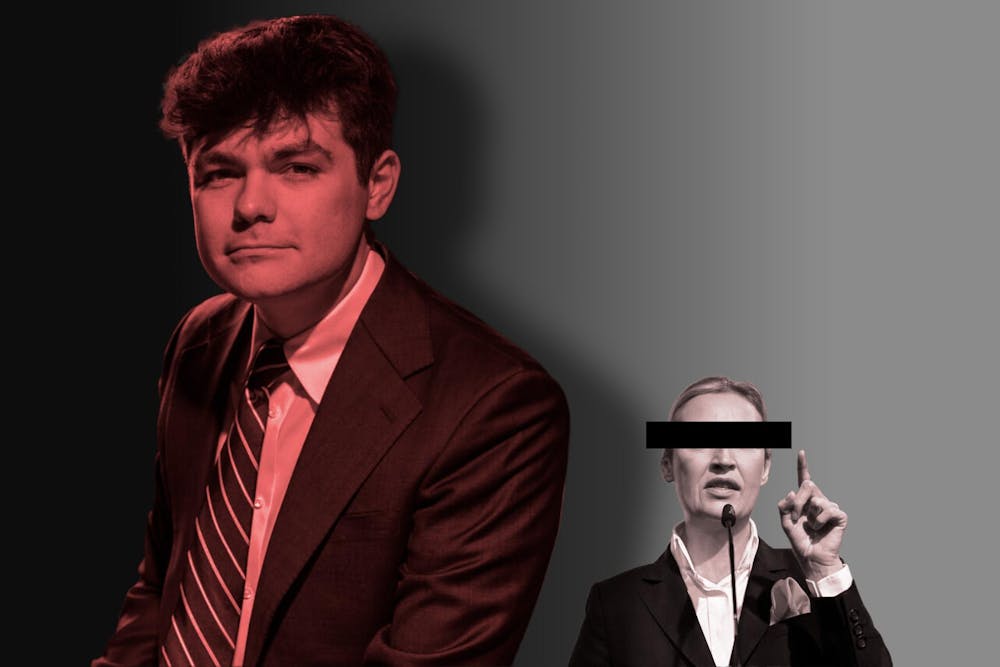
Germany is in crisis. The Alternative for Deutschland, the German far-right party, has climbed in popularity, while almost every other political party has declined in support. It is currently neck and neck in the polls with the CDU/CSU, Germany’s center-right political alliance. The AfD, which has been classified as “right extremist” by Germany’s domestic intelligence agency and which was caught discussing plans with neo-Nazis to deport German citizens descended from migrant groups, is a threat, but currently has no path to power. German political parties, institutions and the general public have all refused to cooperate with the AfD, denying them the ability to put their anti-democratic policies into practice. Germany is in crisis, and the Germans know it and act like it. This is miles away from how the United States has responded to a growing ideology that devalues life and is incompatible with democracy and Catholicism.
This sounds right now like another column about polarization and radicalization, in which I make an argument about how the Republicans are so right-wing, which will invite a response from a Republican about how the Democrats are the real radicals, and nothing of substance will be gained. This “both-sidesism” does have some truth to it: Republicans and Democrats have both shifted further to the right and left, respectively. This is a natural part of politics. However, I believe that there is a form of radicalization which is inherently malignant, and which is becoming more apparent in the upper echelons of power: the devaluation of life and expansion of government violence.
Violence is, to an extent, inherent to government. For a government’s actions to have any meaning, they need to be backed by force, but that force is usually a last resort. Unfortunately, our government is resorting to violence more and more. At home, U.S. Immigration and Customs Enforcement has become increasingly violent. LAst year saw the most deaths in ICE facilities in 20 years. Since Trump took office, eight people have been killed, and 19 have been wounded in shootings by ICE and Border Patrol agents. Abroad, the United States is engaged in a war with Iran that Cardinal Robert McElroy, the archbishop of Washington, has characterized as “not morally legitimate.” The war is being led by a defense secretary who promised, “maximum lethality, not tepid legality,” and has delivered with a war that has killed over 1,000 Iranians, including over 100 children in a school attack. Cardinal Blase Cupich of Chicago has criticized the Trump administration for showing footage of the war cut with action movie scenes, lamenting the “gamification” of war.
This cavalier attitude toward death at the highest echelons of power is occurring at the same time that an older ideology with an inherent disrespect toward life makes a resurgence: fascism. Nick Fuentes, a white supremacist who has praised Adolf Hitler and claims Jews run the world, has a growing and increasingly influential fanbase. According to a poll by the Manhattan Institute, an estimated 50% of Republican men under 50 agree with Fuentes that the Holocaust didn’t happen or was exaggerated. College Republicans — the national organization, not our campus chapter — recently appointed a Fuentes fan as political director.
The Trump administration is expanding the circumstances under which the government is willing to use violence, while a nascent fascist movement is rapidly expanding in numbers and influence. It would be disingenuous to suggest that no one is opposing this movement, but there is much to be desired. Confronted with the rise of right-wing extremism, German society has moved to ensure that the AfD is as far from power as possible. Every other major German political party, representing 74% of German voters, has refused to work with the AfD at the federal, state and local levels, preventing them from influencing government in a coalition. A number of German stores have signs asking AfD members to take their business elsewhere.
These measures may seem extreme if Germany were not a country littered with reminders of the cost of doing otherwise. In Germany, the streets are littered with small golden bricks called Stolpersteine. These stones sit outside the homes of people abducted by the Nazis. You can walk the streets of Berlin and see the cost of far-right extremism on your street, in the neighbors lost and families torn apart. An ideology of death cannot be reasoned with. It cannot be compromised with. Those who would sentence their fellow citizens to death for being a political inconvenience will rot the foundations of democracy with any modicum of power. If we are a Catholic university that upholds the sanctity of life, we must oppose the expansion of violence under the current administration, and we must strongly oppose the slow creep of fascism from the shadows.
Contact Patrick Kompare at pkompare@nd.edu.