The University of Notre Dame hosted its second annual Death Penalty Abolition Week March 23-27, bringing together exonerees, attorneys and advocates to discuss wrongful convictions and the movement to end capital punishment.
Sponsored by the Notre Dame Law School Exoneration Justice Clinic, the Institute for Social Concerns and the Klau Institute for Civil and Human Rights, the week featured a series of events focused on the human and legal consequences of the death penalty.
A central theme throughout the week was the risk of executing innocent individuals.
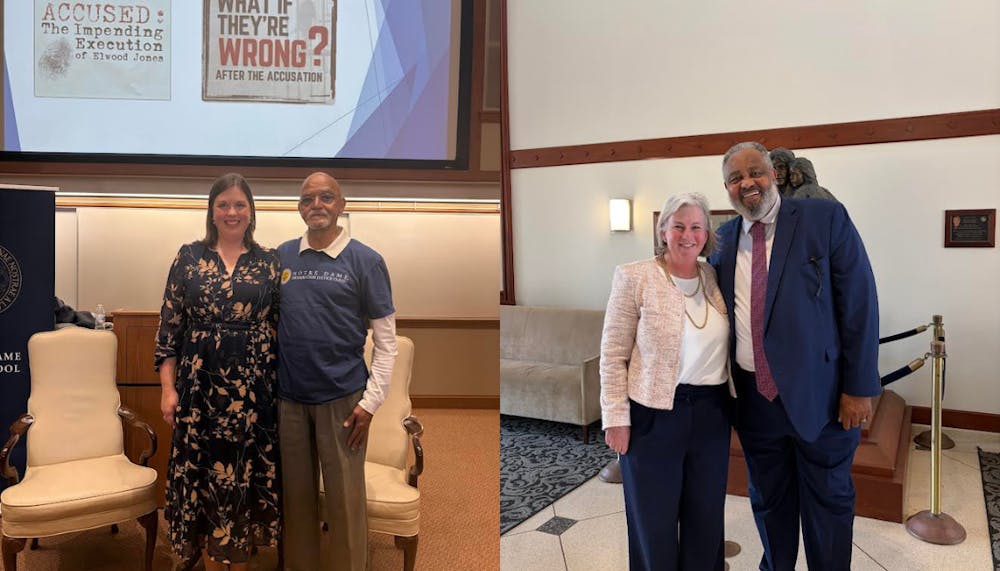
Tuesday’s event, “Defending the Innocent from Wrongful Execution,” featured federal public defender and Notre Dame alum Erin Barnhart and death row exoneree Elwood Jones, whose case highlighted systemic failures in criminal investigations and trial processes.
Barnhart noted the urgency of the situation, pointing to data from the National Registry of Exonerations, which has documented nearly 3,800 exonerations, including more than 200 individuals who were once sentenced to death.
Jones, who spent years on death row before being exonerated, said that his case was built on weak and incomplete evidence.
“There was no forensic evidence tying me to the crime,” he said.
Barnhart echoed these concerns, explaining that wrongful convictions often stem from investigative tunnel vision and systemic breakdowns. She pointed to overlooked evidence and gaps in the prosecution’s case, emphasizing that narratives can form easily around a suspect even without reliable proof.
Beyond the legal failures, Jones spoke about the lasting personal consequences of wrongful conviction. Even after his release, he has yet to receive compensation from the government for the years he lost. Instead, he has relied in part on community support, including a GoFundMe campaign, as he works to rebuild his life after incarceration.
“Every day, you’re reliving it,” Jones said, describing the emotional toll of revisiting his case through appeals and public retellings. His remarks underscored that exoneration does not mark the end of suffering but rather the beginning of a new set of challenges.
Thursday, author and exoneree Anthony Ray Hinton spoke about his experience spending nearly 30 years on Alabama’s death row for crimes he did not commit.
“At age 29, with no violent history, I was falsely convicted and sentenced to death,” Hinton said, recounting how mistaken identity and flawed forensic evidence led to his conviction.
Hinton described the psychological toll of solitary confinement and the uncertainty of awaiting execution, calling his time on death row “30 years of pure hell.”
Despite his eventual exoneration in 2015 following a unanimous U.S. Supreme Court decision, Hinton emphasized that justice was never fully restored. Hinton was exonerated with the help of civil rights attorney Bryan Stevenson, a nationally recognized advocate for death penalty reform.
“Where is my justice for the 30 years that I sat in that cell?” he said, pointing to the lack of compensation and accountability following his release.
Hinton also urged students to reflect on the broader implications of the death penalty, particularly the risk of irreversible error.
“Every time the state executes someone, they execute them in your name,” he said. “And if we get it wrong, there is nothing we can do to bring them back.”
The week concluded Friday with a panel titled “A Call to Action,” which shifted the focus from awareness to advocacy. Speakers included Kathleen Lucas, director of Pennsylvanians for Alternatives to the Death Penalty; Donna Schneweis, director of Kansas Coalition Against the Death Penalty; and Sarah Craft, the interim director of the Indiana Abolition Coalition, with Syl Schieber, an advocate for the elimination of the death penalty who earned his PhD in economics from Notre Dame, moderating the conversation. They emphasized that learning about wrongful convictions is only the first step and encouraged students to translate that knowledge into concrete action.
Panelists highlighted the importance of legislative advocacy, urging students to contact lawmakers and engage directly in policy discussions. They noted that many legislators lack a clear understanding of how the death penalty operates in practice, making education and sustained dialogue critical tools for change.
Speakers also underscored the long-term nature of abolition work, explaining that meaningful change often comes through repeated conversations with policymakers over time. In some cases, advocates have seen legislators shift their positions after continued engagement and exposure to new information.
Other events throughout the week included Bishop Kevin Rhoades presiding over the 5:15 basilica Mass on Tuesday and Sister Helen Prejean reflecting on her life's work opposing the death penalty within the Catholic Church.