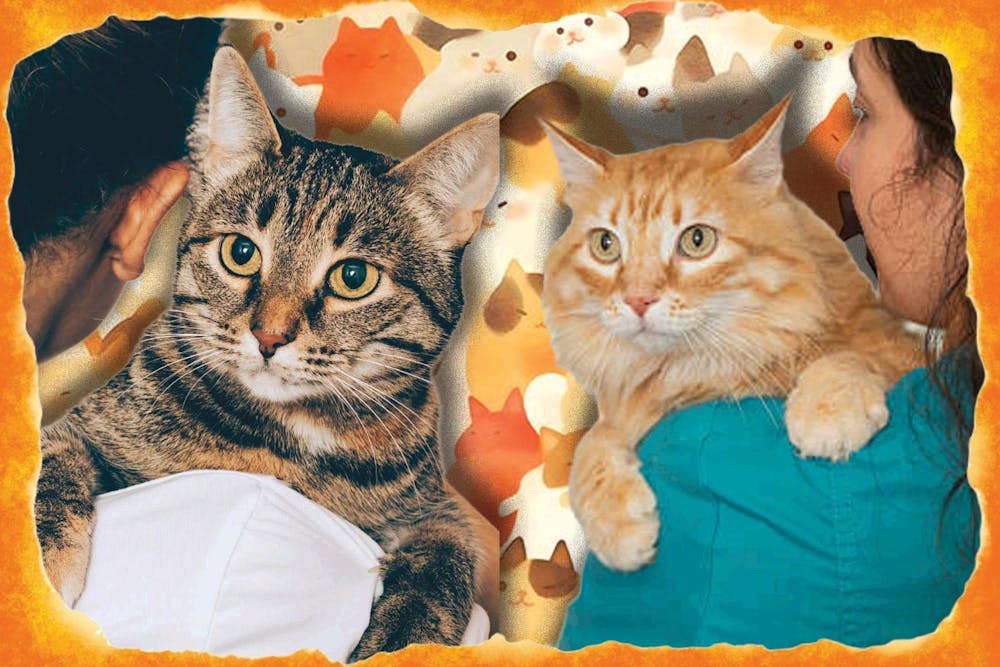
I became a cat person five years ago. My then-wife and I were making our way to the side door of our apartment building in downtown South Bend when an emaciated gray tabby suddenly wrapped itself around her legs. After taking the kitten to the vet for a checkup and making sure no one was looking for her, we adopted the cat and named her Fidelina, or Lina, in English. Then, thinking she could use some company, we went to the Cat Cafe at the Commerce Center in South Bend and brought home Nemo, a dark, grayish cat with a white spot above his chest like a bow tie on a tuxedo.
When my ex and I split in late 2024, she moved back to Mexico, and I stayed in South Bend with the cats. I told her she could take Lina and Nemo with her, but she thought it would be too much of a hassle to cross international borders with them. I also thought there was another reason she didn’t want to take the cats. For most of her life, my ex had been a dog person. Me, I had had no pets in my life other than goldfish and ants when I was a child. And those, in my view, don’t really count. So, it seemed I was a prime candidate to become a single cat parent.
Cat people, especially men, are often portrayed unflatteringly in literature and pop culture. In fact, the most-read American short story of the last decade features a single man in his thirties with a cat as its chief antagonist. Published online in The New Yorker magazine around the time of the #MeToo movement, Kristen Rupoenian’s 2017 short story “Cat Person” went viral for its portrayal of a bad romance between a female college student and a man a decade her elder. Roupenian spins a yarn about bad sex, stalking and texting that embodied the feminist grievances at the core of #MeToo. Rupoenian later garnered bad press after it was revealed she had based the story on real people without their consent. Additionally, the man who inspired the character of Robert, the guy with the cat, died suddenly in the early years of the pandemic, adding to the paratextual controversy around the story.
On the other side of the gender binary, there is the stereotype of the crazy cat lady. “The Simpsons,” for instance, occasionally shows a disheveled older woman ambling through the streets and spouting nonsense while a cat sits perched on her shoulder. In one of my favorite books, Sandra Cisneros’ collection of vignettes, “The House on Mango Street,” protagonist Esperanza Cordero describes her neighbor Cathy as the “queen of cats.” Cathy, the child narrator says, has “baby cats, big cats, skinny cats. Cats asleep like little donuts. Cats on top of the refrigerator. Cats taking a walk on the dinner table. Her house is like cat heaven.” Cathy is not crazy, per se, but the narrative paints her as a racist seeking to leave amid the Latino influx into their Chicago neighborhood. In the world-making of the text, racism functions as a kind of paranoia akin to mental illness, one closely linked to Cathy’s obsession with cats.
And then, of course, there is the association of cats with bad luck, superstition and even witchcraft. According to a book on cats that I bought shortly after becoming a cat dad, these stereotypes were especially pronounced during the Middle Ages in Europe. Cats were believed to be in cahoots with the devil and were often blamed for all sorts of misfortunes and maladies. On the other hand, in ancient Egypt, cats were supposedly revered for their beauty and physical abilities. In the 2004 film “Catwoman,” starring Halle Berry as the titular superhero, the main character, Patience, a shy graphic designer, drowns after unwittingly discovering corporate malfeasance and being chased by security guards at a giant cosmetics company. A rare Egyptian Mau cat bestows upon her supernatural powers, and Patience is reborn as Catwoman, a leather-clad, whip-wielding badass who fights crime in the city but who also has a penchant for stealing jewelry.
So far, I haven’t developed superhuman abilities and I haven’t yet become a witch or a witcher. But I’ve found myself musing about how taking care of Nemo and Lina has changed me. For one, I’ve become more attentive to the importance of keeping a normal schedule. I start my work day early and try to be home by five or six so that they don’t spend too much time alone. Twice a week I clean out their litterbox, and four times a day I give them food — two servings in the morning before leaving for work and two servings in the evening when I come back home. I have to keep a steady supply of both canned meat and clay litter around. I also have to clean more than I would ordinarily given how much fur Lina sheds and the mess that tends to develop around the litter box. My cats are my anchors, reminding me of my daily responsibilities and the importance of keeping myself disciplined in order to get my work and chores done.
Truly, it’s a blessing to have them at home. Lina’s fur and purring are luxurious, and Nemo delights me with his crazy antics. Both of them, though, make me pay for keeping them cooped up in my apartment. Lina likes to bite at my ankles when she gets hangry and she often swipes at me when I pass through my bedroom threshold. Nemo has a penchant for hopping onto my back and shoulders, leaving bloody scratches all over my torso. I have to put him in the bathroom when I eat and cook because otherwise he is all over my food. When I go to sleep, I close my door so that they don’t wake me up in the middle of the night to feed them. They’re a joy to have, but they’ve also taught the virtue of patience and gentleness. I nurture them, and they nurture me.
Of course, I can’t help but wonder whether all this is symptomatic of the modern malaise of dysfunctional relationships and falling birthrates. At my age, I should have a family, with real kids, in addition to pets, I guess. And a house in the suburbs, why not? That, after all, is the American Dream. But for now, I guess I’ll settle for being a cat person. A good one. Peace.
Oliver "Oli" Ortega is a Ph.D. candidate in English specializing in contemporary Mexican-American and Latino literatures. Originally from Queens, NY, he has called the Midwest home for 15 years. He lives in downtown South Bend. You can contact Oliver at oortega1@nd.edu.