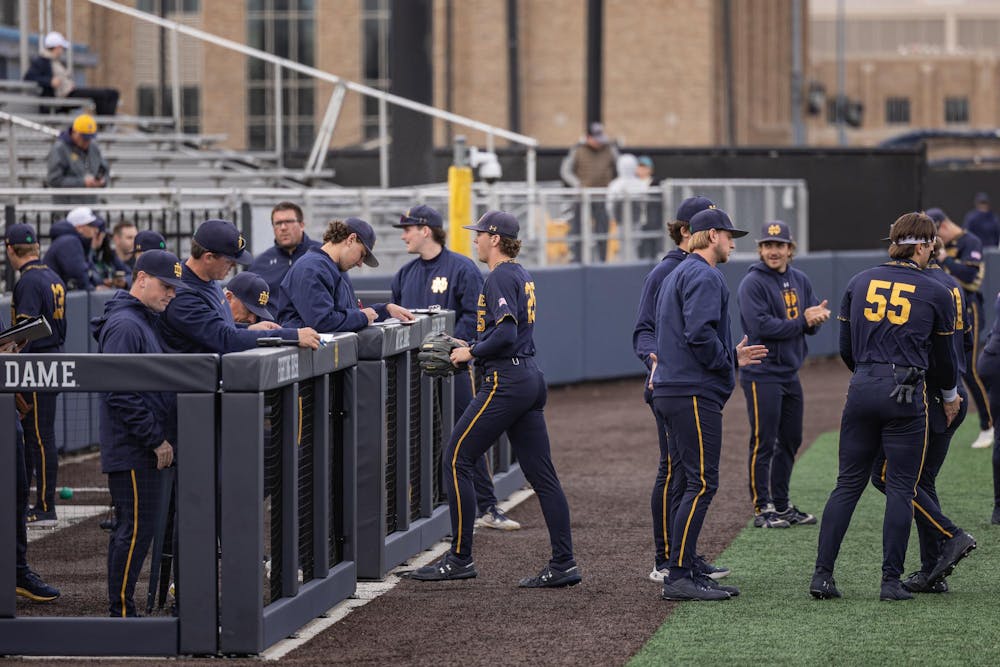
If there’s one word that guides Seth Voltz’s coaching philosophy, it’s development. Voltz, now in his fourth year as head pitching coach for Notre Dame baseball, approaches coaching each pitcher on his staff in an individualized way.
“I think you treat everyone differently,” Voltz explained. “When you recruit guys, whether they’re 22 or 17, you have a plan for them.”
Voltz feels comfortable implementing his growth-oriented, intentional approach at Notre Dame because, in his eyes, it fits what Irish athletics is all about.
“Our program is always going to be built on development. I mean, that’s the Notre Dame way,” he said. “You get some of the best student-athletes in the country, and they wanna be here, and you gotta develop them.”
Voltz also acknowledged that focusing on development might be an unorthodox style of coaching in the transfer-portal, name, image and likeness-heavy landscape of ACC baseball.
“Some programs now are just grabbing older guys out of the portal, and I’m not gonna say they aren’t developing them, but their lineup may have 600 at-bats across the whole nine, and then they have pitchers that have 200 innings under their belt,” Voltz observed. For context, an everyday college hitter logs around 160-180 at-bats per season, while an established weekend starter records around 60-70 innings in a full campaign.
It’s unlikely the transfer portal-dependent method to roster construction will ever work for Notre Dame, which can’t attract top portal recruits like Florida State, UNC, Wake Forest and other ACC powers can. Instead, the program’s spotlight on maturation, both on the field and in the classroom, is what sets them apart in a crowded recruiting conference class each year. As Voltz explained, “the [the transfer-dependent model] ... that’s not our model, we’re okay with that. It’ll always be about development.”
If there’s been a poster boy for the success of Voltz’s coaching this year, it has to be Friday night ace Jack Radel. The staff workhorse currently sports a 3-1 record and a 2.41 ERA over 41.0 innings this season; nine of those innings came in a masterful complete game shutout of then-No. 19 Clemson, whom the Irish eventually swept.
While Radel was solid last year, Voltz credited the big leap forward he’s made this year to the focused, perfectionist way the junior righty attacks his own development.
“He’s an incredible person who’s motivated, who’s mature, who can make what’s in front of him very important,” Voltz said of Randal. It’s those competitive attributes that have allowed the mechanical tweaks and new pitch shapes Voltz has recommended, like a new change-up and an improved curveball, to really supercharge his game on the mound.
But Voltz was quick to point out that it’s not just Radel succeeding on the bump for the Irish this year. Righty Ty Uber, a graduate transfer from Stanford, has locked down the Sunday starting role — one that Voltz envisioned for him when he recruited Uber for the Irish. Voltz credited the graduate for embracing such a role after being primarily used in long-relief by the Cardinal.
“We put a lot on Ty’s plate in the fall, from a development standpoint — you know, delivery, tried a few pitch types, some zone adjustments,” Voltz recalled. “He was very open-minded to all of them, and we started to see it click in the pre-spring … he’s been incredible.”
Voltz’s critical focus on growth has been a big reason why the Irish are off to a hot start this season. The team owns a 15-9 overall record and a 6-6 mark in conference play — Notre Dame’s best start in ACC action under head coach Shawn Stiffler, now in his fourth year at the helm. The Irish even earned a No. 23 national ranking two weekends ago after sweeping the ranked Tigers.
While the offense has been productive, the team’s fortunes, especially in ACC play, seem to rest on the performance of the pitching staff. Notre Dame is 2-2 in conference weekend tilts, with the pitching propelling them to encouraging wins over Duke and Clemson, while faltering in losses to Louisville and UNC. The series wins provide a tantalizing glimpse of where Voltz is taking the staff, while the losses serve as a reminder that growth is nonlinear and takes time and patience.
Voltz isn’t deterred by the setbacks. Speaking before the UNC series, he reflected, “I think, you know, other than Louisville, where we had a bump in the road, [the pitching] has been very good.”
If the pitching staff continues to embrace Voltz’s development plan for each of them, and if they continue to be very good, they might just lead the team to its first NCAA postseason berth since 2021.