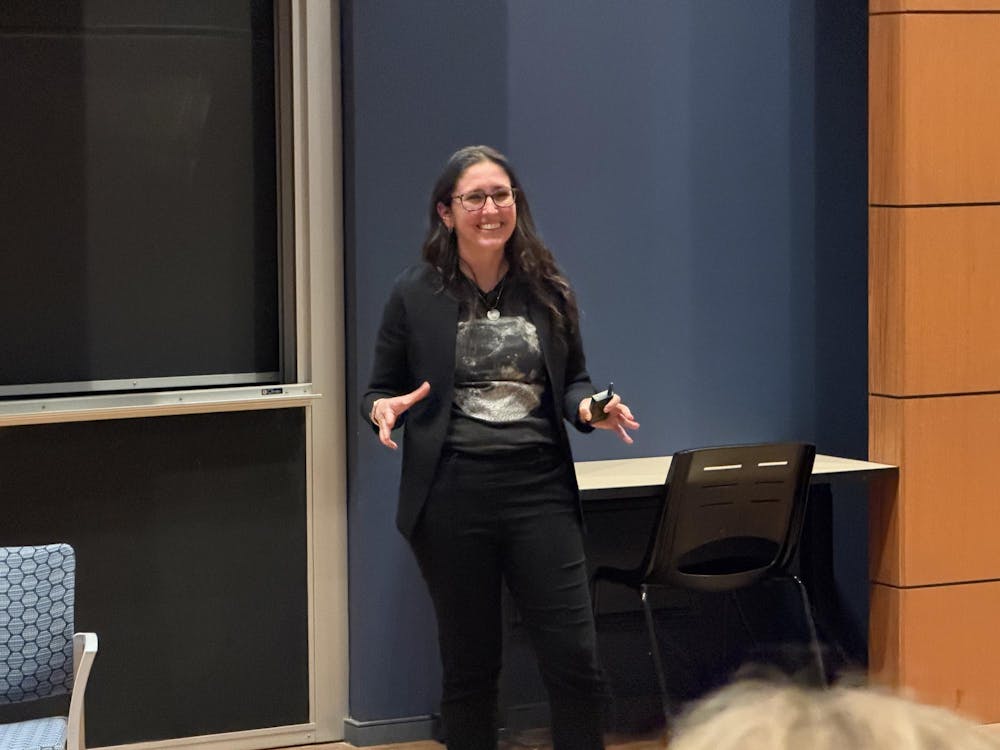
The geological sciences major’s legacy remains visible since it has been absorbed into the Earth sciences concentration in the Department of Civil and Environmental Engineering and Earth Sciences. One example is Kelsey Evans Young, a 2009 Notre Dame graduate who serves as Artemis science flight operations lead as well as the Artemis II lunar observations and imaging campaign lead at NASA.
Young returned to her alma mater April 28 for the first time since 2016 to give a lecture titled “Artemis Lunar Science” in DeBartolo Hall.
The lecture began with a video introduction to the Artemis II mission, followed by remarks from Clive Neal, professor of civil and environmental engineering and earth sciences, who taught Young when she was a student.
Young received her master’s and doctoral degrees from Arizona State University and worked at the Lyndon B. Johnson Space Center before becoming a civil servant involved in the Artemis II mission.
Young said her interest in geology began in Neal’s physical geology class during her freshman year, where she realized geology could be used to study not only Earth, but other planets.
Young has helped develop a handheld X-ray fluorescence spectrometer and became the first science officer to sit on console in Mission Control during an Artemis mission.
Young said the Apollo missions were “generational in what they provided to lunar and planetary science.” She said Artemis builds on those missions and other lunar orbiters from the early years of spaceflight.
The mission launched April 1 from Kennedy Space Center at Cape Canaveral, Florida. Young showed the audience the mission’s flight path and said it was the first flight of the Orion spacecraft. The crew used three Nikon cameras with three different lenses to take photographs from space. They were also tasked with making verbal descriptions of what they saw and annotating their images.
Young displayed several images of the moon taken by the Artemis II astronauts, who flew roughly 5,000 miles from the lunar surface. She said astronauts were able to view parts of the far side of the moon that had not previously been seen from that perspective.
The astronauts also photographed Earth before the moon flyby. As lead scientist, Young said she spoke with the astronauts immediately before and after the flyby.
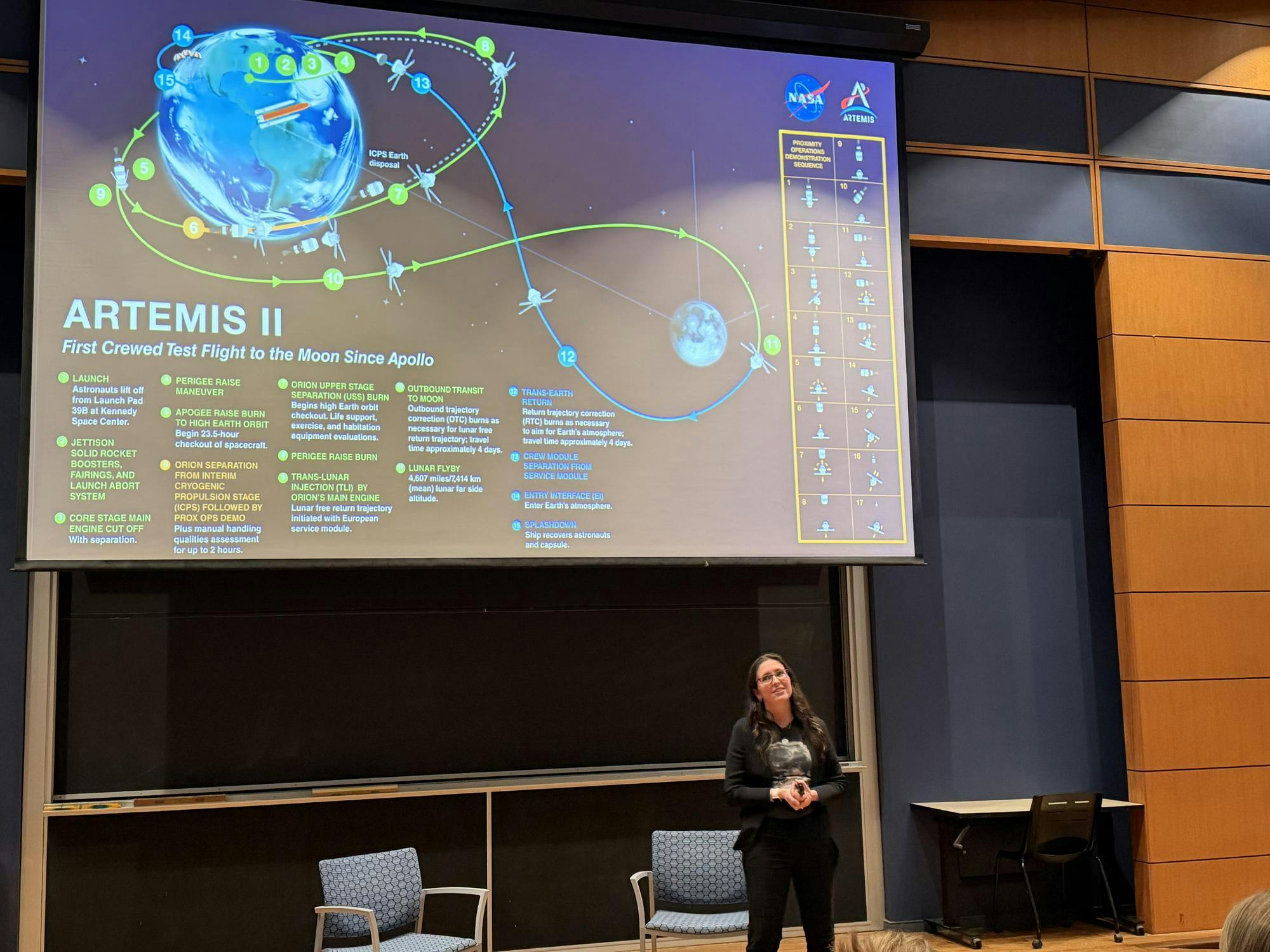
Young shows the audience the flight path taken by the Artemis II rocket.
Young described the Lunar Geography Review and Lunar Targeting Plan, two tools used to help astronauts understand what they were viewing and what they were supposed to photograph.
Young said the flyby went smoothly because of the training NASA put the crew through. The preparation included taking astronauts to the Icelandic Highlands to study topography, training them in camera use and preparing them for worst-case scenarios.
As the crew got closer to the moon, Young said, “you could just feel the excitement and the passion start to rush up with the crew.”
Young also described the crew’s reaction as they approached the moon.
“They had this childlike joy,” Young said.
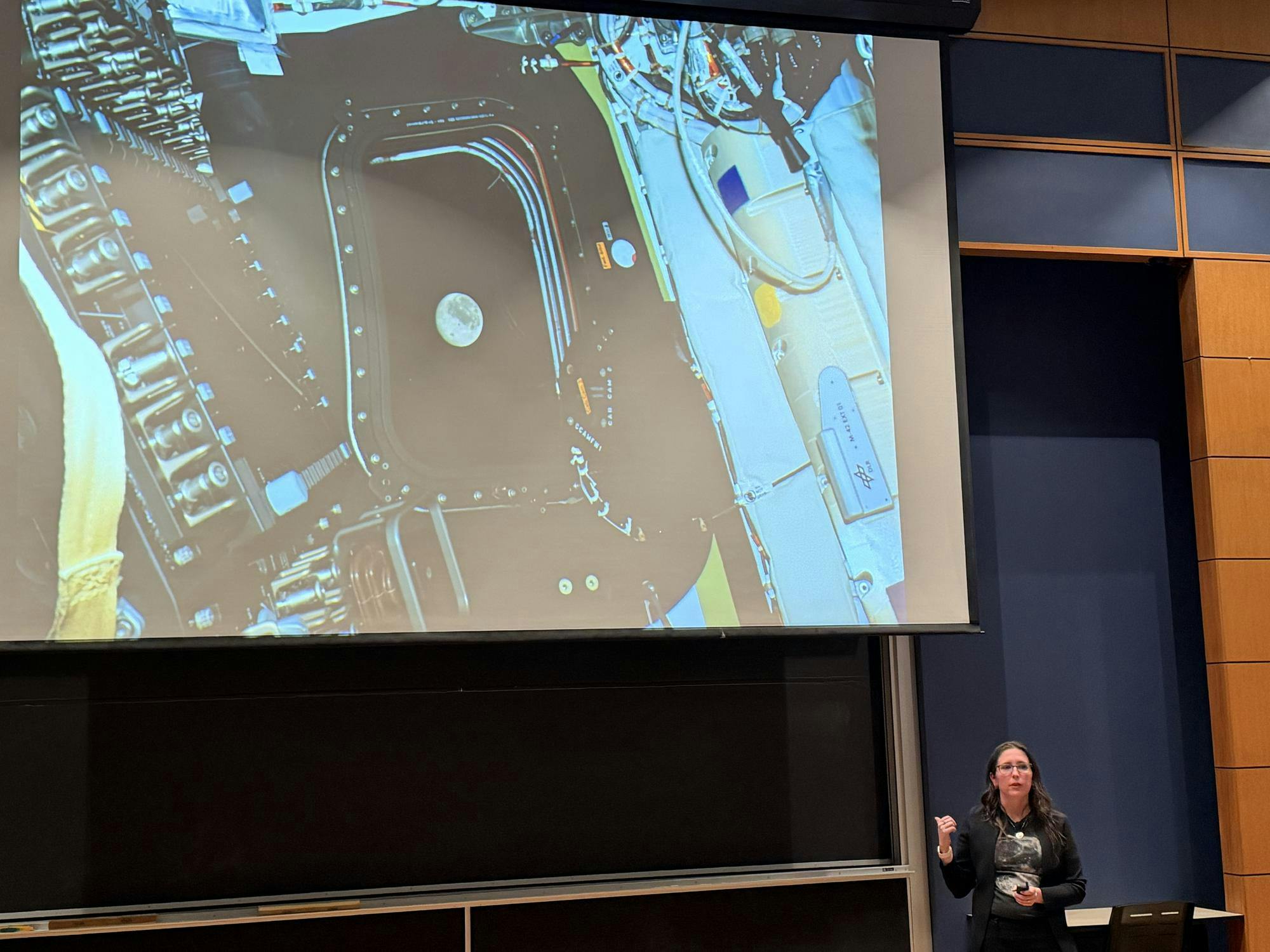
Young showed what she described as her “all-time favorite photo” from the Artemis II Mission.
She discussed several geologic features on the moon, including Aristarchus, an impact crater, and Mare Orientale, an impact basin. The crew also photographed “Earth-set,” a solar eclipse from the moon’s perspective and views facing away from the moon into the solar system. Young said the crew also saw impact flashes on the moon.
Young said the team on Earth felt “moon joy.”
“We were so, so, so happy and full of pride and full of joy,” Young said.
During the question-and-answer period, Jack Benchik, a 1965 Notre Dame graduate, said he studied geology and worked as a lunar geologist on Apollo 11. Benchik asked about cooperation between NASA and the U.S. Geological Survey.
Young said the next goal is to create a moon base to support the “next generation of lunar science.”
Speaking with The Observer after the lecture, Young said returning to South Bend caused her to reflect on the impact of her Notre Dame education.
She specifically pointed to “the interdisciplinary nature of the education and experiences I got here.”
“Because geology was integrated into engineering, I was required to, and given the opportunity to take, engineering classes in addition to the fundamental building block geology classes,” Young said.
Young said the department required her to take two spring break geology trips. She also took a research trip to Iceland, after which she presented at a conference. She said those experiences helped lead her to her current career.
“I think it kind of started me developing the confidence to chart my own path a little bit and not be freaked out, but rather inspired by this idea that not having a path laid out in front of you actually represents this world of opportunity,” Young said.
Young also offered advice to Notre Dame students.
“Don’t do something just because you think that’s the right thing to do,” Young said. “Do it because you love it and you’re interested in it.”
“Not every class you’re going to take and not every internship you’re going to do, you’re going to love every second of it,” Young said. “But if you love the destination that you have in mind, it’s going to make all those other things much easier and totally worthwhile. Do what excites you, do what’s going to make you excited to go to work every day and surround yourself with people who think the same way.”