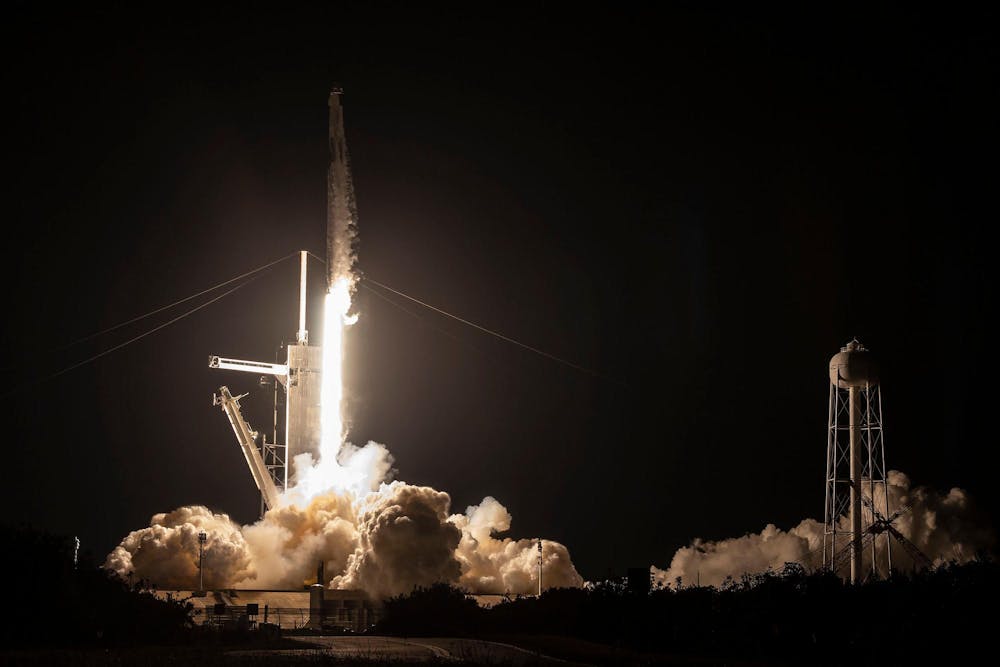
IrishSAT, an undergraduate student-run club at Notre Dame, recently launched their Compact High Accuracy Reduced Power Magnetorquer Satellite, also known as CHARMS, aboard a SpaceX Falcon 9 on the Transporter-16 mission. This marks IrishSAT’s first hardware in space.
Sarah Kopfer, who graduated from Notre Dame in 2025, is currently an avionics engineer on the Blue Origin lunar program. During her time as an undergraduate student, she was a member of IrishSAT, serving as the chief technical officer her junior year and then president her senior year.
Kopfer explained that IrishSAT had a goal of building a cube satellite but did not have a way to get it into space. Eventually, they were asked to meet with Near Space Education, who had received a federal education grant.
“They offered us a free ride up in 2026, which was so exciting, but it meant a super-fast turnaround. We only had about a year from start to finish to deliver our entire satellite,” Kopfer said.
CHARMS is a payload onboard a larger Near Space Education cube satellite.
Jackson O’Neill, outgoing president of IrishSAT, described the size of CHARMS, saying, “It is about a ham sandwich that is sitting on top of maybe two ham sandwiches.”
The project they set out to solve with CHARMS is one of stabilizing a tumbling CubeSat.
Tyler Hanson, senior and outgoing chief technical officer, said that when cube satellites are deployed from the rocket, they are spinning and “it is almost impossible to send any form of communication to it.” This is an issue for lack of communication, but also when the satellites are unable to orient themselves, they cannot get solar power.
Traditionally, cube satellites stabilize with a combination of reaction wheels and magnetorquers, but this equipment is bulky and expensive, according to Hanson.
“We wanted to make this low-cost and low-power so that it would be very accessible not only to industry but also other CubeSat teams and collegiate teams that might be working on kind of a limited budget,” O’Neill said.
To do this, O’Neill said they only use magnetorquers. The core idea of a magnetorquer is it creates a magnetic field by running a current through a coiled copper wire, and the magnetic field can then react with Earth’s magnetic field to stabilize the satellite.
“There are companies that make things like this, but based on all of our testing, we were outpacing those specs by a lot,” Kopfer said.
According to O’Neill, the development costs for CHARMS added up to about $4,000, but the unit itself was only about $1,500.
“Most of our cost reduction comes from doing everything in-house. The most interesting piece of technology, in my mind, that we built was a magnetorquer wrapper.” O’Neill said. “For the magnetorquers that are about the size of your finger, we wrapped it over 2,000 times. We did not want to do that by hand, so we actually made an automated machine that could do that.”
Most of their work is open source between the electrical engineering senior design website and the IrishSAT website, according to Kopfer.
“We are not a profit corporation, so people can take our designs as they see fit. We have not published anything on our website specifically about the printed circuit board or the dimensions of the mechanical stuff of the payload, but we actually just published a document about the software,” O’Neill said.
The team expressed excitement toward seeing the project finally launch.
“I keep saying really cool, but I think that does not really cut it,” Hanson said. “It is just so cool because I remember when we were giving it off to SpaceX to send. We were doing our final testing, final integration, I was holding it and I was like this thing is going to be up there.”
Kopfer shared this excitement.
“It is really exciting to have finally hit that milestone. It has been something I have been wanting for 10 years now, so it is so rewarding and it just feels like the perfect let go of college into career because now that is what I get to work on every single day,” Kopfer said. “Getting to see it launch then the other day was so absolutely exciting. It was 4 a.m. for me, so I set my alarm and woke up and watched it go up and get deployed. We could actually see it shoot off into space off of the rocket, so it was really cool.”
As of Wednesday, O’Neill said they had heard from Near Spaced Education that their satellite was turned on for a minute or two and received some communications that it is on and working.
“We are excited to start the mission operations phase,” he said.
IrishSAT is still striving to build a CubeSat of their own. Hanson explained this would be not only a cool build of their own, but it could carry a payload of antenna research by Jonathan Chisum, an electrical engineering professor, to space. They have applied to the NASA CubeSat Launch Initiative program the last several years but have not yet won.
“When we do get that, they will cover the launch cost which is like 90% of the cost of building a cube satellite,” Hanson said.
Editor's Note: A previous version of this story misspelled Jackson O'Neill's name.