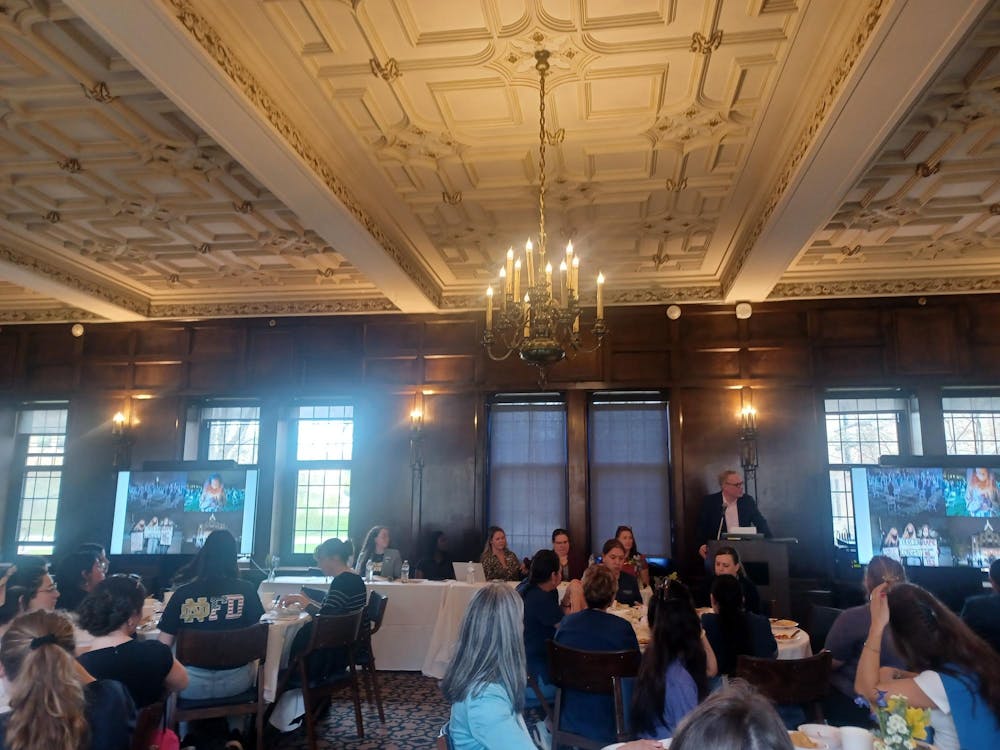
Saint Mary’s alumnae and former faculty returned to speak at the 2026 Raise Your Voice Symposium keynote panel. In 2021, College President Katie Conboy established this symposium as a means to address, respond to and develop awareness toward sexual violence occurring within and outside of the tri-campus community.
Redgina Hill, vice president of belonging, opened the event and recognized the Committee for Sexual Violence Prevention, a subcommittee of which organized the symposium. She also thanked Tom and Mary Seeberg with a round of applause given by the audience for their time.
Tom and Mary Seeberg are the parents of Lizzy Seeberg, a late student of Saint Mary’s College who experienced sexual assault as a freshman. After filing a police report for sexual assault against former Notre Dame football player Prince Shembo, she received severe backlash and harassment for the report. Seeberg committed suicide September 10, 2010, 10 days after filing the report. A memorial garden and plaque was created in her memory and is the sight for annual prayer services in her name.
After recognizing survivors in the room, she followed with a prayer. Food service was provided from Aromas Durango and All Over Creations.
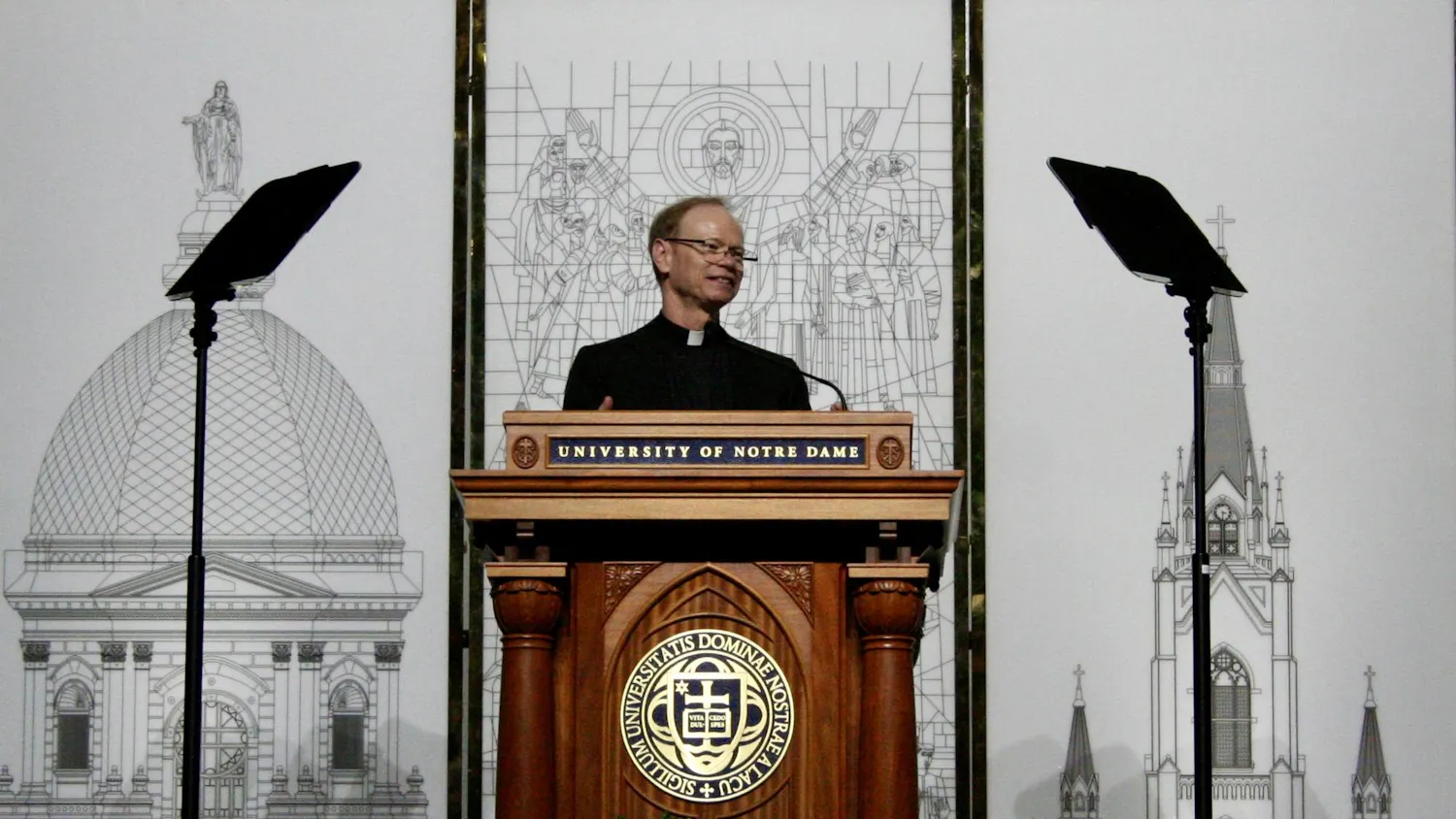
The keynote panel began at 12:30 p.m. with Tom Seeberg as the opening keynote speaker. He shared gratitude for the support his family recieved following Lizzy Seeberg’s death.
“We’re very blessed people. And you might think through some of the things we’ve been through, we might we might not say something like that,” he said. “But I will tell you, even in the early days of losing Lizzy and the drama that followed, the blessings started to come in.”
He shared that though the 2015, “The Hunting Ground,” was a developed advocacy piece, he was disappointed that they did not mention the actions and support the Saint Mary’s administration gave following Lizzy Seeberg’s assault.
Tom Seeberg noted that administrative members like former vice president for student affairs Karen Johnson and former Belles Against Violence Office (BAVO) coordinator Connie Adams ‘08 made efforts to not only stick by Lizzy Seeberg in the hospital, but they also came down to Chicago to the family’s home to discuss how the assault was reported and how the administration was made aware of it.
He also mentioned the development of the Memorandum of Understanding, when first Adams and Tom Seeberg sat down to talk about the lack of tri-campus support and communication given to Lizzy Seeberg. Progress was only made seven years later with its establishment and requirement of signatures for each tri-campus institution.
“We talked about how awkward it was that a survivor could report an incident across the street, and there was really nothing in that process where there would be a question to say, ‘Do you need help when you come back across the street to Saint Mary’s?’” he stated. “It was like one of those things where … structurally, there’s a sin of omission or sin of commission.”
He shared that in the age of social media, many actions can be shallow, but others can be genuine, including the institutions and the audience that plays a part in representing larger issues.
“But if you act, and you advocate out of love and wanting to make it better, about building something better, it tends to work out better for us moving towards … from what I call from a culture of compliance. And Lord knows higher ed has a lot of needs to be compliant, but moving towards a culture of commitment is where we want to be,” Tom Seeberg said.
Following a discussion of how universities can improve with conflict of interest police agencies and an increase in mental health resources, the keynote panel began. Founding director of student empowerment Christin Kloski ‘15 moderated the panel with Adams and guest speakers Jackie Zins ‘04, Kayla Gaughan ‘17, Elizabeth Quaye ‘17 and Grace Maher ‘21.
Zins began the conversation, discussing Take Back the Night and how it advocates against sexual violence globally. In bringing this initiative to the College in 2003, she explained how it was built and later grew to become a continuous legacy at Saint Mary’s. In its first year cycle at Saint Mary’s, it grew from 20 participants to 115.
In an interview with The Observer, Zins, a school psychologist, discussed how important it is to know the legacy of an event such as Take Back the Night and how it plays a role in the daily lives of students.
“It is an event where essentially the importance and the impact are that survivors are heard and believed, and they have a communal people showing up for them,” she said. “And I think that is one of the most important things we can do, I think, as participants in the event, is to show up for other people.”
Adams then talked about her role as the inaugural BAVO coordinator, when the office was launched through a grant provided to the College from the U.S. Department of Justice in 2009.
She discussed further partnerships that were established from there, including her building the BAVO Student Advisory Committee that ensured a place of connection and advocacy for students, alongside bringing GreenDot bystander training to Saint Mary’s and providing an official kickoff event for Take Back the Night.
She recalled one of the most memorable moments of her career, which was when a group of students chanted, “Green Dot,” outside of her office one day after an encounter they stepped in on.
“One of my proudest moments as a staff member was walking into the dining hall one day, and this is during the orientation time, and I had a couple of groups of student leaders that started chanting, ‘Green Dot, Green Dot, Green Dot.’ And I walked over and they had shared an intervention that they had done the night before,” she said. “Someone that was being led away at a party and they had the skills to safely step in and to keep that person safe. I have more of those stories than I can share, but it’s those moments — that’s what this is about.”
In an interview with The Observer, she shared hopes that students and faculty can learn from the symposium how to take a stance and be an advocate against sexual violence.
“Each of us has a role to play in this work, even if we never directly encounter these topics,” she said. “These issues in our personal lives, we have a role to play in how we are generating a stance to prevent and end sexual violence and that is central to what the Raise Your Voice symposium is striving to do.”
Gaughan discussed organizing the Sl*t Walk in 2014, where they used Saint Mary’s mission statement as a guide to form the goal of ending victim blaming. She worked with both the tri-campus and South Bend communities in gathering marchers to create a difference.
“The Sl*t Walk came about because a bunch of us were in some dorm rooms and some other community spaces on campus, and we were frustrated about victim blaming,” she mentioned. “It’s rampant; it is really frustrating, and people were using the word ‘sl*t’ as a way to rationalize or blame others, and I wanted to reclaim it. Now it wasn’t just me, there was a community of us.”
When “The Hunting Ground,” documentary was released in 2015, she and a group of students hosted the first screening of it. About 200 people came to the screening in Opus Hall.
Quaye then presented on the “I’m Someone” project that she launched with five other people in 2015 to protest against sexual violence during a Notre Dame football gameday, for the Study of the U.S. Institute (SUSI) program within the Center For Women’s Intercultural Leadership (CWIL). It was repeated twice more and launched various successive movements following the protest.
White bandanas were worn across the mouth to symbolize the voicelessness that society often perpetuates to survivors.
“We wanted to be intentional and not just streamline the name to be a woman’s issue. We wanted to stand for bringing awareness to sexual assault on college campuses, because this is where we have an impact,” she said.
Maher was the last keynote speaker, discussing the impact that the class of 2021 had at Saint Mary’s following the publication of Zahm’s derogatory culture towards smicks in 2021.
She shared that though this came at no surprise, it established the need for the campus to come together during the troubling time.
“Campus truly never felt closer together. Students from the class of 2021 and leadership positions took to social media and to The Observer to share statements of support for our fellow students,” she shared. “They organized events, went with college leadership, all in an effort to create lasting change.”
In an interview with The Observer, she explained the Raise Your Voice Symposium was an act by the administration to demonstrate a prioritization of the student population’s wellbeing. She reflected on what the first Raise Your Voice Symposium looked like.
“So the original Raise Your Voice actually was a week long, and there were several events that happened. There were lectures, workshops, research panels, and the entire week was geared around education and sort of raising awareness for our community and the broader community,” she said. “Because more often than not, there are a lot of people who don’t understand everything that constitutes sexual violence, and so many people have experienced it and not even realized it themselves.”
Following a moderated Q&A, closing remarks were given by Adriana Petty ‘01, the director of multicultural and international student services, and Shay Jolly Schneider ‘05, associate dean of students. Senior Kayli Zelinske-Mader then closed the event with her poem, “Oh, to be a woman.”