In interviews with The Observer, Haleigh Ehmsen '16 and Jennifer Vosters ‘16, former Observer staff members and graduates of Saint Mary’s, discussed their experiences as both students and writers during the release of the documentary “The Hunting Ground” in 2015. They also reflected upon general tri-campus sentiments at the time.
Ehmsen shared that she felt Saint Mary's handled the documentary's release properly compared to other universities and respected the actions taken by the College itself.
“Saint Mary’s really embraced the documentary in a way that was like, ‘we’re going to share this because this is a conversation topic that we need to be talking about, that our institution is very included in. But we’re going to do that in a way that is safe for students on campus’ … I was reminded of how the administration at the time really wanted students to be able to watch this … and process it together as a community,” Ehmsen said.
As a freshman at Saint Mary’s, Vosters inquired about who was responsible for the handling of sexual misconduct cases of Saint Mary’s students by perpetrators from Notre Dame.
She reflected upon how the situation left her confused and angry about the lack of response both institutions had towards sexual violence at the time, especially with Lizzy Seeberg’s death.
“I remember I felt really kind of angry about that, and was angry a little bit at Saint Mary's for not pushing to figure that out. At least from my perspective, it seemed like there was more Saint Mary's could be doing to hold Notre Dame accountable … Also I felt really angry towards Notre Dame as an institution for not taking this seriously, for not making it a priority … particularly for Saint Mary's students who didn't have the kind of recourse it seemed because we weren't enrolled there,” Vosters said.
In Ehmsen’s perspective, she did not remember any outrage on the documentary not being immediately shown following the release date and leniency was given towards the College.
“I don’t think that anybody was concerned that it wasn’t being shown the day it came out, just because … we know that the university has to buy the film rights and it's expensive. They have to schedule it and stuff like that,” Ehmsen said.
However, she shared that following the film’s immediate release there were more conversations being held with administration and more pushback on the issue from Saint Mary’s and Notre Dame.
As a writer and student, Ehmsen felt conflicted initially between both her roles and being able to fully be present as both of them. She she shared how it was challenging to not get emotionally involved within the subject matter while respecting the administration’s wishes.
“When I saw the film and wrote about it, it’s hard because you’re a student and you know people who have been in difficult situations and definitely feel the emotional pull of fellow students who have been sexually assaulted, especially the Lizzy Seeberg story. Those stories just kind of haunt you. You just have to balance it and write and share what you think is important and then see what the reaction is,” Ehmsen said.
Though the Belles Against Violence Office (BAVO) had existed prior to the documentary, students took note that the office notably increased its efforts towards sexual violence education and prevention.
“[Their initiatives] certainly entered my radar in a way that it hadn't before the before the documentary screened like the things that BAVO was doing on campus and and wanting to kind of pay attention and get involved a little bit more," she said.
In the fall of 2015, tensions seemed to rise again after three reports of sexual assault were alerted to students less than two weeks into the fall semester. On Sept. 3, The Observer Editorial Board released an editorial titled “We’re mad as hell” in response to the assaults and called for students to “get mad” about sexual violence and encourage greater response from the University.
A week later, Vosters wrote a viewpoint article to further address the lack of urgency felt in the community coming back from summer break. Her piece, titled “Sexual violence is a life issue,” explored what it would take for the tri-campus and administrators to put an end to sexual violence.
“We, at least over at Saint Mary's, felt like we had gone through this sort of mini reckoning in the spring, and it opened a lot of conversations and, here we are, it's still happening at the same place … where‘s the outrage there? When are they finally going to start taking some responsibility here? … I was really mad, so I wrote it, and I was gratified that it did seem to really resonate with what a lot of people at Saint Mary's were feeling,” Vosters said.
Soon after the release of both articles, Notre Dame and Saint Mary’s hosted the main activists highlighted in “The Hunting Ground,” Andrea Pino-Silva and Allie Clark, to speak at each campus. Saint Mary’s also appointed a sexual violence task force to improve College procedures and policies regarding sexual violence and provide better support for survivors.
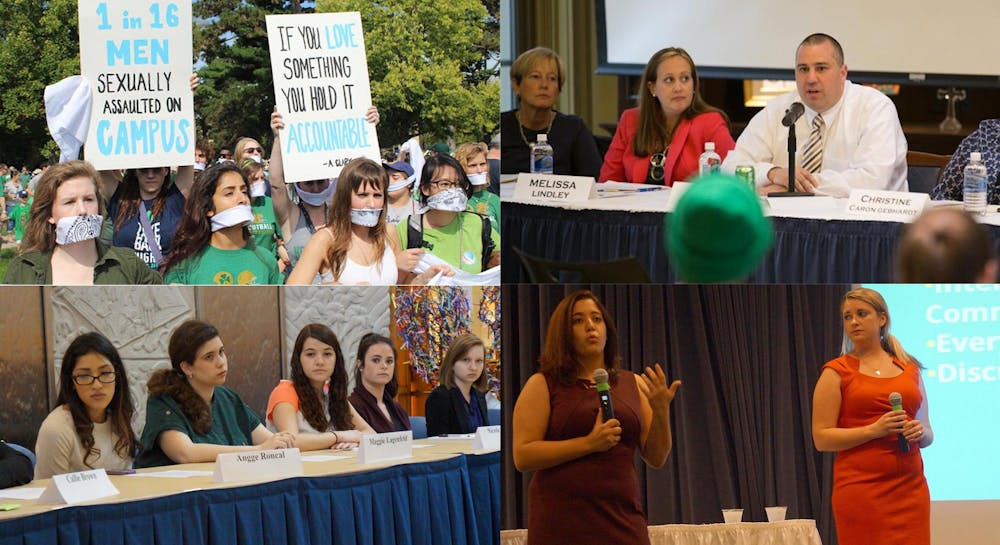
On Sept. 28, a protest of approximately 50 students and faculty marched through Notre Dame’s campus during a home football game to raise awareness for sexual assault survivors. Vosters explained that she participated in the march.
“My classmate had formed a loose club called ‘I’m Someone,’ which was trying to draw attention to sexual assault and how … you don't need to be somebody’s wife, somebody’s mom, somebody’s daughter, for it to matter what happens to you or someone,” Vosters said.
Throughout the fall semester, several viewpoint and news articles on TItle IX and sexual assault were released. In November, Notre Dame launched GreeNDot for the entire campus. The Observer also released a five-part investigative series on the reporting process, College and University initiatives, student group responses, rape culture and the next steps towards preventing sexual violence.
Ehmsen felt Saint Mary’s and Notre Dame both responded appropriately in listening to students, raising awareness and taking action against sexual violence.
“I felt like they were doing what they could. At a small school, students have kind of direct communication with a lot of the administrators, so those people were hearing directly from students. And in that sense, I say this now, working at a larger university, the students have a lot of power at Saint Mary's, and the administration really listens to them,” Ehmsen said.
By the spring of 2016, a year after the first screening of “The Hunting Ground,” the Saint Mary’s sexual violence task force released their report on their suggestions for bettering the policy, procedures and prevention of sexual violence. Within this report, a memorandum, titled the “Memorandum of Understanding,” was to be implemented at all three campuses for greater communication and investigation into sexual assault.
This memorandum was officially signed by the College and University presidents and implemented within the tri-campus community a year later in March 2017. It has since been renewed and re-signed each year.
Reflecting on how “The Hunting Ground” changed the tri-campus’ administrative and cultural approach towards sexual violence, Vosters shared she feels that the documentary showed how violence “is not inevitable” and was meant to shake its audience out of “complacency” towards sexual assault on college campuses.
“If ‘The Hunting Ground’ is still serving that purpose, and I think it's sadly still really necessary, in terms of shaking us all out of our sense of inevitability about something like this, and reminding everybody that we do all have a role to play, and we are not wrong for expecting different results … We're not wrong for wanting better and safer for everybody, and we're not wrong for … wanting accountability and actual results,” Vosters said.