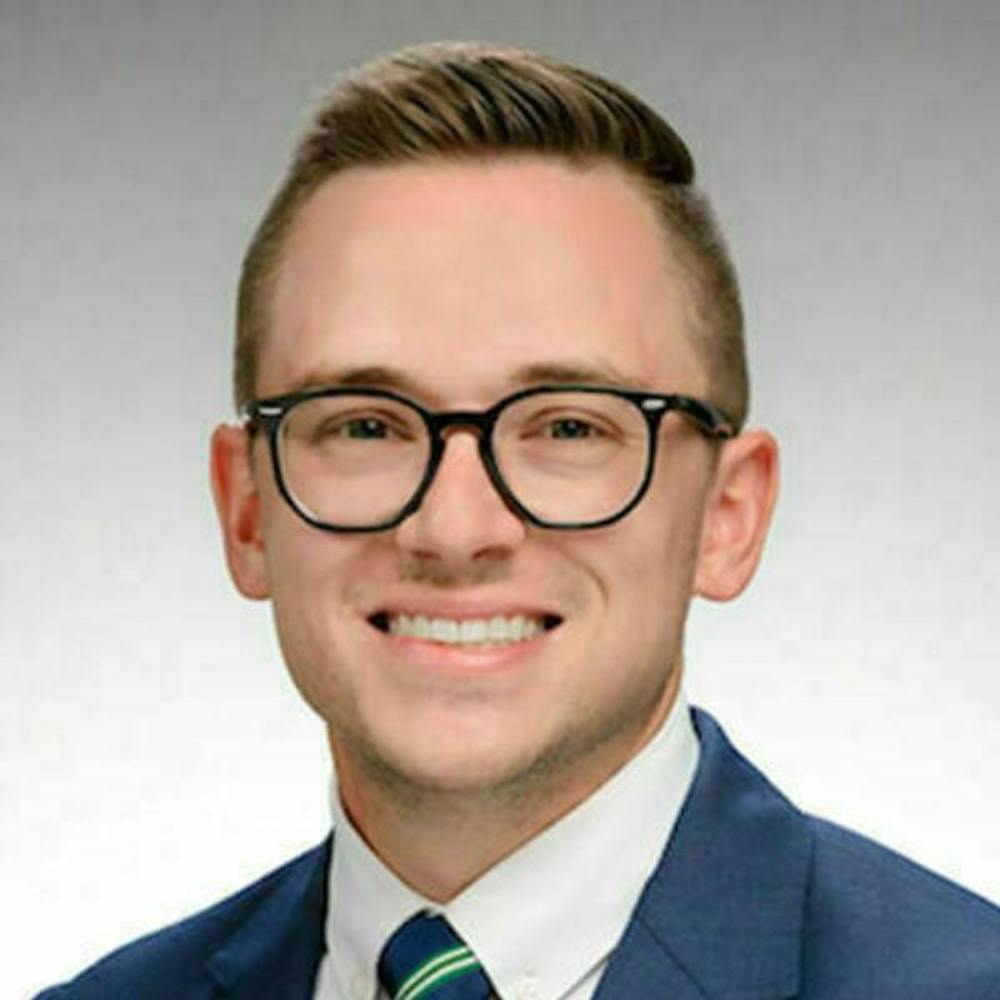
After serving as the director of the Sheedy Family Program in Economy, Enterprise and Society since its conception in 2022, Paul Blaschko is being replaced by Richard Clark, a tenure-track assistant professor of political science. Blaschko is leaving the University at the end of his current contract, which runs through June 30. Clark will assume the role July 1.
The program unifies a business background with a liberal arts pedagogy for students with concentrations in both Mendoza College of Business and College of Arts and Letters. The program includes three required courses and offers a variety of optional electives open to cohort students, despite it not being a degree, center or institute.
Dean of the College of Arts and Letters Kenneth Scheve explained in a written statement to The Observer that this leadership turnover comes after a standard review of the program. He shared that this review found that the program “was highly valued by students and an important part of their Notre Dame experience” connecting to the “quality of the stewardship of this program by its current leadership team.”
Yet, this report also found room for expansion, which required a social scientist as director.
“Because of that positive evaluation, we wanted the program to continue in its current direction. At the same time, we identified that in our efforts to bridge the liberal arts to careers in business there was room in the College and in the Sheedy Program to do even more,” Scheve wrote.
In an information session for students in the program on Monday, associate dean for undergraduate studies Mary Flannery said this growth is “not changing what is existing, but adding to it.”
Scheve explained that, to implement this expansion, they determined a need for a social scientist to serve as director, while also having the current leadership board remain, such as Blaschko.
He wrote, “The opportunity to continue leading the core aspects of the Sheedy program as associate director was verbally offered to him, but he declined the role.”
At the Sheedy student information session, Blaschko announced his departure from the University following the end of his contract. While he was regretful that he was unable to state where he was going next, he shared that he had several offers and would be staying in South Bend. He plans to continue attending the dinners, a key aspect of the program.
While limited in the details he could share ahead of an official announcement, Blaschko wrote in a statement to The Observer, “I’m extremely proud of what Chris and I have built with all our students and collaborators, including many in the Dean’s office and across the university, over the past five years. This program has meant more to me than I can express, and I’m most proud of the community our students have formed. The Sheedy program is distinct in so many ways, and I’m excited to see what’s next.”
Clark explained that one of his key goals is to expand the program, and he noted that he has explicitly been brought on to “bring in some social science perspectives to the program.”
Within those goals, Clark explained that they have heard existing students emphasize the importance of the current cohort structure. In the most recent admissions cycle, they have admitted two cohorts of around 30 students each, totaling 60 students. Clark believes this is, “probably the upper bound of what a cohort structure would look like.”
Regarding the social science aspect, Clark cited his work on the Global South development and world business, falling in line with the program’s mission.
In terms of program structure, he noted that this expansion of social science could either look like a collection of strong social science offerings within the electives, or it could look like some of the current required classes being transitioned to electives.
In an effort to reach freshmen, Brett Beasley, an assistant teaching professor in the program, has been building out the Business Explorers Program, which predates the leadership changeover plans.
The yearlong program, launching fall 2026, will feature the “Business for Humans” class. With one goal of the program being “preventing midlife crisis,” the course will guide students to engage with self-assessment, discernment and videos with program alums.
Flannery explained that “literally nobody” thinks the way the information on the departure was communicated was “done well,” describing it as a “PR should-be case study of where information got out before people were really ready to announce it.”
Sophomore Paul Kaminski, part of the Sheedy Family Program, explained that he learned that Blaschko was unlikely to be allowed to continue serving as director after he volunteered this information during his “Work, Meaning, and Happiness” class.
After learning this, Kaminski felt the need to create a platform for the community to take action, so he started a petition April 17 with the goal to highlight “the impact Paul has made on the program and on all of our students’ lives,” he said in an interview with The Observer.
To achieve this goal, he invited students and alumni to share anecdotes. On the first full day the petition was live, it reached over 100 signatures. As of Monday, the petition has 136 signatures and 21 supporter voices.
Kaminski and other students at the session expressed to The Observer their concerns that the replacement of Blaschko marks a deviation from Sheedy as a teaching program and aims to bring in more research aspects.
Despite noting that his research fell in line with Sheedy’s values, Clark shared, “I think Sheedy’s place on campus is less research oriented and more pedagogical.”
Flannery noted that she has looked into how the Sheedy Family Program could collaborate with research more at different points in time but said, “The Sheedys did not give money for there to be a lot of research.” She also specified that the shift from the director being on teaching track to tenure track is a secondary effect.
Chris Hedlin, another founding member of the program, is set to serve as associate director beginning July 1. Hedlin did not respond to our request for comment, with an out-of-office message noting she was on parental leave this semester.
Kaminski said Blaschko told him that the number of seats in the “God and the Good Life” class, which he co-created, was being cut from the typical 900 to 1,100 per year to only 450.
The Observer was able to confirm these numbers for 2022-2023 and 2023-2024. 450 seats will be offered for fall 2026.