Before I transferred to Notre Dame, I went to college on the East Coast. I had never been before my freshman orientation; I had never been anywhere outside the Midwest or the South.
While “Midwesterner” wasn’t really a part of my identity while growing up here, it became one in Boston. I spent most of my time around people from the East Coast, and when you start every class of your freshman year announcing where you’re from, “Kansas” is bound to stand out against the various Massachusetts suburbs everyone else grew up in. I began to identify with people from states I’d never even been to; I would smile extra at anyone from Wisconsin, Iowa, or (back then) Indiana.
After a while, my various Midwestern connections got me in contact with the founders of a new “Midwest Club,” where members would gather monthly for a dose of Midwestern culture. At our first meeting, over chili and cornhole, we went around in a circle and made our usual introductions: what’s your name, what’s your major and where are you from?
Expecting a rich and diverse range of Midwestern experiences, from Omaha to St. Louis to Des Moines, I was shocked at what I heard. Two-thirds of the group was from a state I couldn’t even place on a map — Ohio.
The purpose of this article is not to bash Ohioans, if excluding someone from the definition of “Midwesterner” could be interpreted as bashing. As a lifelong resident of a flyover state, it would be audacious to make fun of anyone else’s home state. In fact, I have a lot of respect for Ohio: they have a lot of well-known cities. My goal is simply to address the objective but strangely unsaid truth that Ohio is, never was, and never will be part of the American Midwest.
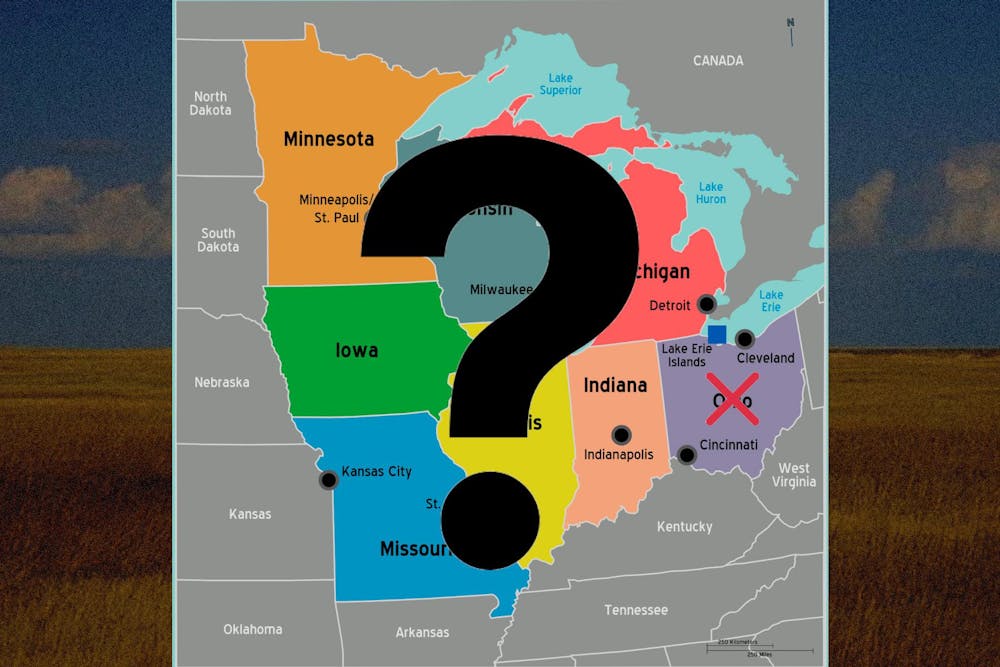
First, the geography simply doesn’t work. I’m no etymologist, but I do know that “Midwest” comes from two other words, “mid” and “west.” Ohio is neither of these — in my research for this article, in fact, I studied a map of the United States and noted that Ohio is located firmly on the north and eastern part of the country. It may not be “East Coast,” as there are states more east and on the coast but it certainly isn’t mid or west. If Ohio is geographically part of the Midwest, then so are Kentucky and Tennessee; I’ll let this evidence speak for itself.
Additionally, there’s a significant culture difference between Ohioans and the true Midwest. True Midwestern states traditionally have agriculture-dominated economies. Nebraska, Iowa and Kansas all have one thing in common: they produce a lot of food. It’s part of our day-to-day lives; most of my friends growing up have a family member that lives on a farm, including myself. We drive past hay bales; we’ve ridden in tractors, and we buy our meat directly from the farmer to store in a meat freezer in the garage.
Ohio, on the other hand, has a historically industrial economy. They are known for manufacturing over agriculture, making them culturally and economically more similar to the East than the Midwest.
Finally, Ohio just doesn’t have Midwestern history. It was admitted to the U.S. before any Midwestern states; the next to join (Indiana and Illinois) were not added until years later. The bulk of the Midwest was added in the Louisiana Purchase and thus has a shared history; they were settled by pioneers, turned into farm land and developed a shared culture: the nation’s heartland.
As a whole, Ohio is simply not part of the Midwest I grew up in but the East I moved to. If a family vacation to you looked like New York or Philadelphia, not Chicago or St. Louis, you aren’t a Midwesterner, and that’s okay. Ohio makes a beautiful, rich and important part of the American Northeast.
Sophia Anderson is a junior transfer at Notre Dame studying political science and planning to go to law school. You can contact her at sander38@nd.edu.